
We may earn revenue from the products available on this page and participate in affiliate programs. Learn More ›
With a backpack leaf blower, yard cleanup is a snap. Leaf blowers make quick work of removing fallen leaves, grass clippings, dirt, and other debris from a property. Leaf blowers with adapter pipes can even clean rain gutters. A leaf blower can help speed up many projects to save time on yard work. With so many models on the market, deciding on which one to buy can be a challenge. To help, we tested the best backpack leaf blowers in several different categories.
Whether your yard is large or small, or whether you prioritize lower emissions, higher air velocity, or the least amount of noise, there’s probably a leaf blower that fits the bill for those needs. Brad Saunders, president of Heroes Lawn Care, a lawn care services company that services areas throughout the U.S., says first and foremost, shoppers will want to think about the amount of power and airflow they’ll need: “If you’re dealing with a lot of leaves or heavier debris, you’ll want something with a higher cubic feet per minute (CFM) to move those large piles efficiently and a good mile per hour (mph) to really blow things away.” Then take power source, weight, ergonomics, and sound level into account. And finally, think about the bells and whistles. “Some blowers come with attachments for vacuuming or mulching,” he says. “Variable-speed settings are also a nice touch, allowing you to adjust the power depending on whether you’re clearing a lawn or just tidying up a patio.”
Our favorite in testing was the Husqvarna 360BT Gas Backpack Leaf Blower for its outstanding performance and value. Plus, its engine design reduces exhaust emissions by up to 60 percent and also increases fuel efficiency by up to 20 percent. The list below represents extensive research into more of the best backpack leaf blowers on the market and our reviews based on our hands-on tests.
Key Takeaways
- Top pick: Husqvarna 360BT. Offers outstanding performance, reduced emissions, and increased fuel efficiency.
- Consider power and features. Choose based on yard size, power source, weight, and additional features like variable-speed settings.
- Check local regulations. Noise and emissions rules may affect your choice between gas and electric models.
- Comfort and safety are key. Look for padded harnesses, ergonomic controls, and use protective gear.
Bottom line: Backpack leaf blowers offer efficient yard cleanup with options to suit various needs and preferences. Consider power, comfort, and local regulations when choosing the best model for you.
- BEST OVERALL: Husqvarna 360BT Gas Backpack Leaf Blower
↓ Jump to Review - RUNNER-UP: Echo PB-9010T Backpack Leaf Blower
↓ Jump to Review - BEST BANG FOR THE BUCK: Ryobi 175 MPH 760 CFM 38cc Gas Backpack Leaf Blower
↓ Jump to Review - BEST FOR HOME USE: Worx Nitro 80V Cordless Backpack Blower
↓ Jump to Review - BEST LIGHTWEIGHT: Greenworks 80V 610 CFM Cordless Backpack Blower
↓ Jump to Review - BEST FOR LARGE YARDS: Echo PB-580T Backpack Leaf Blower
↓ Jump to Review
Before You Buy a Backpack Leaf Blower
Before buying a backpack leaf blower, it’s smart to check out regulations that might be in place with the local or state government or in a homeowners association. Noise is a factor that is a growing limitation to the use of leaf blowers. In many areas, regulations do not allow the use of loud equipment in neighborhoods during certain times of the day or week. Be sure that it’s OK to operate a leaf blower, which typically produces sounds between 65 and 100 decibels (dB), at the time of day and day of the week when you typically do yard work. If not, you will need to decide between raking and working at a different time.
The other big concern is the increasingly regulated use of 2-cycle engines. Even the cleanest gas lawn equipment engines that comply with California Air Resources Board (CARB) regulations pollute significantly more than the combined power plant emissions produced when charging batteries. Some states and cities have declared a moratorium on gas-powered lawn equipment. If the window on use of fossil fuels in your area is closing soon, it might make the most financial sense to go electric now rather than buying gas equipment only to replace it in a year or two.
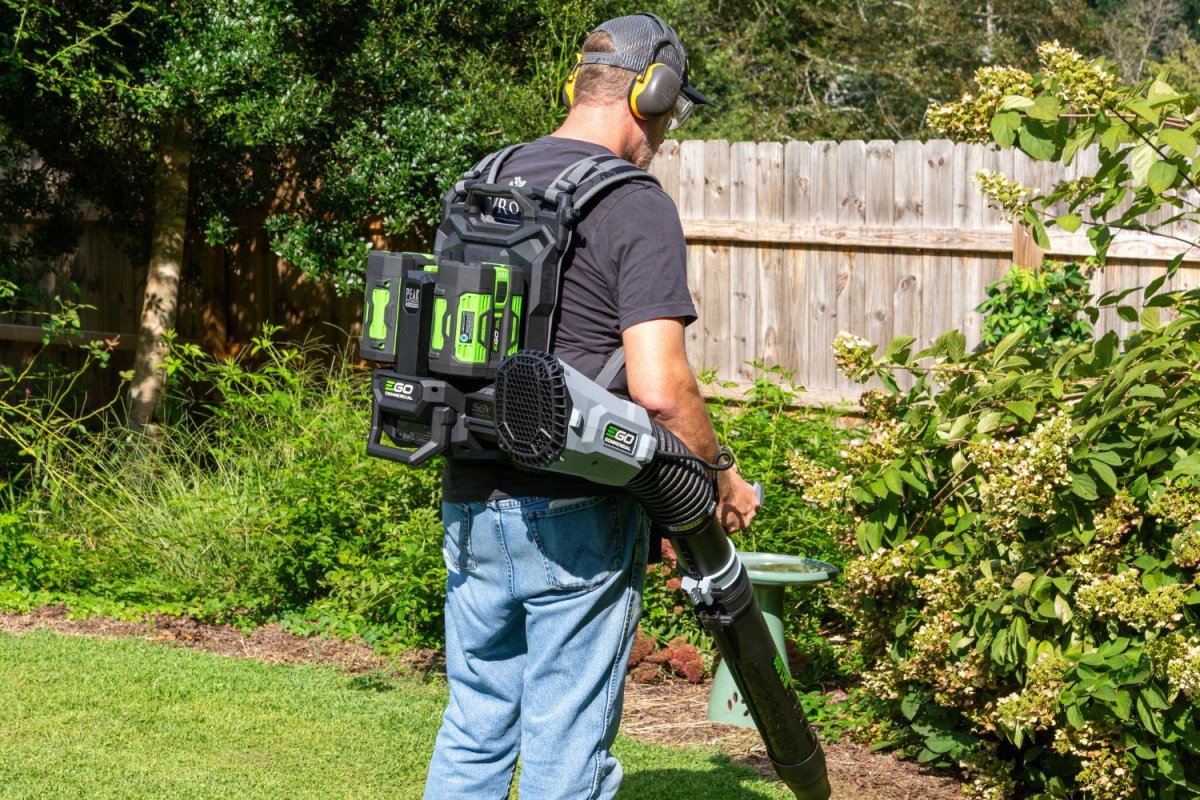
Finally, be sure to consider the potential health side effects of using a backpack leaf blower. In a commercial setting, anyone operating a leaf blower is expected to wear hearing and eye protection. In some conditions, a dust mask may also be required. Private users are strongly advised to do the same. Also, because hearing is impaired by blower noise, it is smart to wear high-visibility clothing and walk with oncoming traffic in front of you whenever operating a leaf blower in the street.
Backpack Leaf Blowers Comparison
| Product | Power Source | Airflow | Weight |
|---|---|---|---|
| Husqvarna 360BT Gas Backpack Leaf Blower | 65-cubic-centimeter (cc) 2-cycle engine | 890 CFM, 232 mph | 23.2 pounds |
| Echo PB-9010T Backpack Leaf Blower | 79.9cc 2-cycle engine | 1,110 CFM, 220 mph | 26.7 pounds |
| Ryobi 175 MPH 760 CFM 38cc Gas Backpack Leaf Blower | 38cc 2-cycle engine | 760 CFM, 175 mph | 20.2 pounds |
| Worx Nitro 80V Cordless Backpack Blower | Four 20V 4 Ah batteries | 800 CFM, 150 mph | 23.6 pounds |
| Greenworks 80V 610 CFM Cordless Backpack Blower | 80V 2.5 Ah battery | 610 CFM, 145 mph | 14.64 pounds |
| Echo PB-580T Backpack Leaf Blower | 58.2cc 2-cycle engine | 517 CFM, 216 mph | 22.7 pounds |
Our Top Picks
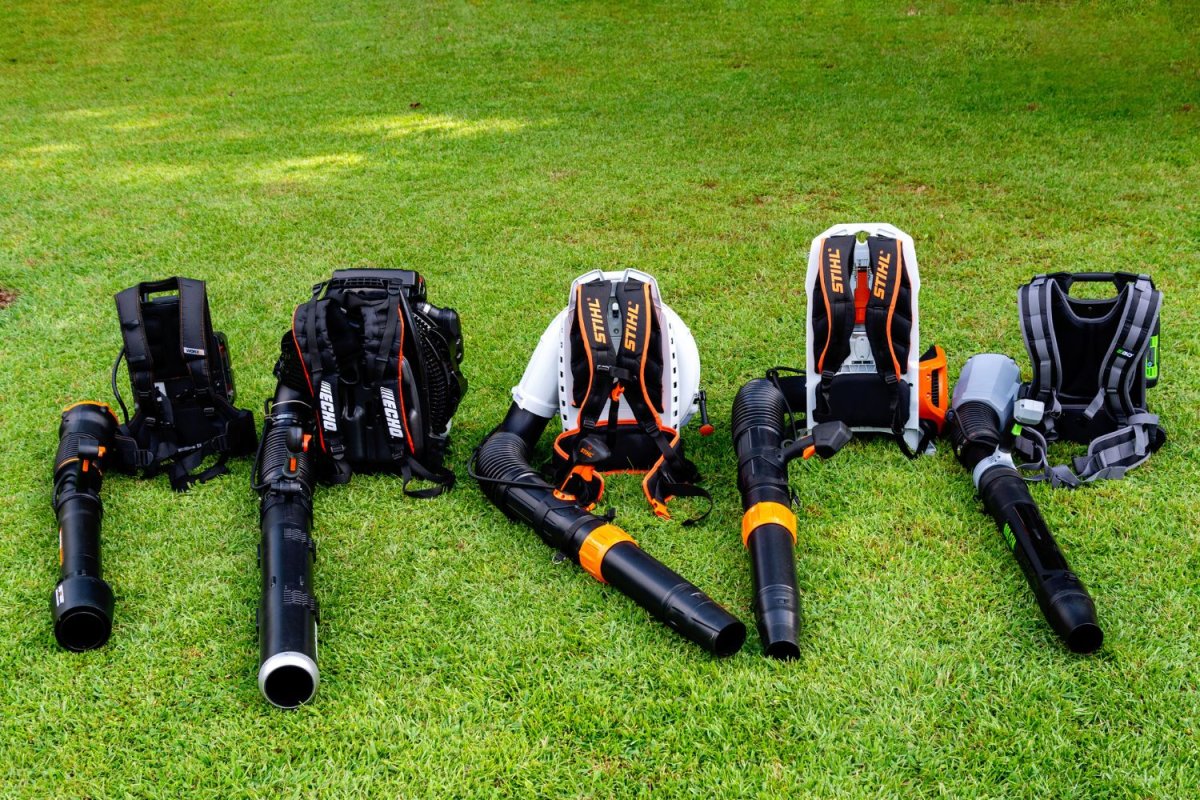
We tested the industry’s best backpack blowers in our own backyard test course. Whether you maintain a large or small property, and whether you need more power or less noise, you might find just the right fit on this list of some of the best backpack leaf blowers on the market.
Best Overall
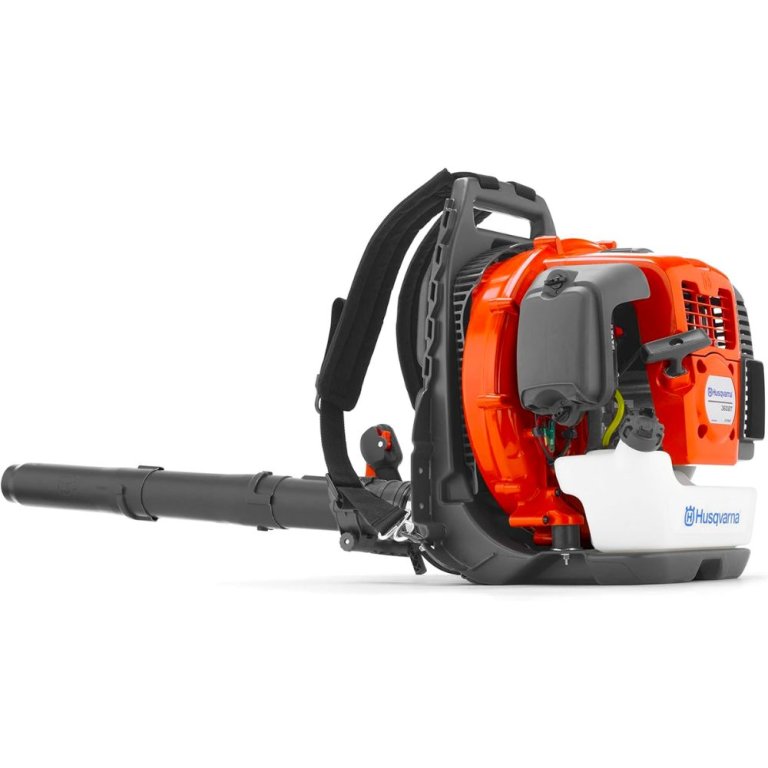
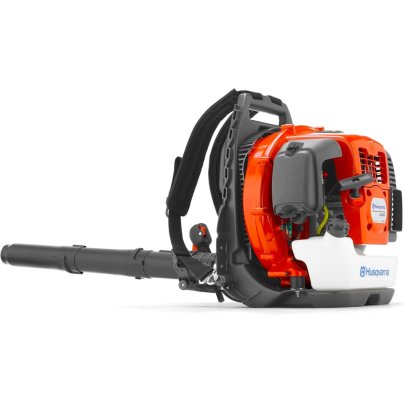
Husqvarna 360BT Gas Backpack Leaf Blower
Buy at Amazon Buy at Lowe's Buy at Northern Tool + EquipmentWhat We Like
- Professional-quality top air movement
- Suspension system features vibration dampeners
- Large fuel tank extends runtime
- Reduced emissions compared to other gas blowers
What We Don’t Like
- Heavier than other models
- Bulky in storage
Product Specs
- Power source: 65-cubic-centimeter (cc) 2-cycle engine
- Airflow: 890 CFM, 232 mph
- Weight: 23.2 pounds
Our Ratings: Ease of Use 5/5;Comfort 4.5/5; Performance 5/5; Noise 3.5/5; Value 5/5
The Husqvarna 360BT gas-powered backpack leaf blower is a good all-around pick for large or small landscapes at a midrange price. The 65cc 2-cycle X-Torq engine pushes up to 890 CFM of air at 232 mph for general landscape cleanup. This machine weighs 23.2 pounds and comes equipped with a 74.4-ounce (0.58-gallon) fuel tank. Its engine noise level was about average compared to the others we tested, and it was easy to start and comfortable to carry. This blower truly excelled in air movement, outperforming all the others we tested on a price-to-performance comparison.
Although this is a gas model, Husqvarna’s X-Torq engine design reduces exhaust emissions by up to 60 percent and increases fuel efficiency by up to 20 percent. Dampeners between the engine and chassis reduce vibrations. The padded harness and hip belt are shaped to fit the contours of the operator for more comfortable operation. The offset handle makes the blow force easier to control, preventing arm strain and fatigue. The variable-speed throttle with cruise control can be set for easier handling.
Get the Husqvarna backpack leaf blower at Amazon, Lowe’s, or Northern Tool + Equipment.
Runner-Up

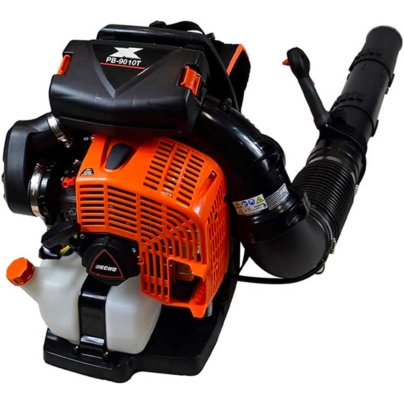
Echo PB-9010T Backpack Leaf Blower
Buy at The Home DepotWhat We Like
- 48 newtons of powerful blow force
- 2-stage air-filtration system extends engine life
- Large 83.8-ounce fuel tank
- Comfortable padded shoulder straps and vented back pad
What We Don’t Like
- Hard to refill without spilling
- Heaviest gas-powered backpack blower we tested
- No hip belt or sternum strap
Product Specs
- Power source: 79.9cc 2-cycle engine
- Airflow: 1,110 CFM; 220 mph
- Weight: 26.7 pounds
Our Ratings: Ease of Use 4/5;Comfort 3/5; Performance 5/5; Noise 4/5; Value 4/5
A top performer among gas-powered commercial models, the Echo PB-9010T commercial backpack blower offers the most blow force and longest running time of all the machines in our test group. Its powerful and efficient 79.9cc 2-cycle engine complies with CARB emission standards while driving an intense blow force of 1,110 CFM at 220 mph. And its 83.8-ounce (0.65-gallon) fuel tank virtually eliminates stops for refueling on all but the very largest properties.
In our tests, the Echo PB-9010T took first place in both of the timed tasks, rounding up 5,000 square feet of leaves in just 12 minutes and removing a gallon-size pile of damp sand in just 14 seconds. The noise level was a few decibels higher than the Husqvarna and Stihl blowers in the test group. It also weighed a couple of pounds more.
The harness system was fine but came with no hip belt or shoulder straps to reduce the load on the user’s shoulders, although the shoulder straps were very nicely padded. When we brought it along on an all-day landscape cleanup project, the giant fuel tank held enough mixed gas to disperse clumped grass clippings and clear pavement the entire day without running out. This model is an excellent option for those who prioritize production above all else.
Get the Echo PB-9010T backpack leaf blower at The Home Depot.
Best Bang for the Buck
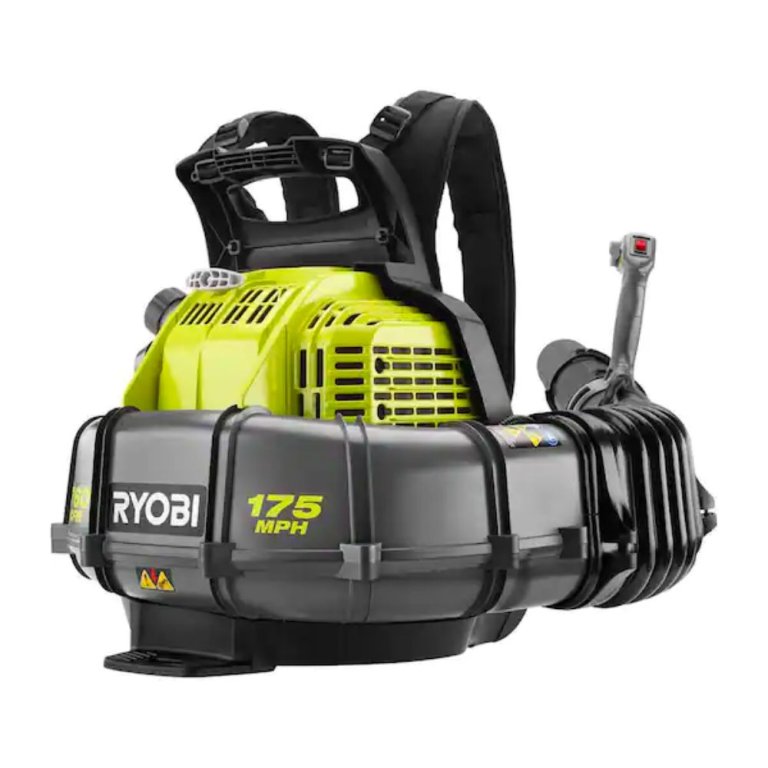
Ryobi 175 MPH 760 CFM 38cc Gas Backpack Leaf Blower
Buy at The Home DepotWhat We Like
- Second-best value among all tested models
- Lightweight backpack blower
- Adjustable, deeply padded shoulder straps
- Small 2-cycle engine with impressive fuel economy
What We Don’t Like
- Rigid blower tube limits maneuverability
- Bulky engine is awkward in tight spaces
Product Specs
- Power source: 38cc 2-cycle engine
- Airflow: 760 CFM, 175 mph
- Weight: 20.2 pounds
Our Ratings: Ease of Use 3.8/5;Comfort 5/5; Performance 4.5/5; Noise 3.5/5; Value 4.8/5
Ryobi’s inexpensive leaf blower with its little 38cc 2-cycle engine can’t really generate as much airflow as our “Best Overall” pick, can it? In our tests, it nearly did. We were impressed by its ability to break up matted wet leaves, grass clippings, and even ant mounds, then blow them away without hesitation. The 760 CFM 175 mph ratings seem to be almost surprisingly accurate.
This level of performance comes at a price, however. The unique rigid blower tube configuration did not allow the full range of movement that other backpack blowers offer. We could perform a sweeping motion but could not rotate the control handle or easily direct the nozzle hard to the right. Still, the impressive blower force makes this a good tool for bigger jobs in open spaces, and it’s offered at a very affordable price.
Get the Ryobi backpack leaf blower at The Home Depot.
Best for Home Use
Photo: amazon.com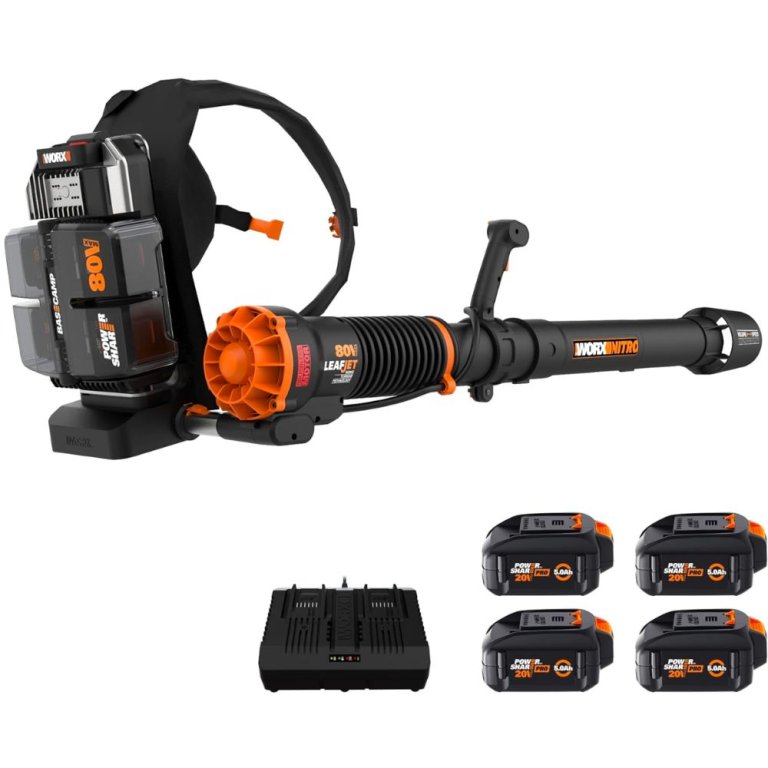
What We Like
- Efficiently cleans up dry leaves, grass clippings
- Adequate runtime for up to a half acre
- BaseCamp battery works with other Worx Nitro tools
What We Don’t Like
- Less effective for heavy, wet debris
- Noisier than other battery-powered blowers
Product Specs
- Power source: Four 20V 4 Ah batteries
- Airflow: 800 CFM, 150 mph
- Weight: 23.6 pounds
Our Ratings: Ease of Use 4.3/5;Comfort 4/5; Performance 4.3/5; Noise 4/5; Value 4/5
Even on small to midsize properties up to a half acre, a backpack blower can be a helpful labor saver. The Worx Nitro backpack blower, powered by the BaseCamp battery pack, uses four 20-volt 4Ah batteries to generate airflow up to 800 CFM at 150 mph with 20 minutes of runtime on the highest setting, or 230 minutes on low. In our timed tests, it cleared fallen leaves off 5,000 square feet of lawn in 25 minutes and dispersed a 1-gallon pile of sand off the driveway in 67 seconds.
Although it was not the lightest, most powerful, nor least expensive battery-powered backpack blower we tested, the Nitro backpack blower delivers enough power and runtime for smaller yards. It rated near the top in operator comfort. The harness system was well padded and extremely supportive, and the motor and battery pack fit closely to the back, which made it easier to maneuver compared to big bulky gas models.
We also appreciated that the BaseCamp power pack uses the same interchangeable 20-volt PowerShare batteries found throughout the Worx ecosystem, and that it is compatible with the Nitro Cordless Lawn Mower. For a balance of comfortable operation, efficient power sharing, compact storage, quality, and performance for smaller properties, the Worx backpack blower makes a great option.
Get the Worx backpack leaf blower at Amazon or Target.
Best Lightweight
Photo: amazon.com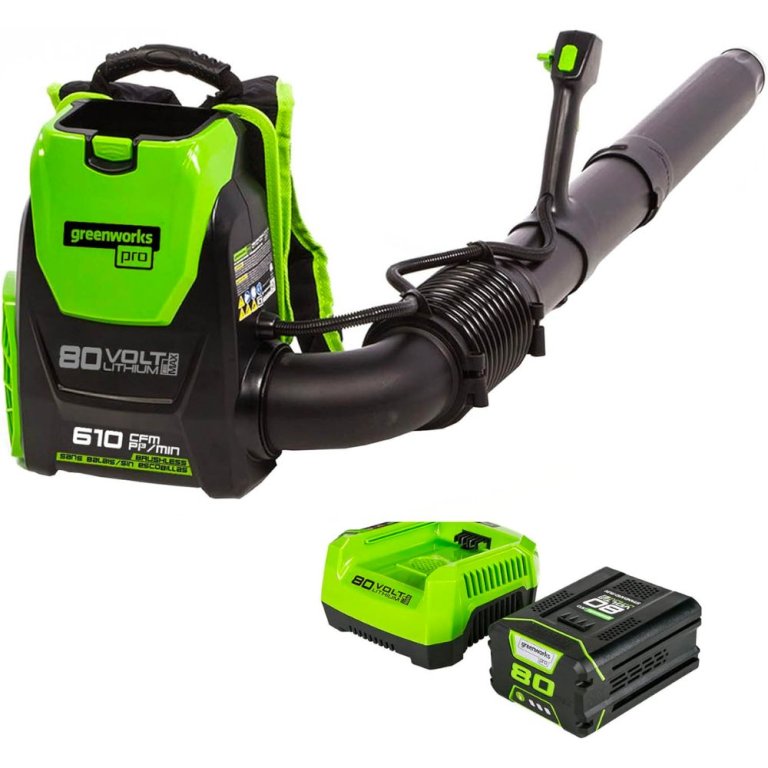
What We Like
- Produces good airflow
- Most lightweight model among our test group
- Easy and comfortable to carry
What We Don’t Like
- Shortest runtime among battery models tested
- Not great for heavy, wet debris
Product Specs
- Power source: 80V rechargeable battery
- Airflow: 610 CFM, 145 mph
- Weight: 14.64 pounds
Our Ratings: Ease of Use 4/5;Comfort 5/5; Performance 3.5/5; Noise 4/5; Value 4/5
The Greenworks 80V cordless backpack leaf blower is a powerful, clean-operating leaf blower that makes an ideal choice for smaller landscapes. It moves up to 610 CFM of air at 145 mph and is powered by an 80V lithium-ion rechargeable battery. Weighing just 14.64 pounds, it was the lightest-weight model we tested.
The Greenworks leaf blower showed similar capability to that of the smaller gas-powered models, which is to say it easily handled dry and damp material but struggled with the heaviest matted debris. Operating on the high power setting, it ran for about 20 minutes, after which it took 45 minutes to recharge the battery.
The brushless motor delivers gas-equivalent performance, with up to 1.5 hours of runtime per charge on the low power setting. A variable-speed trigger and turbo button deliver on-demand power. Cruise control reduces operator fatigue. Adjustable padded shoulder straps provide added comfort. The kit includes one 2.5 Ah battery and charger.
Get the Greenworks backpack leaf blower at Amazon or Walmart.
Best for Large Yards
Photo: amazon.com
What We Like
- Started easily every time
- Comfortable shoulder straps and adjustable suspension system
- Vented back pad eliminates heat buildup
- Less vibration and noise than similar gas blowers
What We Don’t Like
- Priced a bit higher than comparable models
Product Specs
- Power source: 58.2cc 2-cycle engine
- Airflow: 517 CFM, 216 mph
- Weight: 22.7 pounds
Our Ratings: Ease of Use 4.5/5;Comfort 5/5; Performance 5/5; Noise 4.5/5; Value 4/5
With its 58.2cc 2-cycle engine, this midsize blower offers a bit more power than the more budget-friendly models, and it weighs in at an easy-to-carry 22.7 pounds. But the weight is less noticeable here than on the others because of a well-balanced suspension system and generously padded, contoured shoulder straps. It moves up to 517 CFM per minute at up to 216 mph. It’s not the highest airflow in its class, but it’s still capable of moving heavy, wet debris into piles.
This Echo backpack blower is a good choice for those with large yards, where cheaper models may suffer over time from consistent extended use. The controls on the handle and moving parts on the blower tube operate smoothly and feel much more durable than those on the competition. The only inconvenience was that this blower did not include a blower tool—a combination spark plug remover and screwdriver/carburetor adjustment tool—which most others include.
Get the Echo PB-580T backpack leaf blower at Amazon or The Home Depot.
Jump to Our Top Picks
How We Tested the Best Backpack Leaf Blowers
| Testing Stats | |
| Products tested | 10 |
| Time spent testing | 10 hours |
| Tests performed | 4 to 5 |
| Price range | $290 to $700 |
Backpack blowers generally offer far greater airflow and dexterity than handheld blowers so users can clean up big jobs quickly and with less fatigue. We focused our backpack blower field tests on ease of operation, user comfort, and airflow.
We assembled and fueled or charged up the blowers according to the manufacturers’ instructions and then carefully adjusted the handle controls, suspension systems, and shoulder straps to fit comfortably. Then, one by one, we started the blowers and used them to blow fallen leaves on pavement, mowed lawn grass, and rough field grass, followed by old built-up debris in a wooded area. Finally, we used them to clear away wet sand and puddles from uneven pavement. Each of the blowers in this guide successfully completed the full range of testing.
Our Testing Scores
| Product | Ease of Use | Comfort | Performance | Noise | Value |
| Husqvarna 360BT Gas Backpack Leaf Blower | 5 | 4.5 | 5 | 3.5 | 5 |
| Echo PB-9010T Backpack Leaf Blower | 4 | 3 | 5 | 4 | 4 |
| Ryobi 175 MPH 760 CFM 38cc Gas Backpack Leaf Blower | 3.8 | 5 | 4.5 | 3.5 | 4.8 |
| Worx Nitro 80V Cordless Backpack Blower | 4.3 | 4 | 4.3 | 4 | 4 |
| Greenworks 80V 610 CFM Cordless Backpack Blower | 4 | 5 | 3.5 | 4 | 4 |
| Echo PB-580T Backpack Leaf Blower | 4.5 | 5 | 5 | 4.5 | 4 |
What to Consider When Choosing a Backpack Leaf Blower
There are several key considerations to bear in mind when shopping for a new leaf blower. It needs to be powerful enough to clear debris and have sufficient power (in the battery or in the fuel tank) to do the entire yard. In this section, we’ll take a close look at these and other important shopping considerations.
Yard Size
Properties larger than half an acre with leafy trees, lots of grass, outbuildings, and other areas that require detailed cleaning benefit from maximum runtime and airflow from a gas-powered blower. A powerful blower with a long runtime blows debris farther and faster than a less powerful model. They’re also more efficient because you don’t have to stop your work to refuel or change the blower’s batteries.
A lightweight battery-powered blower is suitable for a smaller property or if only blowing leaves off the sidewalk, patio, or driveway.
Power Source and Runtime
Battery power is measured in volts. Battery-powered blowers usually have a limited runtime of about 1.5 hours maximum for light-duty applications. Heavy-duty blowing decreases the runtime to as little as 10 to 15 minutes.
Gas-powered blowers are limited only by the size of their fuel tanks. Engine size is measured in cubic centimeters. Most gas blowers’ tanks hold enough fuel to operate at high power for 1.5 to 3 hours.
2-Cycle vs. 4-Cycle Engine
Gasoline-powered blowers have either a 2-cycle or a 4-cycle engine. A 2-cycle engine needs one revolution of the crankshaft to produce a power stroke, while a 4-cycle engine needs two revolutions of the crankshaft to produce the power stroke. A 2-cycle engine produces more power than the same size 4-cycle engine.
Blowers with 2-cycle engines require a fuel mixture of gas and oil that powers and lubricates the engine at the same time, while 4-cycle engines run on gasoline and have a separate oil reservoir to lubricate the engine. On average, efficient 2-cycle engines produce more power than 4-cycle engines of the same size, but clean-running 4-cycle engines produce lower emissions.
Saunders says that 2-cycle engines are the “go-to for people who need something lightweight and powerful.” He adds, “They’re great because they run at higher revolutions per minute, which means they can handle tasks like trimming and blowing with a bit more oomph.” However, 4-cycle engines have their own advantages: “They tend to have more torque at lower speeds, which can be really helpful if you’re dealing with heavier work. Another big plus is that they’re usually easier to start and run quieter, which is great if you’re working in a residential area or just don’t want to deal with a lot of noise.”
Air Volume and Speed
The two best measurements of a leaf blower’s performance are the air volume, measured in cubic feet per minute, and the airspeed, measured in miles per hour. Air volume is how much air moves through the machine, while airspeed measures how fast it is moving. The better measurement of leaf-moving ability is CFM.
Manufacturers indicate the average maximum CFM and mph values on product labels, but the speed at which blowers truly operate depends on the user. Users control backpack blowers’ power settings via a trigger or a lever. The machine needs to run on full power to reach the maximum CFM and mph ratings indicated on the product’s package. To clean up hard surfaces like driveways and patios, 400 CFM blowers are sufficient. Use a 500 to 700 CFM blower for larger properties with significant lawn and leaf areas.
Weight
Battery-operated backpack blowers weigh as little as 15 pounds, while their gasoline-powered counterparts average about 10 pounds heavier. Weight certainly affects comfort, especially on large properties where leaf blowing may take an hour or more.
A leaf blower’s weight generally coincides with its power, so it’s not always prudent to purchase the lightest model. Instead, choose the blower with an ideal combination of weight and high power.
Comfort Features
Comfort minimizes user fatigue and reduces the chance of injury. Features that affect user comfort include the leaf blower’s size, harness system, hand controls, and tube.
The user’s body size dictates which overall machine dimensions are appropriate. A tall and heavy user can operate any size blower, but an operator with a smaller frame would more likely be most comfortable using a compact blower.
The leaf blower’s harness system can feature an adjustable waist strap and adjustable shoulder straps, all with plenty of padding, plus a sternum strap for added stability and balance. Tubes that flex and rotate comfortably at the user’s elbow are usually more comfortable. The hand controls that are sensitive enough to work smoothly, single-handedly, are easier to use, too.
Noise
Backpack blowers average 95 to 105dB, measured at the user’s ear level. To avoid hearing loss, it is important to wear earplugs or over-ear protection while operating a leaf blower.
Some municipalities have noise ordinances that dictate how loud machinery can be, so be sure to check local laws before purchasing a new blower. There are low-noise backpack leaf blowers on the market that average between 58 and 70dB and are powerful enough to get the job done efficiently.
Accessories
Several safety accessories help minimize the risks of injury while operating a blower. In addition to hearing protection, leaf-blower manufacturers and the Occupational Safety and Health Administration recommend the use of safety glasses to keep lawn debris out of the eyes. A high-visibility safety vest, hat, and gloves allow users working near streets and sidewalks to be seen by oncoming traffic.
Other helpful accessories include extra batteries for cordless electric blowers and a spark-plug wrench and fuel funnel for gasoline-powered blowers.
Types of Backpack Leaf Blowers
While there are many factors to consider when searching for the right backpack leaf blower, the main difference among the options is whether they are powered by gasoline or electricity. The power source affects the leaf blower’s weight, airspeed, runtime, and other factors.
Gas-Powered
Gas-powered blowers are the go-to choice for landscaping professionals because they offer high power and lots of runtime per tank of fuel. They efficiently clean up large properties without the user having to stop and refill the gas tank. Gas-powered blowers are ideal for yards of a half acre and larger, where battery-powered blowers run out of power. They’re also great for smaller properties with heavy leaf cover that require more consistent power for efficient cleanup.
Gas-powered blowers require both fuel and oil, which adds to their operating cost. They emit exhaust fumes and should only be used in well-ventilated outdoor spaces.
Battery-Powered
Battery-powered backpack blowers offer a clean-running, lightweight alternative to gas-powered blowers. They work especially well for smaller properties of less than half an acre and where leaf cover is lighter. Runtime varies significantly among models. Power settings also have a lot to do with how long a blower will run: On average, battery-powered blowers can run for as short as 10 minutes on high power to as long as 1.5 hours on low power.
The performance of most battery-powered backpack leaf blowers is similar to that of gas-powered blowers, but the battery-powered blowers run for a shorter length of time. Because it can take an hour or more to recharge a blower’s batteries, some owners buy additional batteries to avoid downtime.
The Advantages of Owning a Backpack Leaf Blower
To clean up leaves, grass clippings, dust, and other yard debris, it’s hard to beat the functionality of a backpack leaf blower. They help clean up leaves and grass in a fraction of the time it takes to rake, plus they move fine particles like dust and powdery snow with ease. They keep all outdoor areas clean and tidy, including lawns, landscape beds, driveways, porches, patios, and decks.
Backpack blowers are more powerful and versatile than handheld blowers. They easily remove matted, wet leaves from hard-to-reach areas like foundation plantings and fence corners. They can also be used to keep rain gutters clean.
- Backpack blowers are less fatiguing than handheld blowers because the weight of the blower is carried on the user’s back and hips, rather than on the user’s arms.
- They deliver plenty of air power for moving heavy debris.
- The added power of a backpack blower gets the work done much faster than either raking or using a handheld blower.
FAQs
If you’re still unsure about whether a backpack leaf blower is right for you, continue reading. Ahead you’ll find answers to commonly asked questions about using backpack leaf blowers.
To use a leaf blower, pile up debris such as fallen leaves, start by determining where the pile should be. Then walk to the distant edge of the area and use a low, steady sweeping motion to move the leaves toward the pile. Aiming the air tube across the top of the debris keeps it low to the ground. To dislodge matted, wet leaves, aim the tube low and force air beneath it.
Yes. The higher the combined CFM and mph ratings, the more effectively the blower moves wet leaves.
On average, backpack leaf blowers are more powerful than handheld blowers. They also have the advantage of reducing operator fatigue by transferring the weight of the machine to larger core muscles in the body.
Blowing power is a function of both air volume (CFM) and air speed (mph). Greater CFM affects a larger area and keeps material moving further. Higher mph moves bigger, heavier pieces of debris.
Meet the Tester
Mark Wolfe is a writer and product tester with a background in the nursery and landscaping industries. For more than 20 years he mowed, edged, planted, pruned, cultivated, irrigated, and renovated beautiful landscapes. Now he tests and writes reviews about the latest outdoor power equipment, hand tools, lawn-care products, and other outdoor-living goods.