Home > How To Library > Innovative Technology > Building Systems > Building a Container House

Building a Container House

Steel shipping containers can be converted to strong, safe, comfortable, and eco-friendly housing in just 90 days.
Print VersionBookmarkEmail this page to a friend.

Related Showrooms

Renovation Experts - Put your home in good hands. Get FREE estimates on your project.
ZN Custom Building - Modular Homes

A container-based home offers a fast, green, and sustainable approach to building. These inter-modal steel building units (ISBUs) are manufactured in a factory-controlled environment so they are standardized and reliable. They can be used to build an average-sized home with almost no wood.


Landscaping to Reduce Cooling Bills
Once the container is lowered onto the foundation and hooked to the embedded rebar, it is welded to a steel plate set in concrete at each corner.
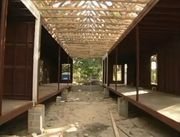
In North Charleston, South Carolina, Tampa Armature Works (TAW) and local contractors quickly and easily constructed a container house, blending it perfectly into the surrounding neighborhood. They used four 40 x 8 x 8 foot ISBUs laid side-by-side to create a three bedroom, 1,280 square-foot home without a hint of its original corrugated-steel exterior.

Pre-Fitting Off-Site
When building with ISBUs, the building blocks are ready-made and ready to transport. TAW starts by shipping the containers to their Tampa factory for modifications. Once there, the house blueprints are reviewed and each unit is custom fit for construction. In a home where four containers are to sit side by side, all but the outermost side panels are removed so that, once connected, the ISBUs create an open 40 x 32 foot interior space. The vertical steel support beams are left in place for load-bearing purposes, with five along each remaining side of a container. Openings are cut into the outer walls for doors and windows.

TAW uses Supertherm insulative coating, which is sprayed on both sides of the remaining container walls to prepare the house for heating and cooling loads. Supertherm is a high-performance, four-part ceramic coating that carries an R value of R-19 and adheres to the steel surface of the shipping containers. "It really worked," says Shannon Locklair, project superintendent for the North Charleston house. "We had an open house one day when it was 85 or 90 degrees out and the air was at least 10 to 20 degrees cooler inside. This was before we had even installed the windows."

Attaching the Home to its Foundation
A container-based house sits on a traditional concrete block foundation. A 40 x 32 foot stem-wall foundation is set and reinforced with steel rebar. Concrete then fills the cells and half-inch-thick steel plates are embedded into the concrete at the corners to secure the incoming ISBUs. Each plate sports a J-hook, which connects the container to the exposed rebar and ties it all the way down to the footing. Additional footings are poured and individual concrete blocks are placed inside the foundation to support the sides of adjoining ISBUs.


Landscaping to Reduce Cooling Bills
The exterior of the ISBU is sprayed with a ceramic coating that insulates the structure to reduce heating and cooling loads.
When the ISBUs arrive on site, they are crane-lifted one by one onto the foundation, hooked into place, and welded down to marry them completely to the foundation. These heavy-gauge steel containers are so strong—each is designed to carry 57,000 pounds—that they need only be fastened at the corners to hold fast, much as they would be on a ship. Attaching them to embedded steel reinforcements and welding them in place ensures they will be immovable.

Once secured, adjacent units are welded to each other above and below. "Once they’re all welded together at top and bottom," explains Structural Engineer Steve Armstrong, "you have, in effect, a big steel box." The result is a single, immensely strong structure that goes up in almost no time at all. Locklair points to the Charleston installation as an example of the speed with which the structures can be completed. "The installation of all four containers took place in a two to three hour time period," he says. "After that we basically had a structure without a roof."

On-Site Construction
A conventional hip roof can be placed and secured atop the “big steel box” structure in a matter of two or three hours. A trussed roof is fastened with metal straps that are welded to the steel sides and wrapped around the rafters at four-foot intervals. Simpson hurricane clips tie each individual rafter to the steel roof for added security and protection against uplift.


Landscaping to Reduce Cooling Bills
An impact-resistant window is set into an opening that was measured and cut prior to delivery of the ISBUs on site.
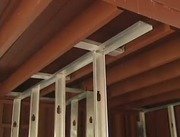
Inside, workers install a ½- inch plywood floor over the existing ¾- inch plywood sub-floor. The crew runs metal hat channels for wiring along the walls and vertical support beams that dot the interior. Metal studs and drywall are used for interior partition walls. Once insulated, the existing container walls are faced in drywall for finishing, transforming the ugly corrugated-steel interior and prepping them for paint or wallpaper.

The exterior is clad with James Hardie fiber-cement siding. Windows and doors are installed into pre-cut openings with a minimal use of wood framing. Doors are hung and the roof is shingled, leaving the house ready for furnishing. "Within 60 days we had our house ready for all the interior stuff." says Locklair. "Within 30 more days it was completely finished."

Building Strong, Smart, and Fast with ISBUs
Savings and reliability are the hallmarks of ISBU building. Homebuilding crews save time, money, and wood by using a product that is manufactured, pre-fitted for installation, and structurally sound. The speed and ease with which the containers are ordered, prefabricated, and installed streamlines the entire construction process. When asked to compare it to traditional stick building, Locklair is quick to answer— "Honestly, I think it was a lot easier."

It is most likely the outstanding fire and safety ratings that will impress insurance companies and code officials. In hurricane-prone areas like Florida or coastal South Carolina, the container house offers tremendous sustainability and strength. "I would like to see someone try to tear that house down," laughs Locklair. "It would take a whole lot more than a bulldozer."


Text by Mark Fuller
© 2006 BobVila.com


Add To:
Del.icio.us
Digg
Google
Y! MyWeb
Reddit
Technorati

Find homes by zip code
Find home plans to suit your lifestyle


Sears - HVAC Repair


FenceCenter.com - Fencing


Rinnai - Tankless Water Heaters


Radiantec - Radiant Floor Heating


eFaucets - Plumbing Fixtures


Sears - Vinyl Siding

View all Showrooms


Related Articles Related Tips Related Videos
Converting Shipping Containers for Housing
Structural Insulated Panels
Modular Homes Make Sense
Structural Insulated Panels
Oriented Strand Board
Structural Composite Panels
Weatherproof Doorframes
Building for Hurricane Safety
Securing the Modular Walls


About | FAQ | Contact | Sitemap | Privacy Policy | Terms of Use | Help
© BobVila.com 2008