We may earn revenue from the products available on this page and participate in affiliate programs. Learn More ›
A cordless reciprocating saw uses a high-torque motor to drive a thin, heavy-duty blade in a rapid back-and-forth motion, making it one of the most powerful and versatile demolition tools available. By ditching the power cord, these battery-powered models offer go-anywhere, cut-anything prowess. There’s not much they can’t do when it comes to rough cutting.
In general, reciprocating saws are meant for demolition—tearing out walls, cutting away pipes, and severing nails and bolts from between floor plates. This saw is a top option for both contractors and DIYers who want to make quick, powerful cuts. Reciprocating saws have been popular since the Milwaukee Tool Company produced the first of its kind—the legendary Sawzall—in 1951. Since then, many tool manufacturers have been making their own reciprocating saws, and with so many models available, we wanted to see which ones truly delivered on the promise of convenience and power.
We ordered the top reciprocating models on the market today and put them through their paces in our workshop. We didn’t go easy on them; after all, a demolition tool needs to withstand a lot of use and abuse. We cut dimensional lumber, plywood, polyvinyl chloride (PVC), steel, and more. Our top spot went to Flex’s popular model thanks to its powerful 24V system and smooth operation. Keep reading to learn more about choosing the best cordless reciprocating saw, and find out how the following models earned a spot on this lineup.
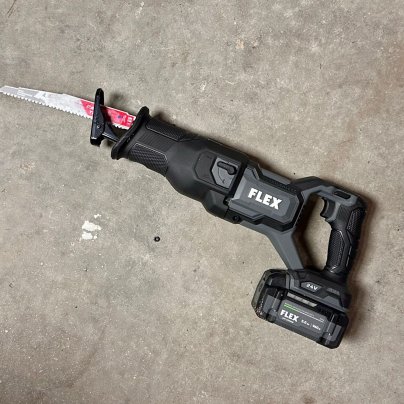
- BEST OVERALL: Flex 24V Brushless Cordless Reciprocating Saw Kit
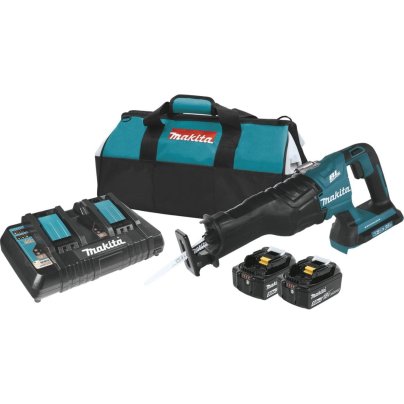
↓ Jump to Review - RUNNER-UP: Makita 36V LXT Brushless Cordless Recipro Saw Kit
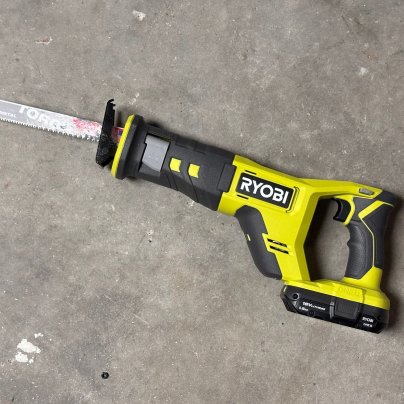
↓ Jump to Review - BEST BANG FOR THE BUCK: Ryobi ONE+ 18V PCL515 Reciprocating Saw
↓ Jump to Review - BEST SUB-COMPACT: Makita 18V LXT Sub-Compact Cordless Recipro Saw Kit
↓ Jump to Review - BEST JOBSITE: Milwaukee M18 FUEL Gen-2 Sawzall Reciprocating Saw
↓ Jump to Review - BEST COMPACT: DeWalt DCS387 20V Variable Speed Reciprocating Saw
↓ Jump to Review - BEST PROFESSIONAL: Makita 40V Max XGT Recipro Saw Kit
↓ Jump to Review - BEST 12-VOLT: Bosch PS60-102 12V Max Pocket Reciprocating Saw Kit
↓ Jump to Review
Before You Buy a Cordless Reciprocating Saw
If there’s one area in which a cordless reciprocating saw does not excel, it’s precision. These saws have a lot of power, but the blades are long, relatively thin strips of metal that attach to the saw on just one end. As the saw pushes the blade back and forth, it will bow and bend—similar to a hand saw, but at greater speeds.
For this reason, it can be challenging to achieve consistent or square cuts on a stack of lumber. Users might be able to get each piece within ¼ inch of each other, but the discrepancy between pieces will likely make them unusable for building, and the cut end will rarely be square.
When straight, accurate cuts are crucial, go with a circular, miter, or table saw—all tools whose design allows them to make consistent, repeatable cuts at specific angles. But for all those other sawing jobs—especially demolition tasks—it’s tough to beat the power and versatility of a cordless reciprocating saw.
The Best Cordless Reciprocating Saws at a Glance
| Product | Max Cutting Speed | Stroke Length | Weight (bare tool) |
|---|---|---|---|
| Flex 24V Brushless Cordless Reciprocating Saw Kit | 3,000 SPM | 1¼ inch | 7.4 pounds |
| Makita 36V LXT Brushless Cordless Recipro Saw Kit | 3,000 SPM | 1¼ inch | 9.3 pounds |
| Ryobi ONE+ 18V PCL515 Reciprocating Saw | 3,300 SPM | 1 inch | 3.75 pounds |
| Makita 18V LXT Sub-Compact Cordless Recipro Saw Kit | 3,000 SPM | 13/16 inch | 5.7 pounds |
| Milwaukee M18 FUEL Gen-2 Sawzall Reciprocating Saw | 3,000 SPM | 1¼ inch | 6.8 pounds |
| DeWalt DCS387 20V Variable Speed Reciprocating Saw | 2,900 SPM | 1⅛ inch | 5.4 pounds |
| Makita 40V Max XGT GRJ01 Recipro Saw Kit | 3,000 SPM | 1¼ inch | 7.7 pounds |
| Bosch PS60-102 12V Max Pocket Reciprocating Saw Kit | 3,000 SPM | 9/16 inch | 2.2 pounds |
Our Top Picks
Adding the best cordless reciprocating saw to a tool chest might seem like a no-brainer, but choosing from among all the models on the market can be a challenge. While reciprocating saws don’t come with many bells and whistles, some are better suited to specific tasks than others. The results of our hands-on testing can help readers choose between the different models. Find out how each one of the following reciprocating saws performed in our testing, and learn the pros and cons of each model before investing in one of these tools.
Best Overall
Photo: Tony Carrick for Bob Vila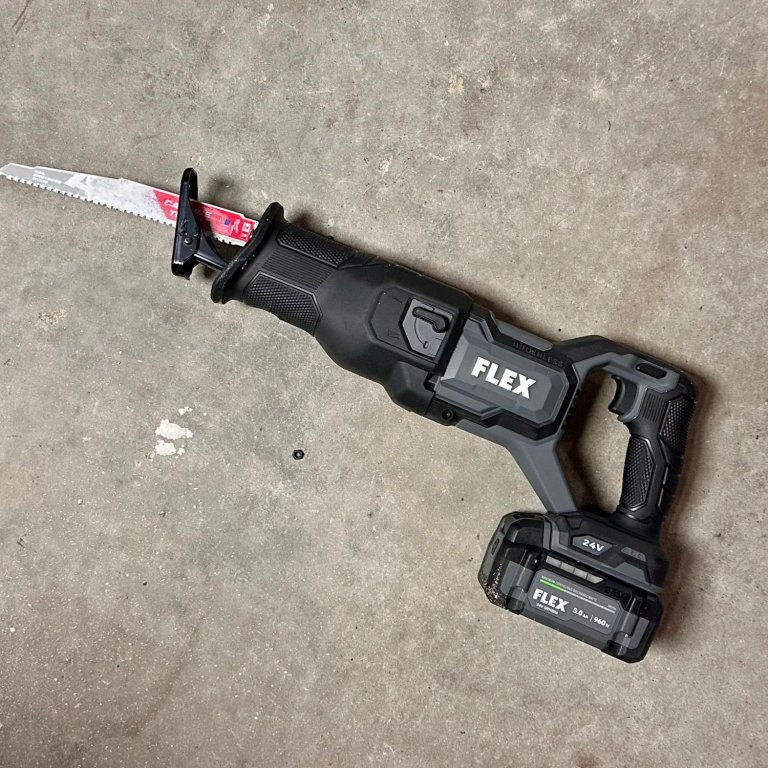
What We Like
- Tremendous cutting performance
- Smooth-as-butter operation
- Rugged build quality
What We Don’t Like
- 24-volt system gives it a heavy overall weight
Product Specs
- Cutting speed 3,000 SPM
- Stroke length 1¼ inch
- Weight (bare tool) 7.4 pounds
This Bob Vila Approved product carries our brand’s highest level of recommendation.
Bob Vila Approved recognizes the household and DIY products that impressed us most in our real-world testing and that exemplify core values of the Bob Vila brand, including craftsmanship, innovation, and value for the dollar. Winners of this designation come recommended by our professional review team and are personally approved by Bob Vila.
Our Ratings
| Ease of Use | 4/5 | Performance | 4.4/5 | Build Quality | 4.5/5 | Value | 4.3/5 |
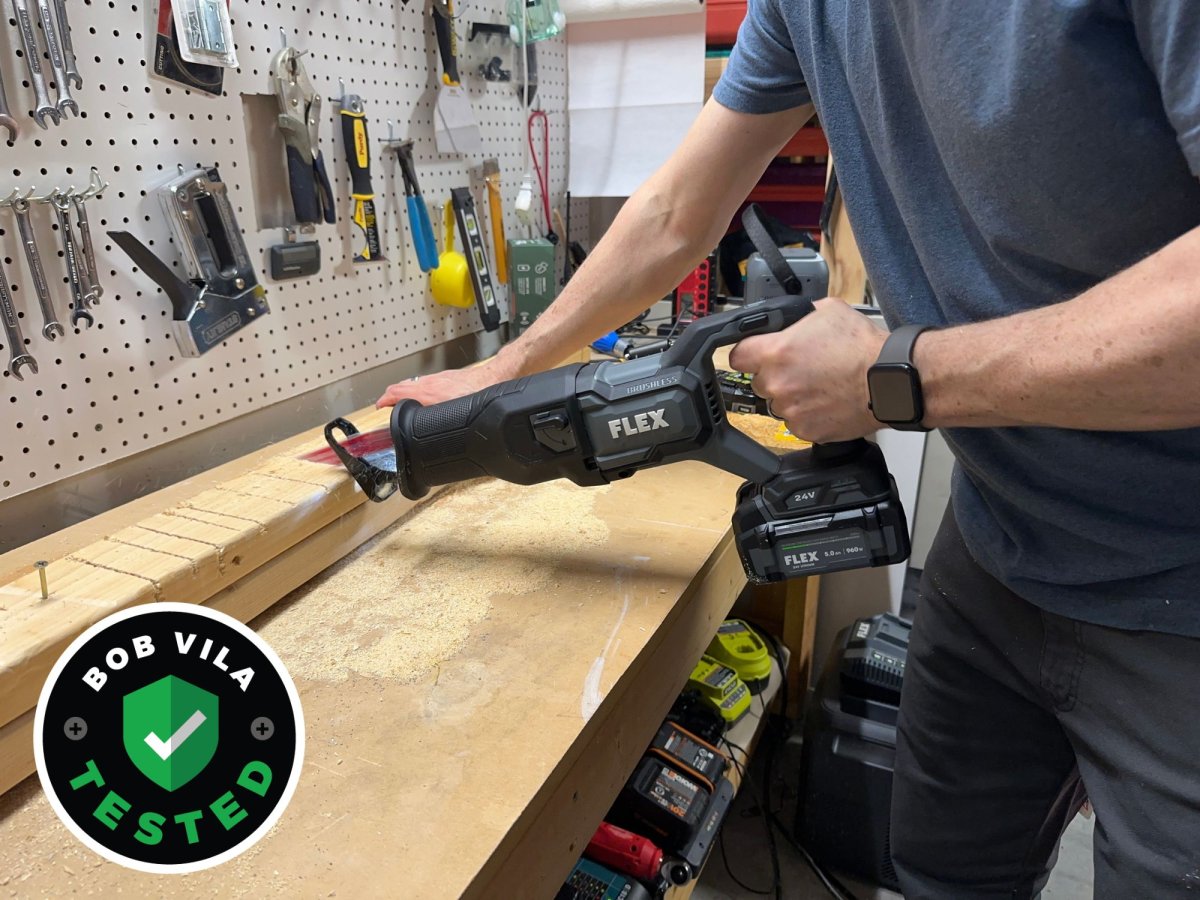
When it comes to power, Flex’s 24-volt cordless tools have a clear edge, and it certainly showed during testing. It chewed through our stacked 2x4s faster than any other saw. Not only that, but it also operated more smoothly than any of the other reciprocating saws we tested. This extra stability came in handy when cutting through lag bolts. We didn’t experience the same bouncing around you get when cutting through metal with other less stable reciprocating saws. There’s also plenty of grip around the handle and body, which is handy for using it one- or two-handed.
It was also the only saw we tested that had an orbital option. This causes the blade to move in an elliptical path rather than simply back and forth, allowing it to remove more wood with each stroke. Other features we liked on this saw include a keyless blade eject, which makes changing blades quicker, and its super bright LED work light.
One downside of a 24-volt system is that these cordless tools tend to weigh more, and that’s the case with the Flex, which weighs 7.4 pounds without the battery, or close to 10 pounds with its 5.0 Ah battery attached. If you don’t mind the added weight, it’s an exceptionally powerful tool that’s still reasonably priced.
What our tester says: “The Flex produces tremendous cutting butter and does so with very little vibration and butter smooth operation.”—Tony Carrick, Product Reviews tester and writer
Get the Flex cordless reciprocating saw at Amazon and Acme Tools.
Runner-Up
Photo: Amazon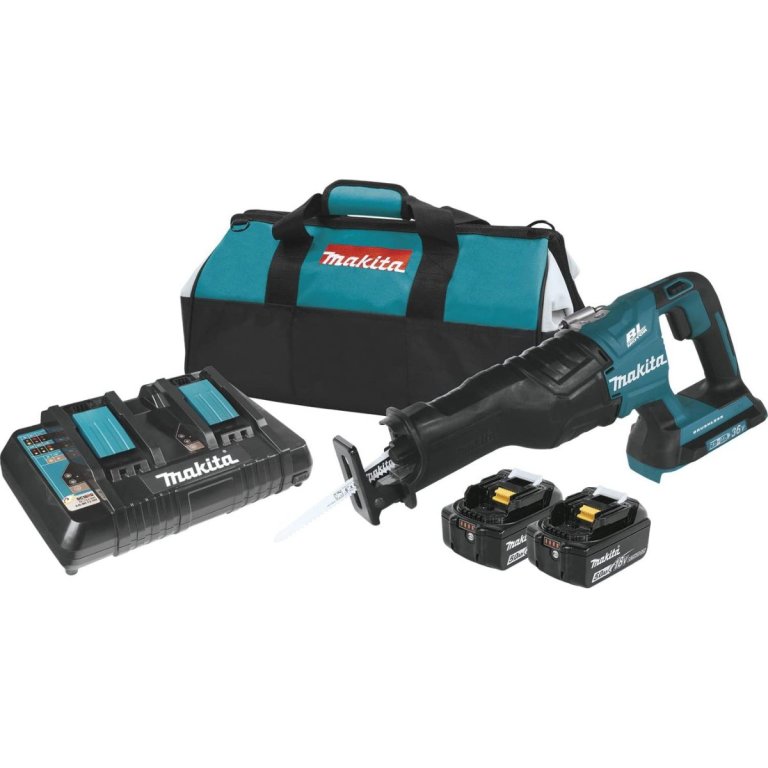
What We Like
- Accommodates 2 lithium-ion batteries
- Longer blade stroke than most of its competitors
- Brushless motor provides impressive extended battery life
What We Don’t Like
- Fairly heavy
Product Specs
- Max cutting speed 3,000 SPM
- Stroke length 1¼ inch
- Weight (bare tool) 9.3 pounds
Our Ratings
| Ease of Use | 4/5 | Performance | 5/5 | Build Quality | 5/5 | Value | 5/5 |
Makita’s 36V reciprocating saw is worth checking out for anyone hunting for a long blade stroke and speed control. It offers speed adjustment via its two-speed selection switch. When we selected the lowest speed option, the saw topped out at 2,300 SPM. When we chose the high-speed option, the blade cut at a robust 3,000 SPM. However, on either setting, we were able to apply light trigger pressure to bring the speed down thanks to its sensitive variable-speed trigger.
In addition to holding two 18V lithium-ion batteries for extended runtime, the saw features a brushless motor that maximizes battery life and reduces wear on the motor. This is a heavy-duty reciprocating saw—it weighs in at a beefy 10.2 pounds with batteries installed—but its rubberized grip and ergonomic design reduce fatigue.
This model also features a lengthy 1¼-inch blade stroke, which provides several more cutting teeth per stroke than shorter reciprocating blades. It made quick work of cutting through our testing materials (plywood, dimensional lumber, steel, and PVC pipes).
As a bonus, it comes with a bright LED guide light and a fold-out rafter hook for hanging the saw over a rafter or joist while working. We really liked this feature because it allows the user to hang the saw safely when working at heights rather than setting it somewhere it could fall.
Get the Makita 36V cordless reciprocating saw at Amazon or The Home Depot(tool only).
Best Bang for the Buck
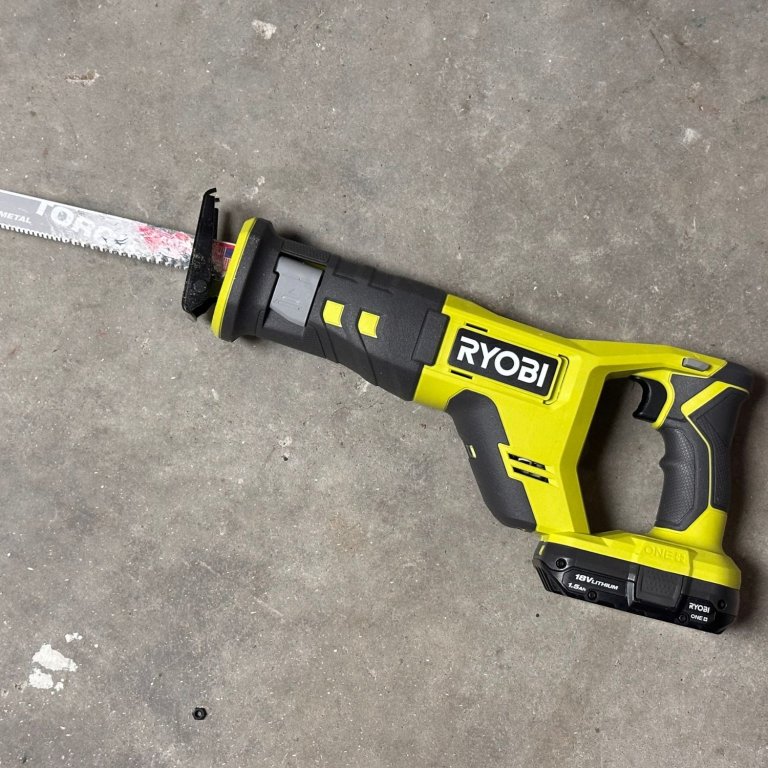
Ryobi ONE+ 18V PCL515 Reciprocating Saw
Buy at The Home DepotWhat We Like
- Lightweight design makes it easy to use
- Delivers surprising cutting power for its price
- Operates with low vibration
What We Don’t Like
- Built for lighter-duty use
Product Specs
- Max cutting speed 3,300 SPM
- Stroke length 1 inch
- Weight (bare tool) 3.75 pounds
Our Ratings
| Ease of Use | 4.3/5 | Performance | 3.9/5 | Build Quality | 4/5 | Value | 4.5/5 |
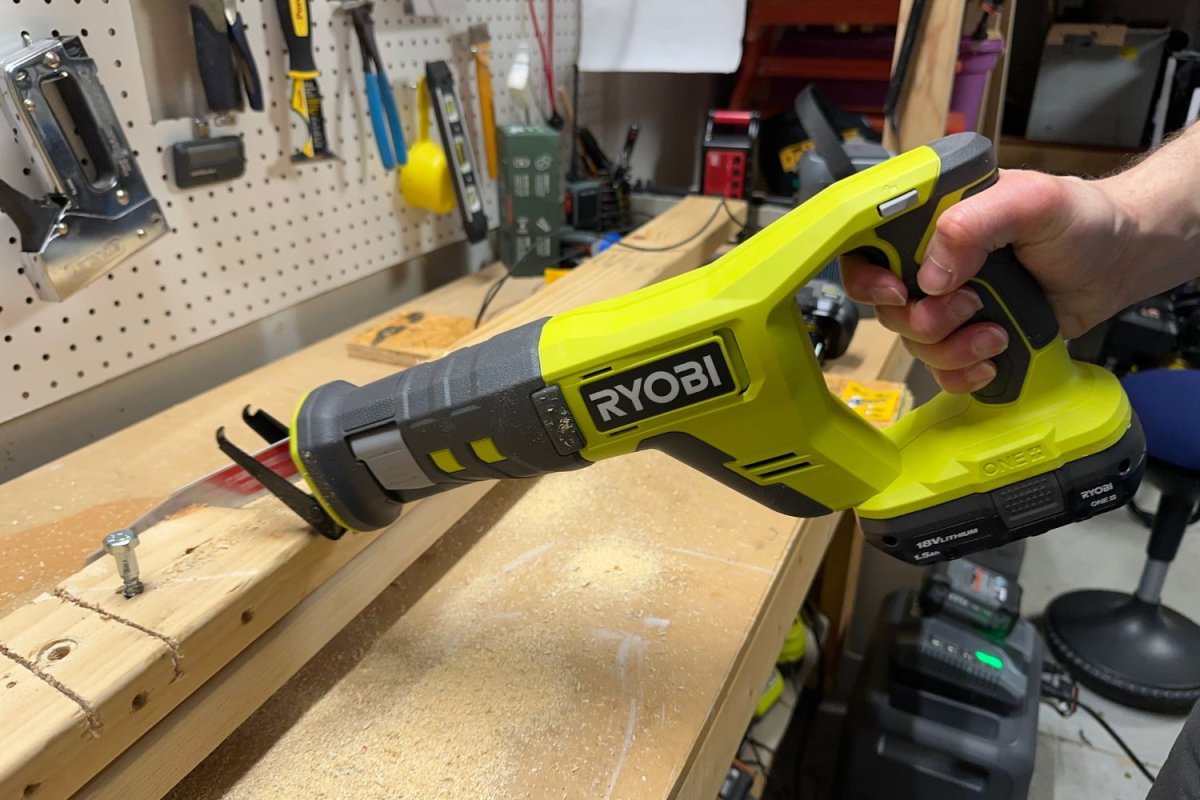
Ryobi’s cordless reciprocating saw offers surprising power for a budget-price cordless tool. This kit, which includes a charger and a 4.0Ah battery, costs about half what other cordless reciprocating saws cost, yet it performs quite well. Though it has a shorter 1-inch stroke length, the saw makes up for it with a fast 3,300 SPM rating. In testing, it chewed through our stacked 2x4s and capably cut through our metal bolts. It didn’t cut as quickly as some of the pricier saws we tested, but it was able to complete each cut without getting bogged down.
Since it’s one of the lightest reciprocating saws we tested, it’s also one of the easier models to use. It also produced lower-than-average vibration, making it a user-friendly option for those who may not have much experience with this type of saw.
Admittedly, it does lack some features. There is no way to change the blade position, and it doesn’t have orbital cutting. And while we like the abundance of rubberized molding around the handle and body, the housing doesn’t feel as rugged as other models. But given its price and cutting performance, it’s an excellent option for DIYers who may only need the service of a reciprocating saw for occasional weekend projects.
What our tester says: “The Ryobi won’t win any speed awards, but it’s a very capable cordless reciprocating saw at a rock bottom price.”—Tony Carrick, Product Reviews tester and writer
Get the Ryobi cordless reciprocating saw at The Home Depot.
Best Sub-Compact
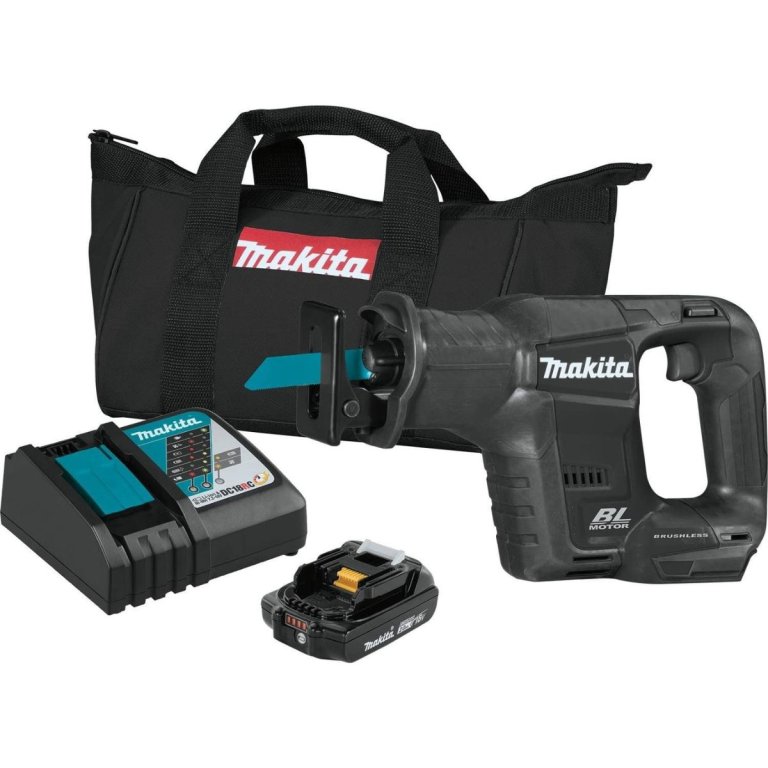
Makita 18V LXT Sub-Compact Cordless Recipro Saw Kit
Buy at Amazon Buy at The Home Depot Buy at Tractor Supply Co.What We Like
- Compact design with plenty of power
- Lightweight at just 5.7 pounds with battery
- Rubberized handle offers plenty of grip and comfort
What We Don’t Like
- Not suitable for one-handed use
Product Specs
- Max cutting speed 3,000 SPM
- Stroke length 13/16 inch
- Weight (bare tool) 5.7 pounds
Our Ratings
| Ease of Use | 4/5 | Performance | 5/5 | Build Quality | 5/5 | Value | 4/5 |
There’s compact, and then there’s sub-compact—the latter describing Makita’s 18V LXT cordless reciprocating saw. This saw’s focus is punching above its weight class, offering 3,000 SPM while measuring just 12½ inches long and weighing only 5.7 pounds. While it’s lightweight, we found it to be a two-handed saw due to its design. We tried using it with one hand, but it’s not balanced well enough—we had to use a second hand along the lower front edge for support.
As compact as this saw is, it does vibrate quite a bit—more like a full-size model than a compact one—but that also speaks to its power. This robust little saw cut right through all our test materials: wood, plywood, steel pipes, PVC pipes, and tree limbs. It didn’t let up for anything, unless we purposely slowed it down via its sensitive variable-speed trigger.
The saw features a brushless motor that delivers more power and battery efficiency than brushed alternatives. This unit has a stroke length of 13/16 inch, which is slightly short, but it’s designed for cutting in tight spots where a longer stroke length might not work.
The rubberized overmold makes it easy to grip the tool firmly without slipping, and the LED guide light is bright and clear. It comes with an 18V 2Ah rechargeable lithium-ion battery. This is a powerful saw, but we admit we weren’t thrilled with its boxy design. We’d love to see Makita redesign this model for one-handed use while keeping all its other perks.
Get the Makita 18V cordless reciprocating saw at Amazon, The Home Depot, or Tractor Supply Co.
Best Jobsite Pick
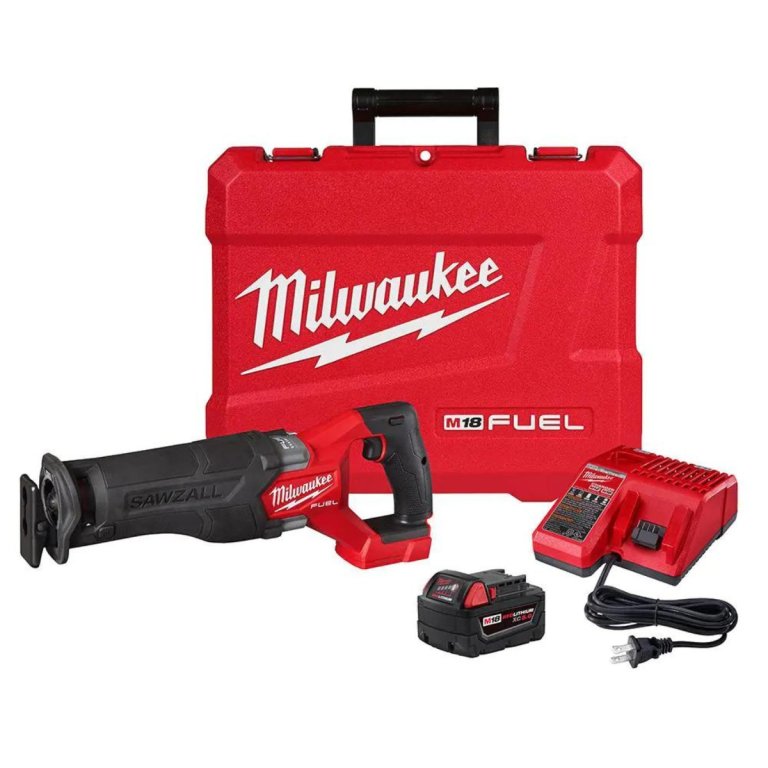
Milwaukee M18 FUEL Gen-2 Sawzall Reciprocating Saw
Buy at Ace Hardware Buy at The Home Depot Buy at Blain’s Farm & FleetWhat We Like
- Operates smoothly with little vibration
- Cuts quickly through wood and metal
- Rugged professional build quality
What We Don’t Like
- Sold at a pro-level price
Product Specs
- Max cutting speed 3,000 SPM
- Stroke length 1¼ inch
- Weight (bare tool) 6.8 pounds
Our Ratings
| Ease of Use | 4.5/5 | Performance | 4.6/5 | Build Quality | 4.8/5 | Value | 4.3/5 |
Milwaukee’s M18 FUEL Gen-2 Sawzall is a high-performing, rugged machine designed to meet the demands of a professional jobsite. It features an overmolded body with a rubberized grip that protects the saw while offering a firm grip, regardless of the angle you’re cutting from.
We expect top-notch performance from Milwaukee’s M18 Fuel line of cordless tools, and this reciprocating saw didn’t disappoint. It sliced through 2x4s with ease and didn’t hesitate, whether we were cutting through metal lag bolts or slicing through PVC pipe. And while it didn’t quite match our top performer in terms of cutting speed, it’s also significantly lighter than that saw, weighing just 6.8 pounds as a bare tool. Couple that light weight with its very low vibration output, and the Milwaukee is a tool that’s easy to wield and won’t leave your arm feeling numb, which is critical for larger demolition projects that require a lot of cutting. The saw also features a bright LED light that fully illuminates what you’re cutting, even when working in dark conditions.
While Milwaukee’s Gen-2 Sawzall is impressive, it’s also expensive. As such, it may be overkill for most DIYers. This is a saw that’s primarily designed and priced for professionals.
Get the Milwaukee M18 FUEL Gen-2 reciprocating saw at Ace Hardware, The Home Depot, or Blain’s Farm & Fleet(tool only).
Best Compact
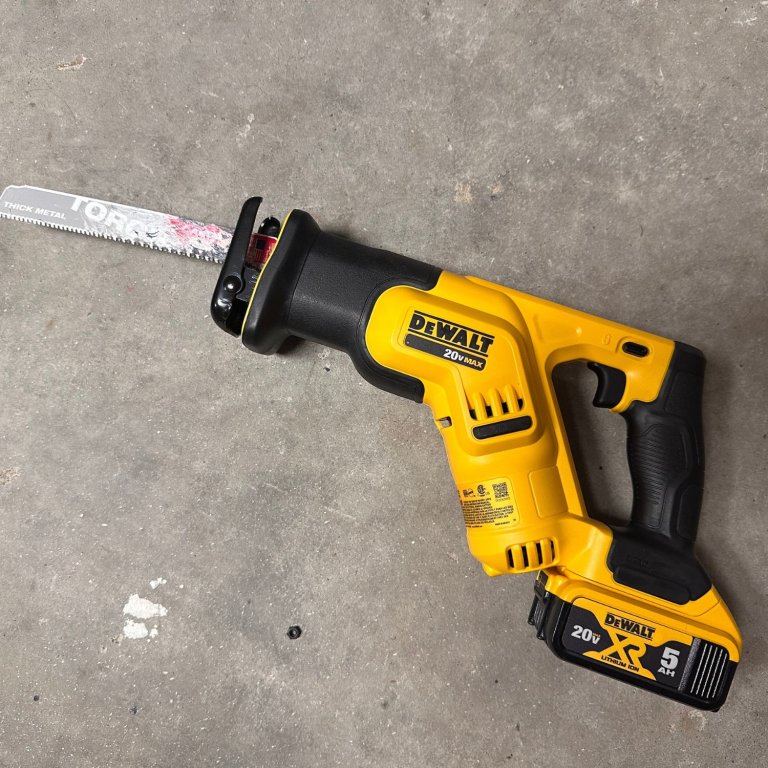
DeWalt DCS387 20V Variable Speed Reciprocating Saw
Buy at The Home DepotWhat We Like
- Lightweight, compact design makes it easy to use
- 4-position blade clamp allows for flush cuts
- Comfortable overmolded handle
What We Don’t Like
- Heavy vibration during use
Product Specs
- Max cutting speed 2,900 SPM
- Stroke length 1⅛ inch
- Weight (bare tool) 5.4 pounds
Our Ratings
| Ease of Use | 4/5 | Performance | 4.4/5 | Build Quality | 4.5/5 | Value | 4.2/5 |
DeWalt’s 20V variable speed reciprocating saw (DCS387) is one of the lightest models we tested, weighing a scant 5.4 pounds as a bare tool. That, coupled with its short, compact length, made it especially nimble to use. At 14.75 inches long, it’s small enough to fit between studs. We had no trouble making cuts with one hand thanks in part to its molded rubberized grip, which allowed us to get a good handle on the saw. There are other features we liked with the DeWalt, including a 4-position blade clamp that was handy for making flush cuts.
Despite its smaller size, it made cuts quickly and efficiently. It has a 1⅛ stroke, which is slightly smaller than the larger reciprocating saws we tested, and a slightly slower blade speed of 2,900 strokes per minute. Though a little slower than our top picks, it still sliced through 2x4s with ease.
There is a drawback to its stripped-down size: vibration. The DeWalt saw produced more vibration than most of the saws we tested. This made it harder to get cuts started as it forced us to bear down more forcefully to prevent the blade from bouncing on the surface of harder materials, like metal.
Get the DeWalt cordless reciprocating saw at The Home Depot.
Best Professional
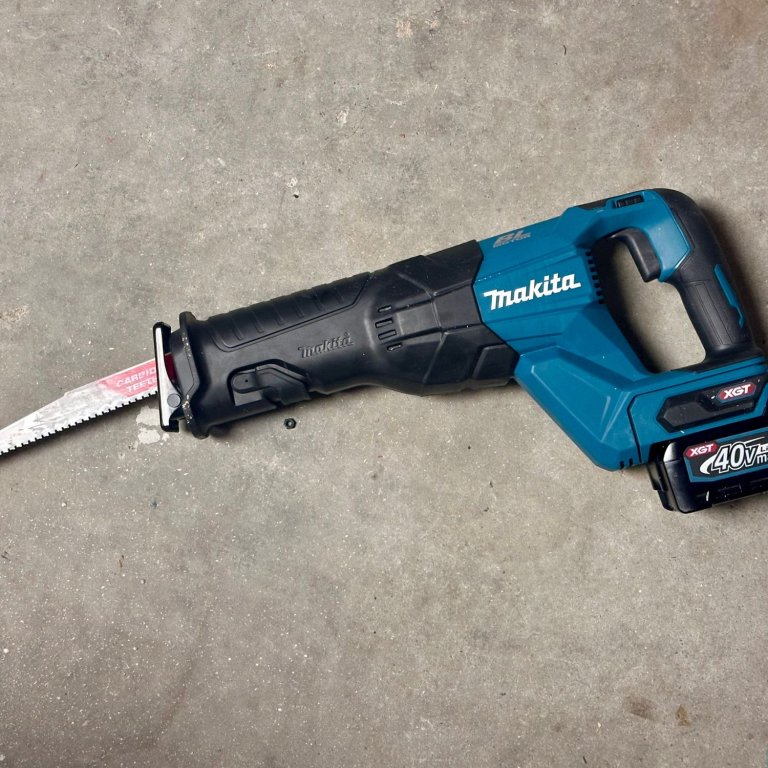
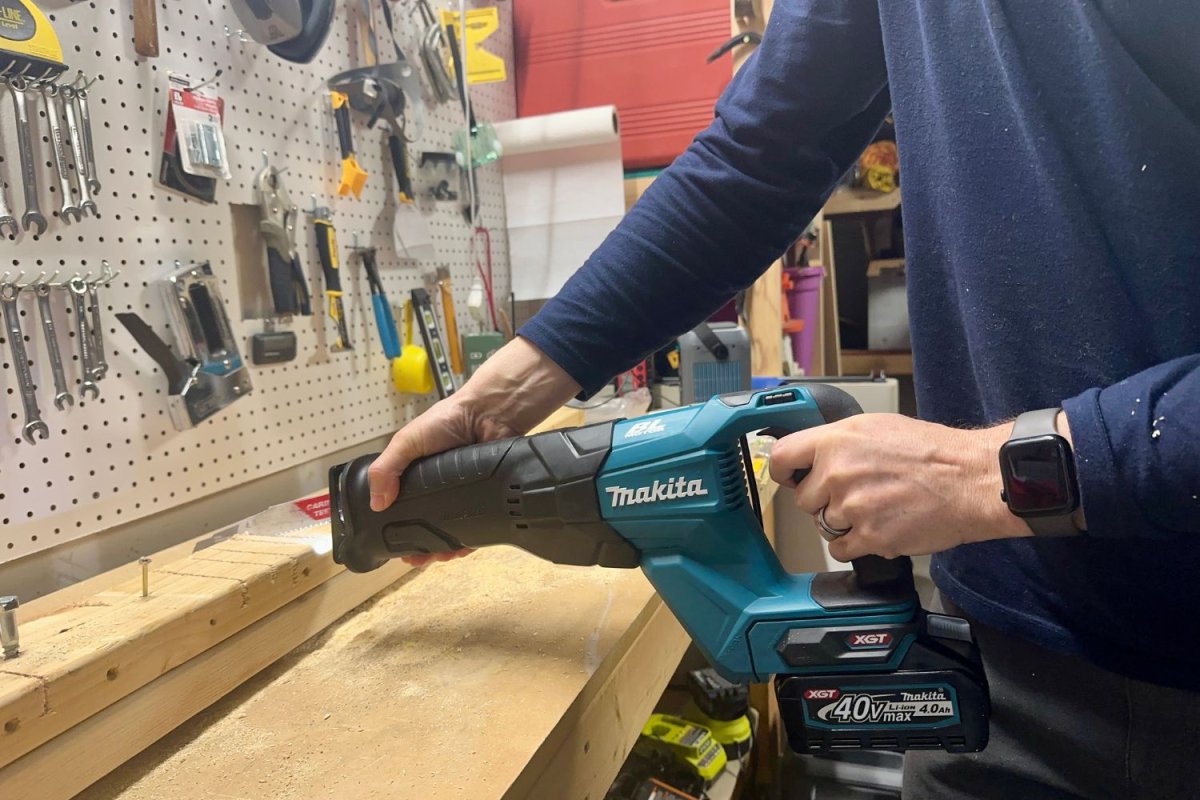
Makita 40V Max XGT GRJ01 Recipro Saw Kit
Buy at The Home DepotWhat We Like
- Tremendous cutting power
- Rock-solid build quality
- Offers 2 speed options
What We Don’t Like
- 40-volt system makes the saw heavy
Product Specs
- Max cutting speed 3,000 SPM
- Stroke length 1¼ inch
- Weight (bare tool) 7.7 pounds
Our Ratings
| Ease of Use | 4/5 | Performance | 4.9/5 | Build Quality | 4.5/5 | Value | 4.2/5 |
Makita’s powerful Max XGT reciprocating saw set a new benchmark for cutting power for reciprocating saws. Backed by the 40-volt system, this heavy-duty reciprocating saw makes quick work of just about anything you put in front of it. It chewed through studs in record time, then made quick work of cutting through a metal pipe.
Unlike the other reciprocating saws we tested, this model has a two-speed switch. This allowed us to dial it down for cutting through metal and plastic. And despite its large 40V motor, it still felt surprisingly quiet thanks to vibration-dampening inside the housing. That’s a crucial factor for pros who may be making dozens and dozens of cuts. The large-capacity battery can provide enough juice for about 145 cuts. Plus, the kit comes with a fast charger, minimizing downtime.
The saw body is covered in heavy-duty rubber, so it’s easy to get a firm grip on it, which you’ll want to do given the size of this saw. It’s a beefy machine, to say the least. Loaded with its 40V 4.0Ah battery, it tips the scales at nearly 10 pounds.
Along with being the heaviest reciprocating saw we tested, it’s also the most expensive. This is a powerful tool that’s designed for professionals and heavy daily use on a professional jobsite, and its price reflects that.
Get the Makita 40V cordless reciprocating saw at The Home Depot.
Best 12-Volt
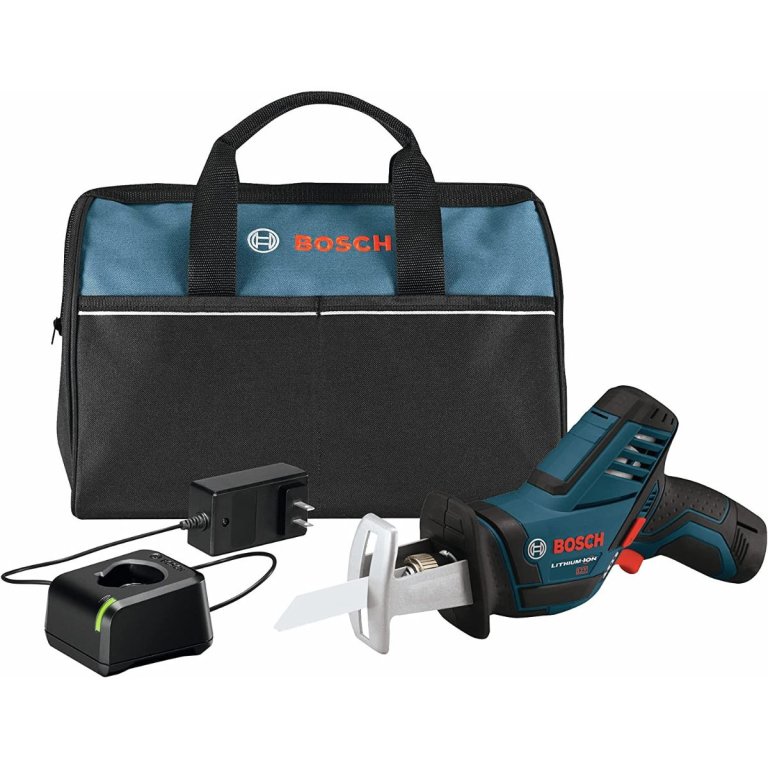
Bosch PS60-102 12V Max Pocket Reciprocating Saw Kit
Buy at Amazon Buy at Tractor Supply Co. Buy at GraingerWhat We Like
- Quieter operation compared to similar models
- Compact design is easy to maneuver; prevents fatigue
- Battery-life indicator displays power level at a glance
What We Don’t Like
- Motor is not brushless
- Guide light is dim compared to similar tools
Product Specs
- Max cutting speed 3,000 SPM
- Stroke length 9/16 inch
- Weight (bare tool) 2.2 pounds
Our Ratings
| Ease of Use | 4/5 | Performance | 4/5 | Build Quality | 4/5 | Value | 4/5 |
After testing some of the full-size reciprocating saws in this lineup, the Bosch PS60-102 reciprocating saw seemed quite small in comparison. It’s a 12V model rather than an 18V or 20V one, and it has a relatively short 9/16-inch stroke length. We weren’t expecting a burst of power from this little tool, but we were pleasantly surprised.
During our tests using the different blades, it took slightly longer to saw through the materials with the PS60-102 than with the more powerful saws, but it didn’t bog down when cutting. It’s a light-duty saw for sure, but it’s robust and capable of making multiple cuts for demolition purposes. Its variable-speed trigger is sensitive and easy to regulate using finger pressure.
Our favorite use for this saw was for tree pruning. We fitted it with an arbor saw, and it made quick work of cutting away both green and dead wood. We found its LED light to be a bit on the wimpy side when used in dim lighting, but we appreciated the battery indicator light right by the trigger. The others we tested had indicator lights on the batteries themselves, which is standard, but checking those requires turning the tool upside down. With the PS60-102, we could easily see the battery life as we cut. It’s also quite a bit quieter than the bigger models, which is to be expected due to the smaller battery, but it’s still a nice plus.
Get the Bosch cordless reciprocating saw at Amazon, Tractor Supply Co., or Grainger(tool only).
Jump to Our Top Picks
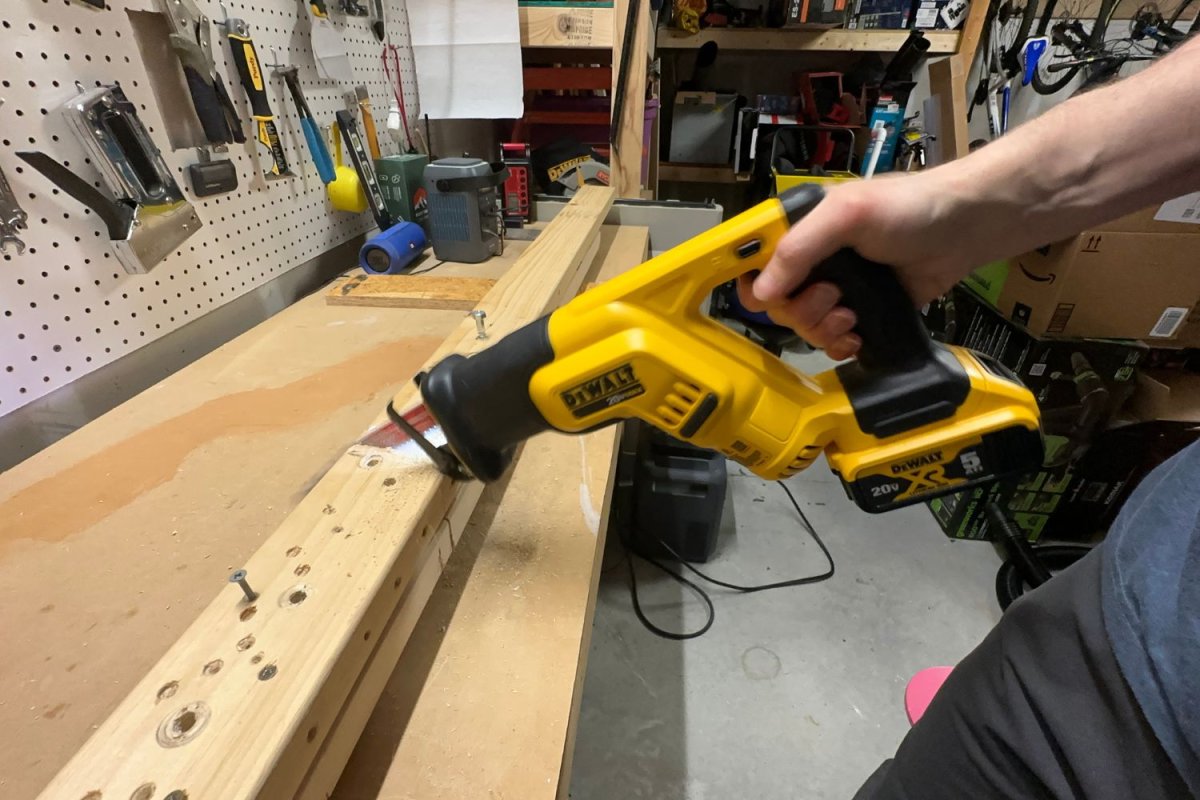
How We Tested the Best Cordless Reciprocating Saws
Putting together a list of the best cordless reciprocating saws to test was challenging work. We had to draw upon our DIY project and contracting experience to pick out the features we felt were must-haves and those we could do without.
In the end, we selected battery-operated reciprocating saws with a range of power from known manufacturers. DeWalt, Makita, and Milwaukee are top-of-the-line power-tool makers, so we had a good feeling about their products, and they didn’t let us down.
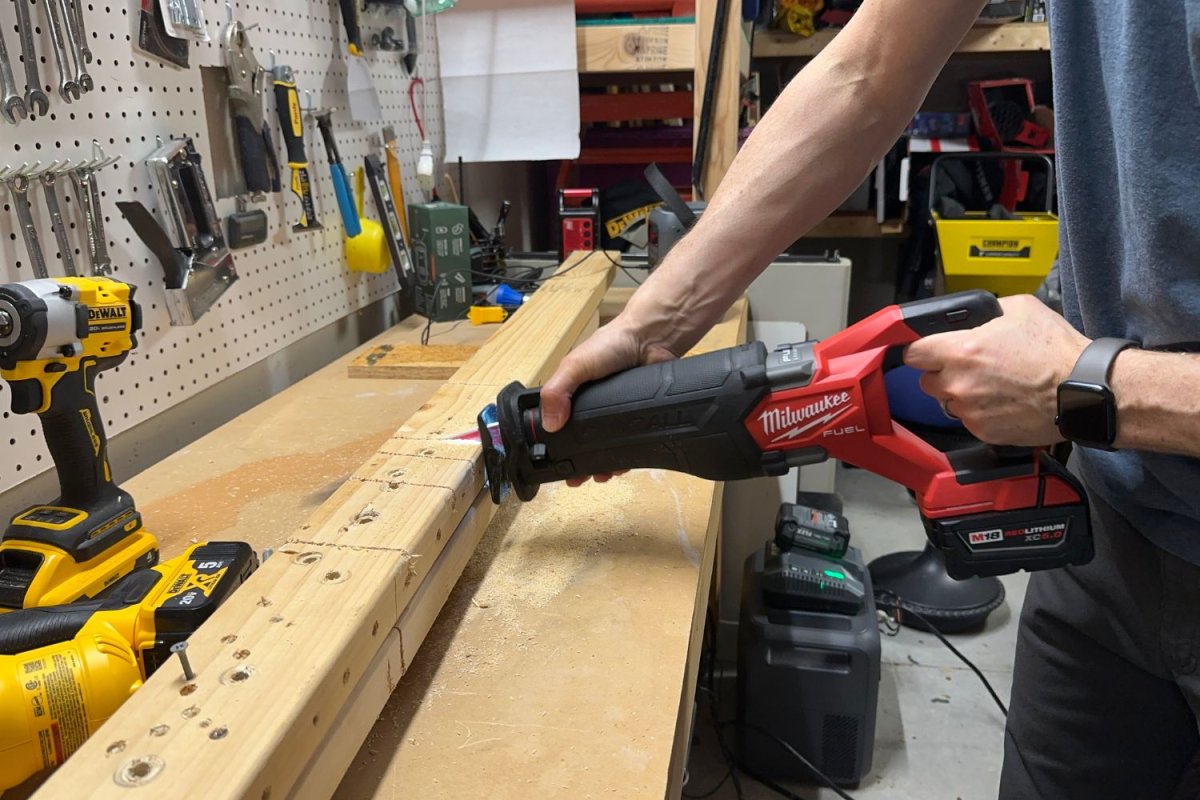
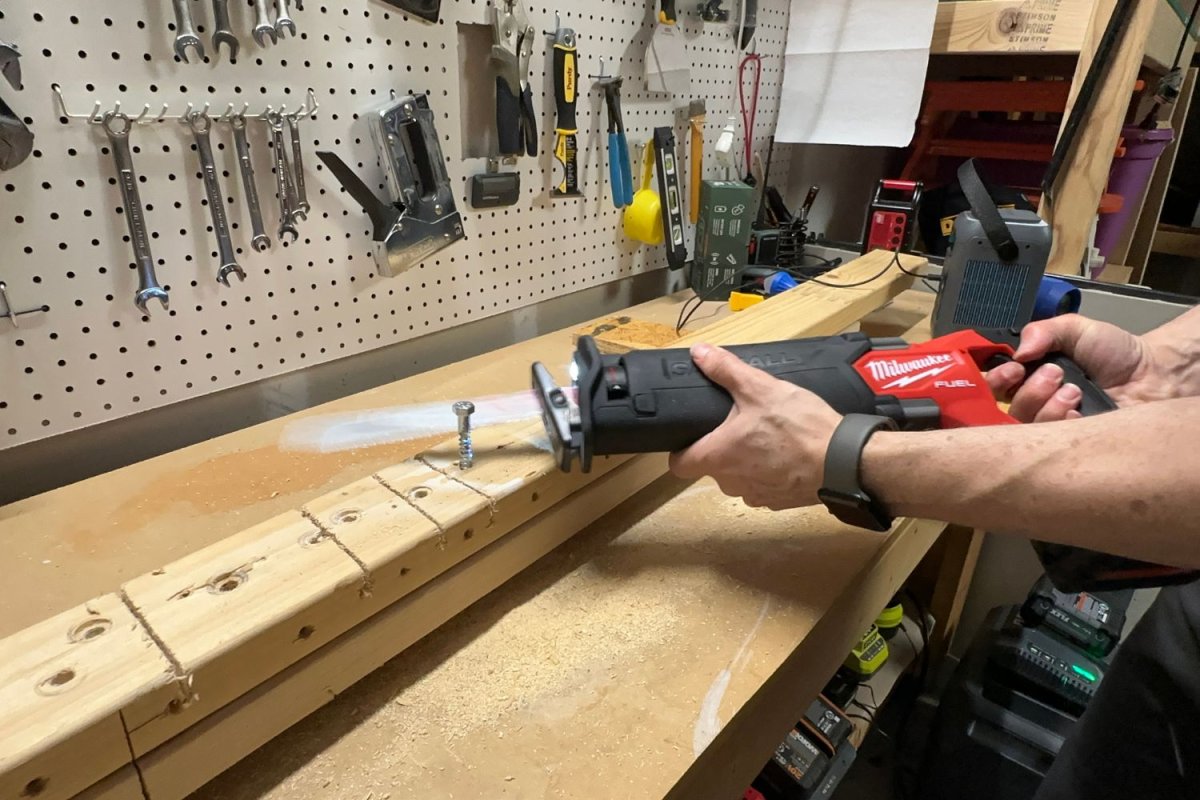
For the hands-on testing, we fitted each of the reciprocating saws with blades designed to cut specific test materials. For example, before we cut metal pipes, we fitted the saws with metal blades. Before we cut tree limbs, we fitted the saws with arbor blades.
We noted how quickly the saw chewed through the material as we cut through plywood, dimensional lumber, steel pipes, PVC pipes, and limbs. We also noted how easy it was to operate the saw. We checked every function on each tool, including the blade-changing mechanisms and variable-speed trigger sensitivity (more sensitivity was better), and we scored each saw using a rubric.
The better a tool performed, the higher its score on that test. After testing was complete, we added and averaged all the scores and used them to help categorize the saws.
Our Testing Scores
| Product | Ease of Use | Performance | Build Quality | Value |
|---|---|---|---|---|
| Flex 24V Brushless Cordless Reciprocating Saw Kit | 4.5/5 | 4.4/5 | 4.3/5 | 4.3/5 |
| Makita 36V LXT Brushless Cordless Recipro Saw Kit | 4/5 | 5/5 | 5/5 | 5/5 |
| Ryobi ONE+ 18V PCL515 Reciprocating Saw | 4.3/5 | 3.9/5 | 4/5 | 4.5/5 |
| Makita 18V LXT Sub-Compact Cordless Recipro Saw Kit | 4/5 | 5/5 | 5/5 | 4/5 |
| Milwaukee M18 FUEL Gen-2 Sawzall Reciprocating Saw | 4.5/5 | 4.6/5 | 4.8/5 | 4.3/5 |
| DeWalt DCS387 20V Variable Speed Reciprocating Saw | 4/5 | 4.4/5 | 4.5/5 | 4.2/5 |
| Makita 40V Max XGT GRJ01 Recipro Saw Kit | 4/5 | 4.9/5 | 4.5/5 | 4.2/5 |
| Bosch PS60-102 12V Max Pocket Reciprocating Saw Kit | 4/5 | 4/5 | 4/5 | 4/5 |
What to Consider When Choosing a Cordless Reciprocating Saw
A cordless reciprocating saw can be an indispensable tool, as it can cut materials in mere seconds that would otherwise take a hand saw several minutes to get through—if at all. But there are a few factors to consider when shopping for these tools, which are explained in detail below.
Standard vs. Compact/One-Handed
When cordless reciprocating saws first appeared, they only came in large, dual-handed versions. Since then, manufacturers have realized there’s a market for compact or one-handed models.
- Standard cordless reciprocating saws feature two-handed designs with lots of power. They’re often almost 2 feet long and can weigh 10 pounds or more. Although they can be a bit of a handful, they provide excellent cutting control.
- Compact and one-handed designs, as the names suggest, are smaller and easier to use. They can be ideal for light-duty jobs since they often weigh less than 6 pounds. Some compact models can produce nearly as much power as standard models, but they still require two hands for maximum control. One-handed reciprocating saws aren’t as powerful, but users can easily operate them with just one hand, leaving the other hand free to hold and stabilize the material being cut.
Power and Variable Speed
Some of the earliest corded reciprocating saws had two modes—on and off—with no method of speed control. A single speed makes it harder to control the cut and wears blades out faster. Luckily, many of today’s cordless models benefit from adjustable speeds.
A good reciprocating saw has a variable-speed trigger that allows the user to throttle the blade speed. Depending on the saw, the user can adjust the speed from just a few strokes per minute to full speed, which might be more than 2,500 strokes per minute. This variable speed allows the user to start the blade as accurately as possible and get the most life out of a blade or battery. And because full-size reciprocating saws are pretty powerful, being able to start the blade at a low speed and increase it when necessary offers a measure of safety.
Orbital Action
Most reciprocating saws use a back-and-forth stroke to gnaw through a material. The backward stroke cuts through the material, while the forward stroke resets the blade. This is usually more than sufficient, but when it comes to cutting through softer materials such as construction lumber, there’s another way: orbital action.
Reciprocating saws with orbital action (slight elliptical motion) use a more circular blade path while cutting. On the blade’s backstroke, the saw blade also travels downward. On the forward stroke, the blade travels upward. This oval motion allows the blade to cut faster through softer materials like pine, cedar, and redwood, but it can’t do much besides making a chattering racket when cutting harder materials, like metal. Orbital action can be a feature on a cordless reciprocating saw, but it’s not common, and none of the saws we tested came with orbital action.
Blade Type and Stroke
All reciprocating saws (corded or cordless) use interchangeable blades; each type has a purpose for which it’s most suitable. Choosing the right blade allows the saw to cut most efficiently.
- Wood blades have large, aggressive teeth that rip through wood very quickly. They’re excellent for cutting through wood without nails as well as yard cleanup.
- Metal blades have small, fine teeth that remove small chunks of metal with each stroke. They’re best for cutting metal pipes, angle iron, and similar materials.
- Demolition/construction/combination blades can cut a mix of wood and metal. These blades’ primary purpose is to cut through wood and slice through any embedded nails they might come across in the process.
- Arbor blades are also called pruning blades. These blades are designed to cut dead or green tree and shrub branches, making them useful for the DIY arborist who needs to prune trees and bushes.
It’s also worth noting that reciprocating saws have different stroke lengths. This refers to the back-and-forth distance that the blade travels. Compact models might have strokes under an inch, while larger models may exceed 1⅛ inches. The longer the stroke, the more teeth will pass over the material with each pass, which speeds up cutting. But saws with longer strokes can be challenging to use in restricted locations where the end of the saw can bump into a wall or other item that’s right behind the material being cut.
We interviewed Jacob Rhodes, the Owner and Chief Engineer at TrueTrac, a family-owned and operated specialty woodworking tool manufacturing company in southern Ohio. He recommends different stroke lengths depending on what you plan on using the reciprocating saw for: “Opt for a saw with a longer stroke length (over 1.5 inches) for deeper cuts in thicker and heavier-duty materials.” He added that “if you’re only using it for delicate cuts and materials like wood and PVC, a stroke length of 1 inch to 1.5 inches is fine.”
Comfort
In recent years, manufacturers have started designing both corded and cordless tools, including reciprocating saws, with an eye toward ergonomics. While the original models work pretty well, there are days when a pro or DIYer might spend several hours using a reciprocating saw, and traditional grips and designs can result in hand and arm fatigue.
Some ergonomic models have specially designed handles that allow the user to hold the saw at different positions depending on the angle at which they’re sawing. This adjustable handle enables them to operate the tool more comfortably.
Also, vibration control via rubber grips is becoming more popular in these saws. The rubber absorbs some of the vibration associated with high-speed sawing. This also reduces the fatigue on the user’s hands, arms, shoulders, back, and neck.
Battery Life
The larger the amp-hour rating (Ah) of a battery, the longer it will work for a particular saw. How long a battery will run, however, depends on too many factors to nail down, including:
- Sawing speed
- Material
- Blade used
- Battery amp-hour (Ah) rating
Rhodes shared some expert advice on this matter, stating that shoppers should “Look for a voltage of at least 18V for tougher cuts and longer life between charges.” He also suggested making sure the batteries are lithium-ion, as “they are the industry standard, offering good lifespan and reliable performance.”
Cordless reciprocating saws with brushless motors will get more life out of a battery than the same model with a brushed motor. Motors with brushes—the old standard—tend to be slightly less powerful than brushless motors. The brushes create friction (resistance) in the motor, which requires the saw to use more battery power, resulting in shorter battery life.
Brushed motor tools are typically less expensive, but a brushless model is definitely the way to go if battery life is a priority. Remember to buy additional batteries for every model. Some saws are listed as a “bare tool” or “tool only,” which do not include batteries or battery chargers. Batteries are pricey, so some users purchase power tools of the same brand and then swap out batteries between them.
Shopping for a Used or Refurbished Reciprocating Saw
Folks who don’t want to invest a ton of money into a tool they might not use that often can always turn to the second-hand market. The used marketplace is usually full of tools that DIYers purchased and have since moved on from. Users can score some of the best reciprocating saws at serious discounts.
Shoppers can check sites like Amazon Renewed, eBay Refurbished, and Walmart Restored for reciprocating saws. These sites often carry the most popular power tools at significantly lower prices than you might pay for a new version.
If purchasing directly from a private seller on a classified site, there are a few things to consider:
- Check that the saw actually runs by snapping the battery in and pulling the trigger (in a safe manner, of course). Listen for any strange noises or clunking.
- Check that the blade chuck works correctly.
- Shake the tool and listen for any rattling inside the saw.
- Plan on replacing the battery relatively soon (so don’t pay top dollar).
FAQs
Even with this extensive background on the best cordless reciprocating saws, you might still want a bit more information. Below, find succinct answers to some of the most frequently asked questions about cordless reciprocating saws.
There are a lot of excellent uses for a reciprocating saw. Some examples include:
– Construction and demolition
– Cutting metal pipes
– Breaking down shipping pallets
– Yard work (such as pruning branches)
Yes, they can be. Reciprocating saws are not designed with any safeties or guards to keep them from cutting someone, so they can be very dangerous if used in an unsafe manner.
Yes, some reciprocating saw blades are universal, but not all. Other reciprocating saw blades have specific uses. Wood and metal blades are for cutting their respective materials, but construction or demolition blades offer a combination of both..
Yes, a cordless reciprocating saw fitted with a wood blade is an excellent tool for cutting tree branches. Arbor blades are also available, which make the task even easier.
To use a reciprocating saw, follow these steps:
1. Don your safety gear (gloves, safety glasses, and eye protection).
2. Unplug the tool if it’s a corded model or remove the battery if it’s a cordless model before opening the blade clamp and inserting the appropriate blade. Close the blade clamp.
3. Connect a battery or plug the tool into an outlet.
4. Assuming a stable position, place one hand on the foregrip and one on the handle (for one-handed models, this might not be possible).
5. Position the blade above the material you’re preparing to cut.
6. Slowly squeeze the trigger to start the blade, and then carefully lower the blade to start cutting.
7. Slowly increase the speed.
8. Release the trigger after cutting through the material.
Corded reciprocating saws have been known to last for many years, but cordless models may not last as long. In general, the batteries will likely go bad first. Lithium-ion batteries only hold full charges for 3 to 5 years.
Meet the Tester
Tony Carrick is a freelance writer specializing in how-to articles and product reviews in the areas of home improvement, landscaping, technology, home security, and design.
Glenda Taylor is a product tester and writer specializing in the construction, remodeling, and real estate industries. She tests a wide range of power tools as well as other home improvement, household, and lawn-and-garden products.
Additional research provided by Tom Scalisi.