We may earn revenue from the products available on this page and participate in affiliate programs. Learn More ›
Pressure-washing is the best way to return a driveway stained with dirt, algae, and motor oil to pristine condition. While it’s a DIY job most people can handle, there’s more to it than simply pointing the sprayer at the driveway and blasting away. Use the wrong equipment, and you can end up with streaks and swirls or even permanently damage the concrete. Getting good results requires the right equipment and the right technique. We sought out Philip Arms of Arms Brothers Pressure Washing in Sugar Land, Texas, for guidance on how to clean a driveway with a pressure washer the right way.
Before You Begin
While concrete may seem indestructible, it actually takes time—years, actually—to reach full strength. In fact, Arms does not recommend pressure-washing concrete until it’s several years old. “We always want to verify that the concrete is at least 3 years old because applying pressure to concrete that has not set for long enough can strip the protective ‘cream’ layer off and cause permanent etching,” he says.
Safety Precautions
A common garden hose with a sprayer attachment doesn’t present much of a health hazard, but pressure washers are a completely different story. While a garden hose’s water pressure tops out at 80 PSI, a pressure washer can exceed 3,000 PSI, which is powerful enough to cause serious eye injuries and even puncture skin.
Blasting concrete with a power washer can also send chips of concrete, sticks, stones, and other debris airborne, creating an additional hazard. With these risks in mind, it’s crucial to take a few safety precautions when operating a pressure washer:
- Always wear eye protection when operating a pressure washer.
- Never aim the pressure washer at people or animals.
- Engage the safety lock on the wand when the pressure washer is not in use to prevent accidental firing.
- Grip the pressure washer wand with two hands when operating it to maintain control over the stream of water.
Tools & Materials
Bobvila.com may earn a commission from purchases made through these links.
- Leaf blower or stiff-bristle push broom
- Pressure washer rated between 2,500 and 3,000 PSI
- Garden hose
- Surface cleaner attachment (optional)
- Pressure washer nozzles (soap, 25-degree, 40-degree)
- Pressure washer cleaning solution
How to Pressure-Wash a Driveway
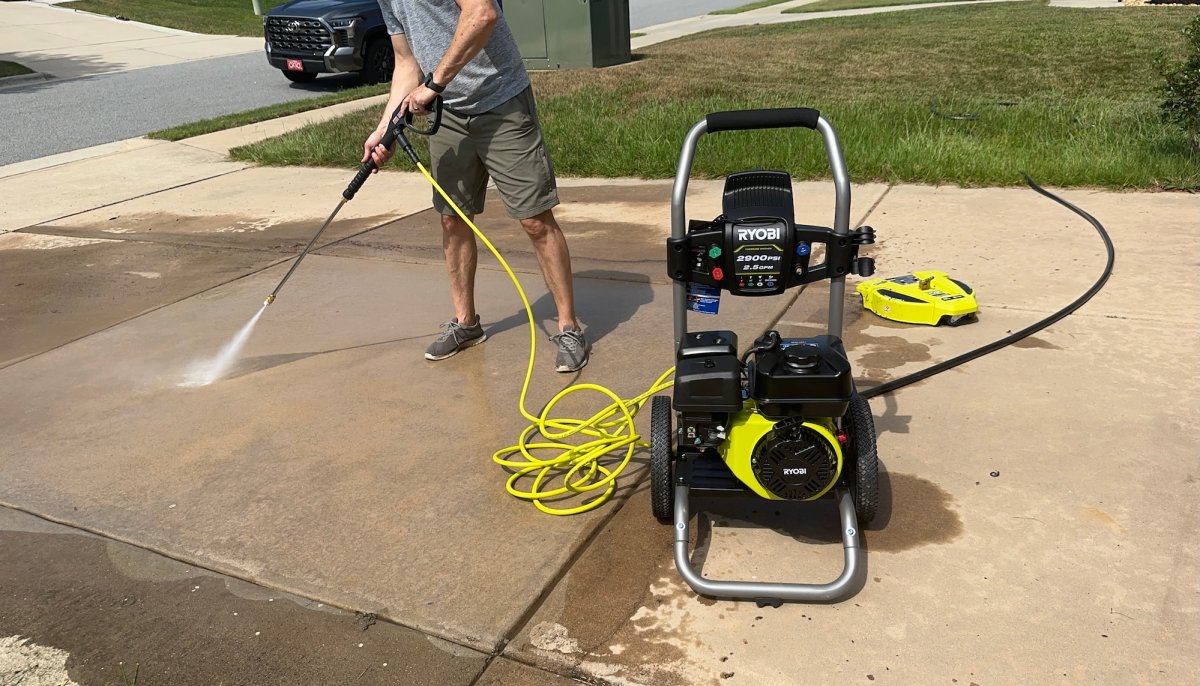
Having the right equipment on hand before you get started is key to achieving good results. The pressure washer should produce enough pressure to lift dirt but not so much that it can damage the concrete. Arms says you’ll need a pressure washer that produces at least 2,000 PSI to blast dirt off of concrete and advises going no higher than 3,000 PSI to avoid etching the concrete.
Since you’ll be covering a broad area, the pressure washer’s flow rate, which is measured in gallons per minute (GPM), is also important. The greater the water flow, the more quickly you can cover ground with the pressure washer. Arms says a machine with a flow rate of 4.0 GPM is ideal, though you can get away with as low as 2.5 GPM for smaller jobs.
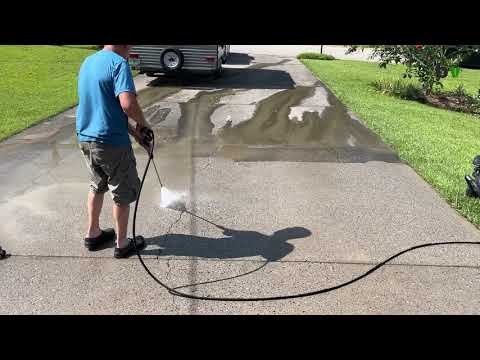
How to Pressure Wash a Driveway, 2 Ways
Step 1: Clear the driveway.
Use a leaf blower or a stiff-bristle push broom to clear away loose dirt and debris. As you’re cleaning, assess the driveway for stains. While pressure-washing does a great job of removing dirt, motor oil, algae, and other tough stains require more elbow grease. Apply degreaser or algaecide to these spots, and scrub them using a stiff-bristle brush.
Step 2: Fill the pressure washer with cleaning solution.
Fill the pressure washer soap dispenser with a cleaning solution that’s safe for concrete. While concrete may appear indestructible, it is vulnerable to chemical erosion. Opt for an alkaline-based degreaser or a peroxide-based cleaner. Alkaline is ideal for breaking down motor oil and other vehicle fluids, while peroxide works best for lifting dirt, mud, and other organic stains. Avoid using acids, such as muriatic or hydrochloric acid, which can eat away at concrete. While you can use bleach, it must be diluted to avoid discoloring and weakening the concrete.
Step 3: Attach the nozzle and apply the cleaning solution.
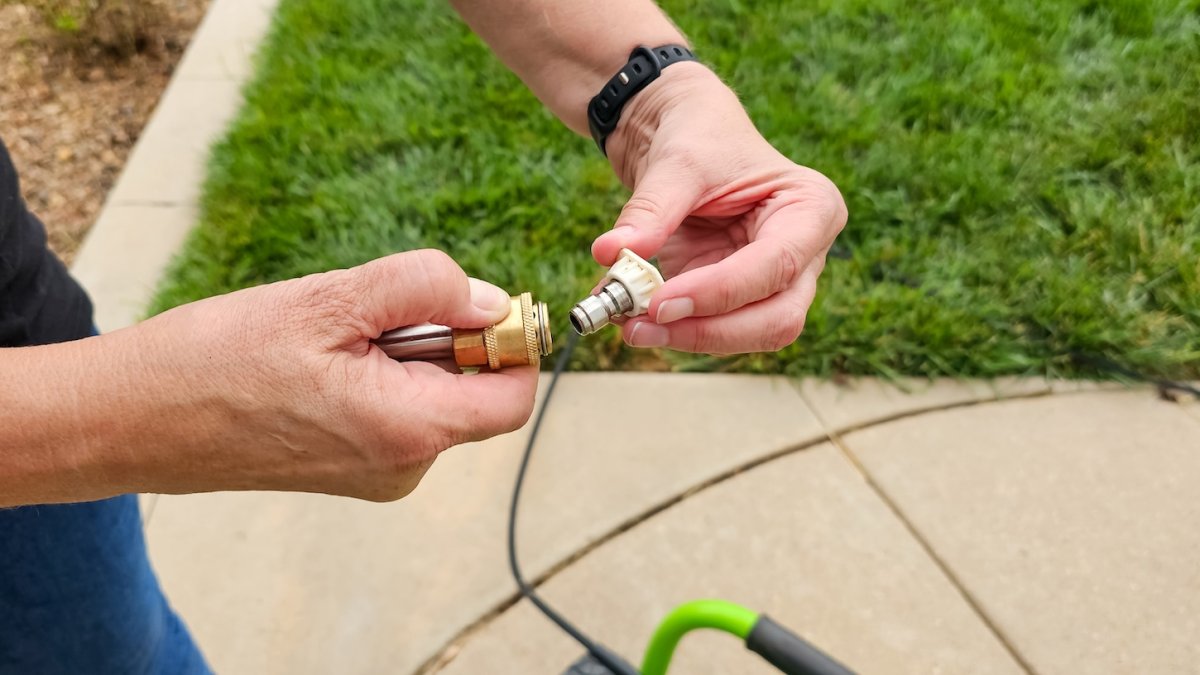
Apply the cleaner using the 65-degree low-pressure soap nozzle (the black nozzle). The nozzle lowers the pressure, triggering the pressure washer’s siphon to draw in soap. Start at the driveway’s lowest point and work your way up to avoid creating streaks. Keep the wand 12 to 18 inches from the concrete surface and sweep it back and forth in overlapping motions. Allow the soap to soak in for about 10 minutes before moving to the rinse stage.
Step 4: Pressure-wash the driveway.
Adding a surface cleaner attachment to your pressure washer is the fastest and most effective way to clean a concrete driveway, though it is possible to clean a driveway with just a pressure washer wand.
Using a Pressure Washer Surface Cleaner
A pressure washer surface cleaner is a disk-shaped attachment with spinning wands that sit underneath a deck that measures 12 to 16 inches in diameter. Using a surface cleaner has several advantages. It allows you to cover ground more quickly than you can with a wand and cleans evenly without the stripes that wands are prone to leaving. In fact, they’re so effective that you typically don’t need to pretreat the driveway with a cleaning agent (though you’ll still want to hit those stubborn oil and grease stains with a degreaser first).
- Make sure your pressure washer meets the minimum PSI requirements for the surface cleaner attachment. Smaller, 12-inch models typically require between 1,500 and 2,300 PSI with 1.4 to 2.0 GPM, while larger 15- and 16-inch surface cleaners need 2,000 to 3,000 PSI with 2.5 to 3.0 GPM.
- Remove the nozzle from the pressure washer wand and store it.
- Attach the pressure washer surface cleaner directly to the quick-connect coupling on the end of the wand. You may need to attach an extender (most surface cleaners come with one) to the wand so you can operate the pressure washer while standing upright.
- Start at the highest point on the driveway that’s closest to the house. Squeeze the trigger and begin moving the surface cleaner back and forth in overlapping motions, working toward the street. Check the driveway as you go; you may need to make more than one pass to get the surface completely clean.
- Switch back to the wand to clean expansion joints, edges, corners, and other areas you may not be able to reach with the surface cleaner.
Best Light-Duty Pressure Washer

Ryobi 2000 Whisper Electric Pressure Washer
The Ryobi 2000 pressure washer operates at a quiet 68 db and effectively cleans concrete, siding, and windows. Read the review.
See ItUsing a Pressure Washer Wand Only
- Install a 25-degree nozzle, which produces a higher pressure stream that will strip away dirt and grime without damaging the concrete. Avoid using a narrower high-pressure nozzle, which can etch the surface.
- Hold the nozzle 12 to 18 inches from the surface of the concrete. Aim the wand at a 45-degree angle to the ground so that it sweeps the dirt away.
- Start at the highest point of the driveway to push the water toward the street and the drain.
- Work in small sections using overlapping strokes while keeping the tip a consistent distance from the driveway.
Step 5: Rinse the driveway and allow it to dry.
Regardless of which method you use for cleaning, use the wand with a wide 40-degree nozzle to rinse away any dirt and detergent left on the driveway surface. Allow the concrete to dry before moving on to the next step.
Step 6: Apply a chlorine-based algaecide.
Most homeowners skip this treatment, but Arms says it’s crucial for long-lasting results. “This [step] involves applying a chlorine-based algaecide that neutralizes all organic growth and gets rid of any pressure-washing lines and keeps the concrete free from organic growth for 3 to 5 years under normal conditions,” he says.
Final Thoughts
Pressure-washing a driveway yourself isn’t a difficult job, but it does require the right equipment and a certain level of know-how to complete the task effectively without damaging the driveway surface. By doing it yourself instead of hiring a professional, you can save hundreds.
FAQ
Q. How much does it cost to pressure-wash a driveway?
If you decide to hire someone to pressure-wash your driveway, expect to pay between $100 and $500, according to Angi. The price will vary depending on the size of the driveway, with costs ranging from 30 cents to 55 cents per square foot. If you take on the job yourself, assuming you already own a pressure washer, you’ll only need to pay for cleaning fluid, which usually runs $15 to $20 per gallon.
Q. What PSI should I use to pressure-wash a driveway?
You need a pressure washer that produces between 2,000 and 3,000 PSI. Any less than that and the pressure washer won’t produce enough power to lift dirt off the concrete. Avoid using a pressure washer that produces greater than 3,000 PSI, as higher pressures can easily etch concrete.
Q. How long does it take to pressure-wash a driveway?
The time required to pressure-wash a driveway depends on the driveway’s size. It takes between 30 minutes and an hour to clean a small one- or two-car driveway, according to Philip Arms of Arms Brothers Pressure Washing in Sugar Land, Texas.