We may earn revenue from the products available on this page and participate in affiliate programs. Learn More ›
I’ve watched birds in my yard for years, and ruby-throated hummingbirds have always been a steady presence. It wasn’t until I had a chance to test the Birdfy Hum Feeder camera that I got a firsthand view of what those little birds are really like up close. Hummingbirds aren’t delicate, quiet, or passive. In fact, they’re the exact opposite: extremely vocal, fiercely territorial, and not afraid to dive-bomb anything or anyone that gets in their way. Watching them close revealed patterns and behaviors I’d completely missed before, and it changed how I think about and design my backyard hummingbird habitat.
Hummingbirds are more individual than expected.
I can’t really identify individual birds within a species. For example, all chickadees look basically the same to me, even between males and females. That holds true for most songbirds. With some exceptions in coloring by gender, they tend to look nearly identical within the species.
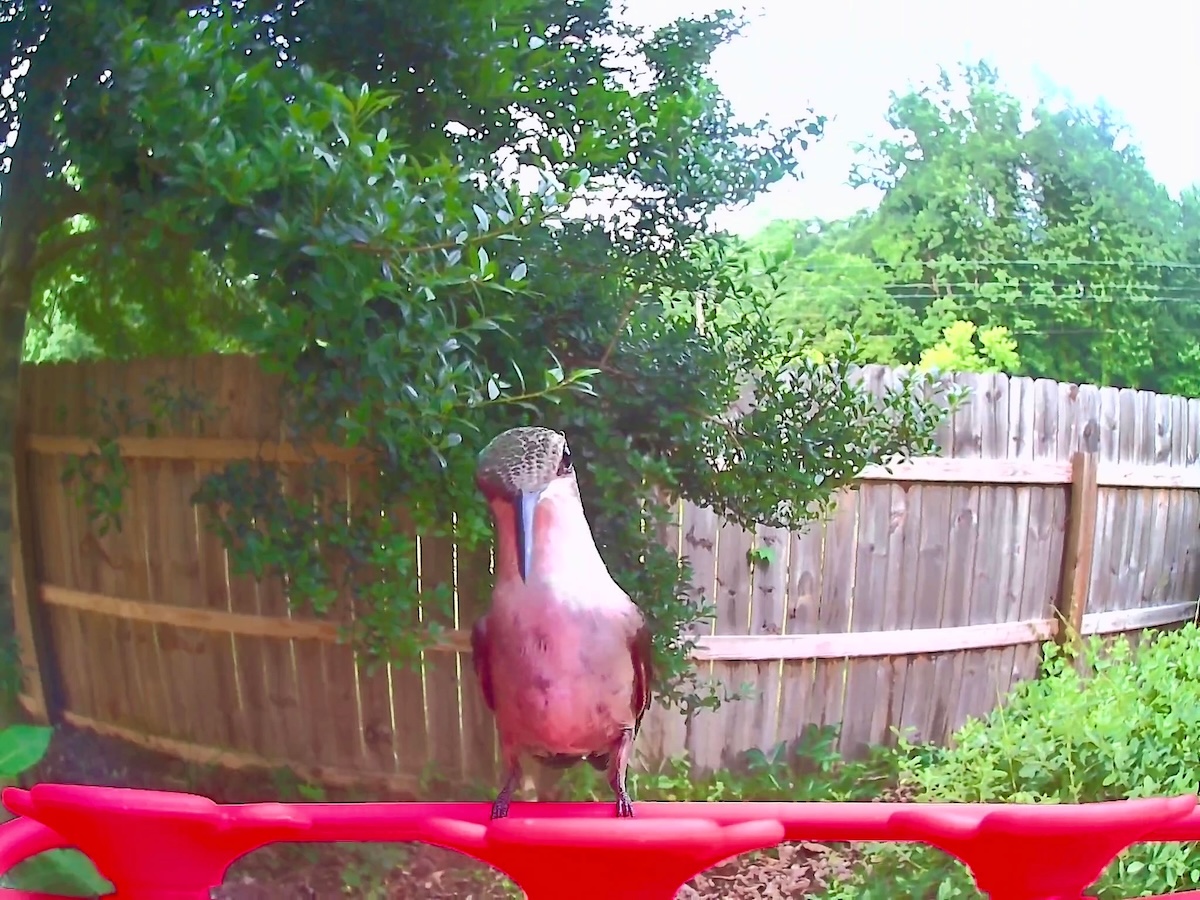
While observing ruby-throated hummingbirds, however, I noticed that each seemed to have a unique quality. There is a general difference between the male and females, with males displaying striking red gorget feathers (found on the throat or upper breast). But with my feeder camera, I was able to distinguish individual birds. Some had thin, narrow necks. Some had more slender heads. Others were more robust and thick.
There were even differences in the length of the birds’ beaks and the spacing of their eyes. In the young males, the pattern of their gorgets even varied. I also have feeder cameras for my songbirds, and I’ve never noticed differences in such detail as I have with my ruby-throated hummingbirds.
They’re more territorial than you’d expect.
Hummingbird watchers all know that these are fiercely territorial birds. They will resource-guard feeders, especially before migration. I did not know to what extent these territorial battles could go. For instance, some birds would expend a lot of energy and time just chasing other hummers from the feeder, regardless of how many ports were available.
In repeated footage from my feeder camera, these “feeder battles” played out over and over again, with one bird relentlessly guarding the feeder and driving off any others that tried to approach. Occasionally, when two birds decided to cohabit the feeder and drink, they would take breaks to squawk at each other and even do an odd bobbing motion. When I investigated this behavior, I learned it was still a form of resource guarding. Often, a single dominant bird controls the feeder, leaving little opportunity for others to feed or even get near it. Looks like bullies come in all shapes and sizes, and even species.
Hummers follow predictable feeding patterns.
Hummingbirds don’t visit feeders at random. Over time, I started to notice clear patterns in when they showed up. They begin feeding early in the morning, often right before sunrise. Activity tends to taper off in the middle of the day. By evening, traffic picks up again as they prepare for the night.
These patterns seem closely tied to energy needs and daylight cycles. After a night without feeding, the birds arrive early to refuel, and they make another push in the evening to sustain themselves until morning. The weather also plays a role. On hotter days, they appear at the feeder more often, likely needing to replenish energy more quickly. As fall migration approaches, their visits become even more frequent, as if they are stocking up for the journey ahead.
Migration happens in waves, not all at once.
One of the best things about using a feeder camera is that I can see the exact moment the hummingbirds return to my yard from their winter home, and when they leave in the fall. I always had a general sense of the timing, but the camera allowed me to pinpoint exact dates for 2 years.
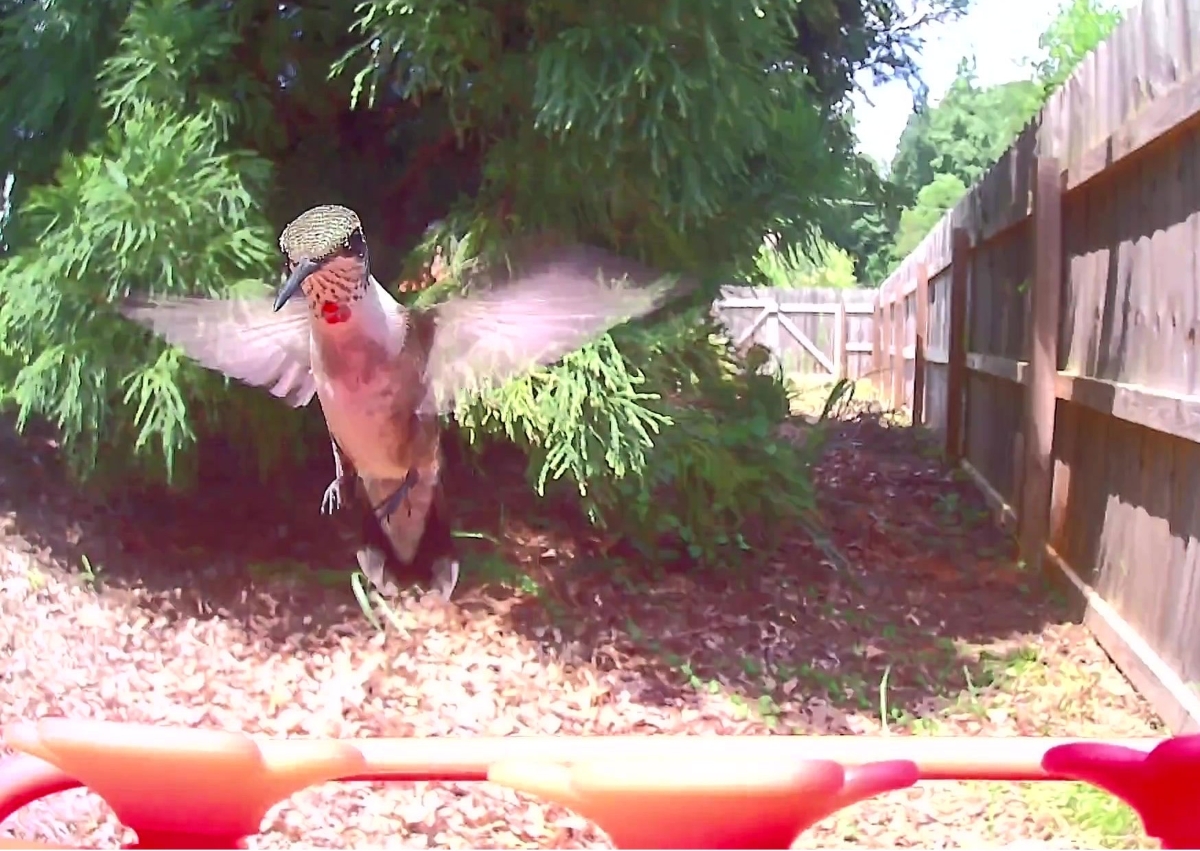
Ruby-throated hummingbirds do not all leave at the same time; they depart in waves. The adult males are the first to go, followed by the females and juvenile males. Initially, I thought all the birds in that second wave were female, but upon closer inspection, I realized some were actually young males, identifiable by their spotty gorget feathers.
Over time, I could see a gradual shift. Visits didn’t just stop, but tapered off. The feeder grew quieter day by day as fewer birds returned. The weather also affects migration. If there is a pending weather event, like a tropical storm in the Gulf during migration, I notice a sudden flurry of feeding. After the system passes, they can disappear almost overnight. Now that I know fall migration is staggered, I leave feeders up longer, since late migrants are still passing through.
Some birds become regulars.
Over time, I’ve been able to recognize repeat visitors. I can’t always identify every bird from year to year, but within a single season, I’ve been able to pick out regulars based on their size, behavior, and unique markings.
One bird in particular stood out. He was a young male who started the season with one prominent, red gorget feather and a slender build. I was able to watch his gorget fill out over the summer. He was also the first to the feeder in the morning, which suggested he was roosting nearby, likely in the large Cryptomeria tree where I placed the feeder. I named him Jake Ryan.
Over time, patterns like this became easier to spot. The same birds would return to the same perches and show up at roughly the same times each day. I loved that I wasn’t just watching hummingbirds anymore; I was recognizing individuals.
Watching hummingbirds changes how you care for them.
Now that I understand their patterns and personalities, I’m more invested in creating a sustainable hummingbird habitat they can return to year after year. I clean and refill my feeders several times a week to ensure they have fresh nectar as a reliable supplemental food source. I’ve also made an effort to support other food sources in my yard and to avoid chemical pesticides that could harm them, since hummingbirds rely on small insects as well as nectar.
Like any animal, hummingbirds need a safe environment to thrive. When they feel safe and happy, they stay. They’ve become more than just tiny, feathered visitors; they’re now part of my wildlife family.
The more you watch, the more you see.
You don’t need a camera to see these insights. Simply slowing down and paying attention to your own backyard can reveal more than you might expect. The camera helped, no doubt. But in the end, it didn’t show me anything new. It helped me see what had been there all along.