We may earn revenue from the products available on this page and participate in affiliate programs. Learn More ›
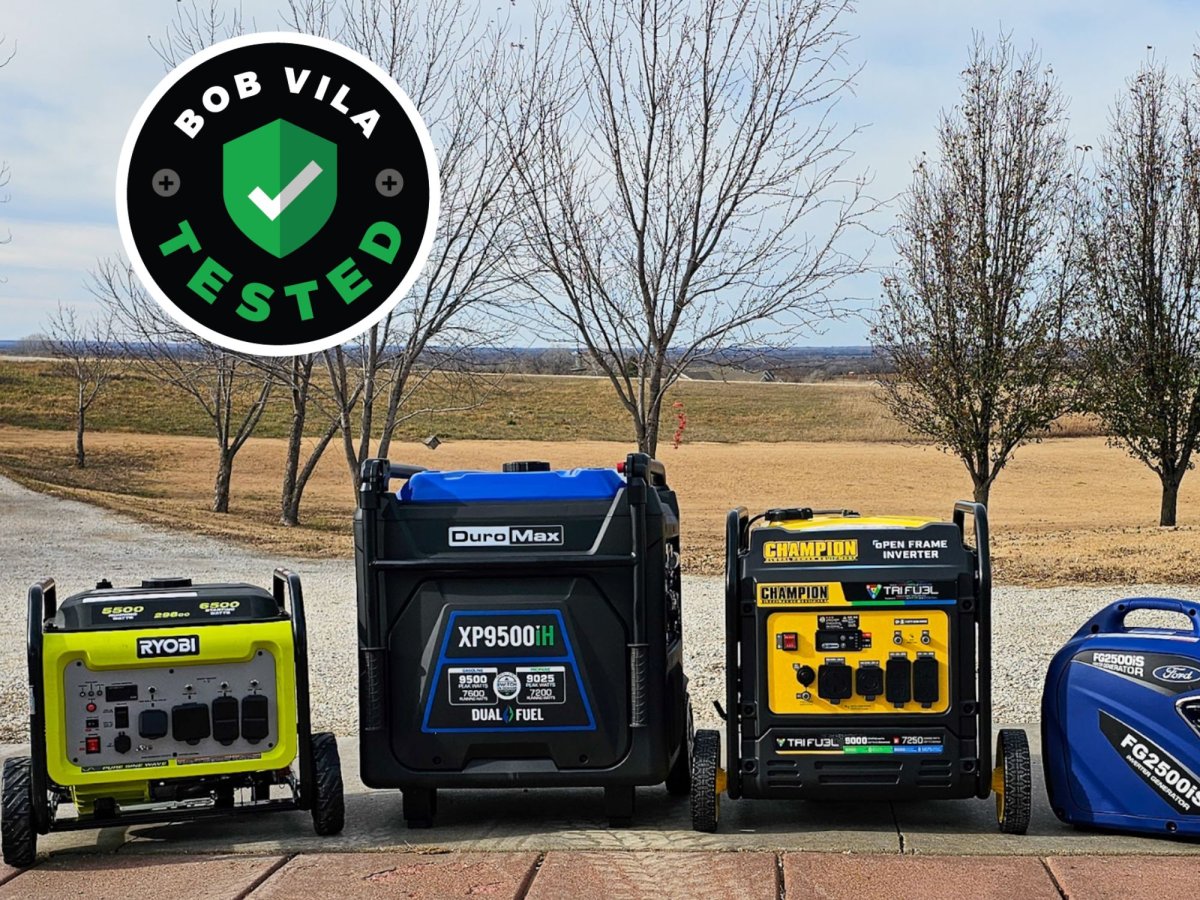
An inverter generator provides portable power for outages, job sites, RVs, and off-grid use while running more quietly and efficiently than conventional generators. To find out which models deliver the best balance of usable power, noise control, and real-world performance, we on the Bob Vila team tested 11 inverter generators at our homes, powering everything from appliances to sensitive electronics.
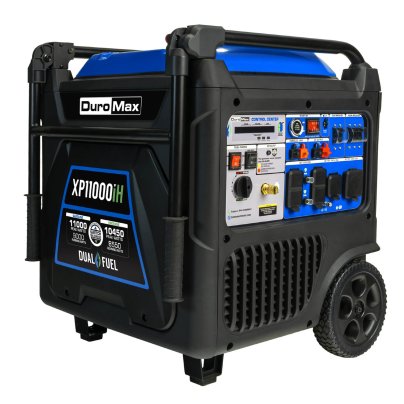
Unlike traditional open-frame generators that run at a constant speed, inverter models adjust their output based on demand, reducing fuel use and operating noise. After testing performance, portability, ease of use, and power delivery, our top overall pick was the DuroMax 11,000W Dual-Fuel Inverter Generator due to its fuel versatility and overall output, which is sufficient to power many appliances during an outage.
Ahead, we break down what separates inverter generators from traditional models and share practical shopping tips to help you choose the best inverter generators for your needs.
- BEST OVERALL: DuroMax 11,000W Dual-Fuel Inverter Generator
↓ Jump to Review - BEST BANG FOR THE BUCK: Pulsar 2,200W Dual-Fuel Quiet Inverter Generator
↓ Jump to Review - BEST LIGHT-DUTY: Ford FG2500iS Gas Inverter Generator
↓ Jump to Review - BEST GASOLINE ONLY: Ryobi 6,500W Open-Frame Gasoline Inverter Generator
↓ Jump to Review - BEST TRI-FUEL: Champion 9,000W Tri-Fuel Inverter Generator
↓ Jump to Review - BEST SMALL: Honda EU2200i Inverter Generator With CO-Minder
↓ Jump to Review - BEST BLUETOOTH: Ryobi 2300-Watt Bluetooth Inverter Generator
↓ Jump to Review
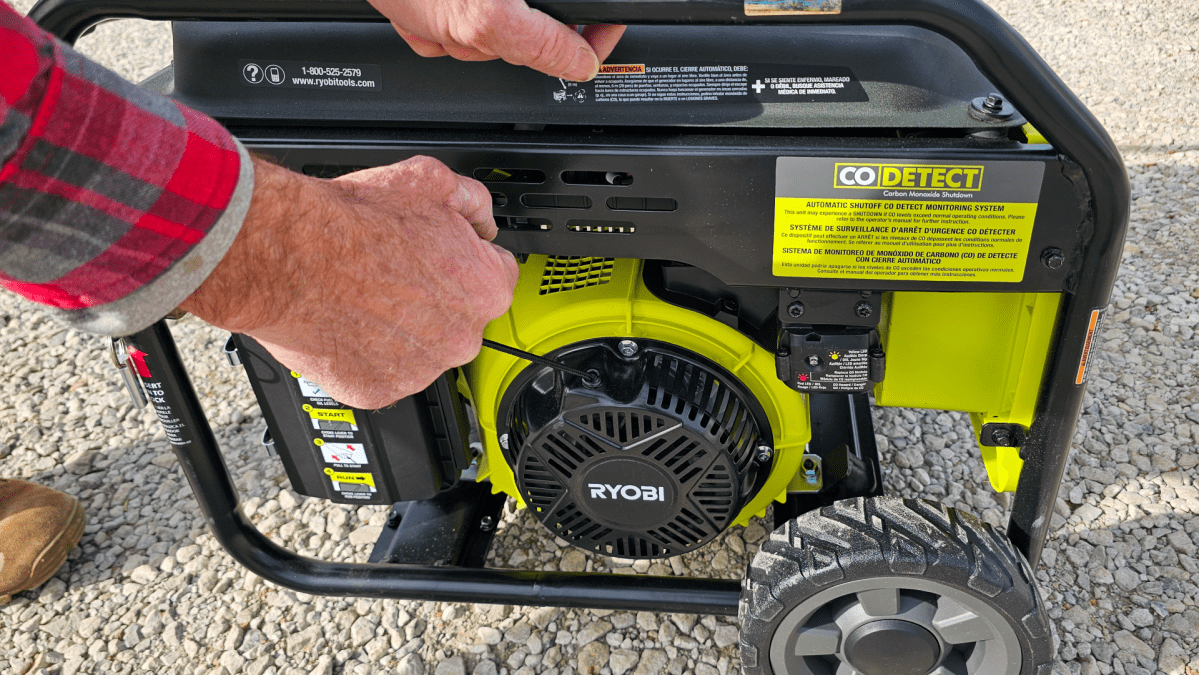
Inverter Generators Comparison
| Product | Type | Output |
|---|---|---|
| DuroMax 11,000W Dual-Fuel | Gasoline | 4,500W peak / 3,700W running |
| Pulsar 2,200W Dual-Fuel | Gas/propane | 2,200W peak / 1,800W running |
| Ford FG2500iS Gas | Gasoline | 2,500W peak / 2,200W running |
| Ryobi 6500W Gasoline | Gasoline | 6,500W peak / 5,500W running |
| Champion 9000W Tri-Fuel | Gas/propane/natural gas | 9,000W peak / 7,250W running |
| Honda EU2200i | Gasoline | 2,200W peak / 1,800W running |
| Ryobi 2,300W Gas | Gasoline | 2,300W peak / 1,800W running |
Our Top Picks
The following inverter generators represent some of the best generators currently available. Each one earned its spot by performing well in our hands-on tests. Whatever your power needs may be, there’s likely to be a generator on this list that’ll hit the mark.
Best Overall
Photo: The Home Depot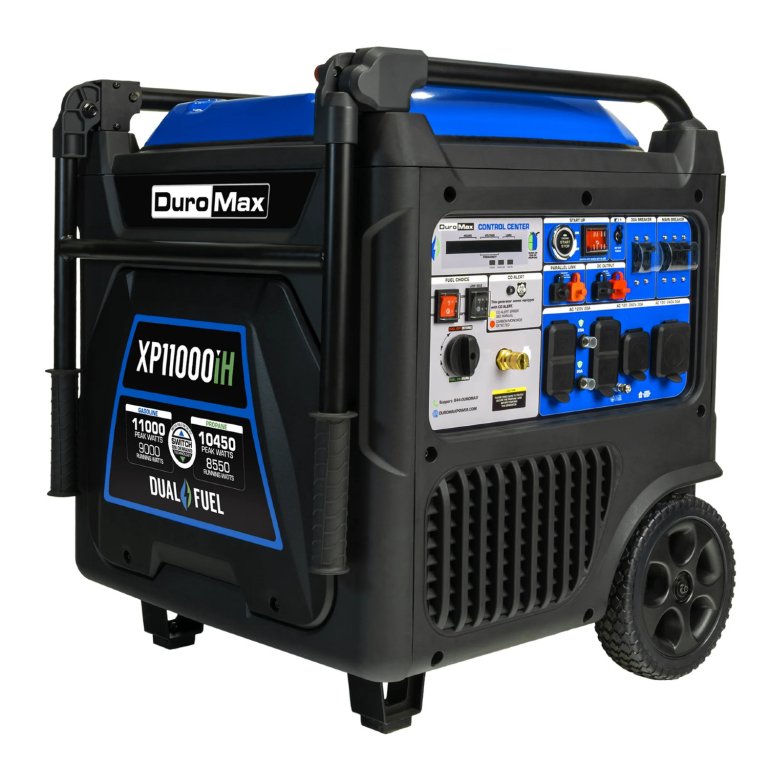
What We Like
- Very high output
- Large inverter generator
- Runs on propane or gas
- Electric start convenience
What We Don’t Like
- Large and heavy footprint
- Not easily portable
Product Specs
- Wattage: 11,000W peak / 9,000W running (gasolone); 10,450W peak / 8,550W running (propane)
- Fuel: Gasoline or propane
- Outlets/ports: 4×120 V, 1×120/240 V 30A, 1×120/240 V 50A, 1×120V 30A (RV-ready), USB-A
- Weight: 226 pounds
Our Ratings: Ease of Use 5/5; Noise 4.5/5; Portability 4/5; Power 4.5/5; Value 4.8/5
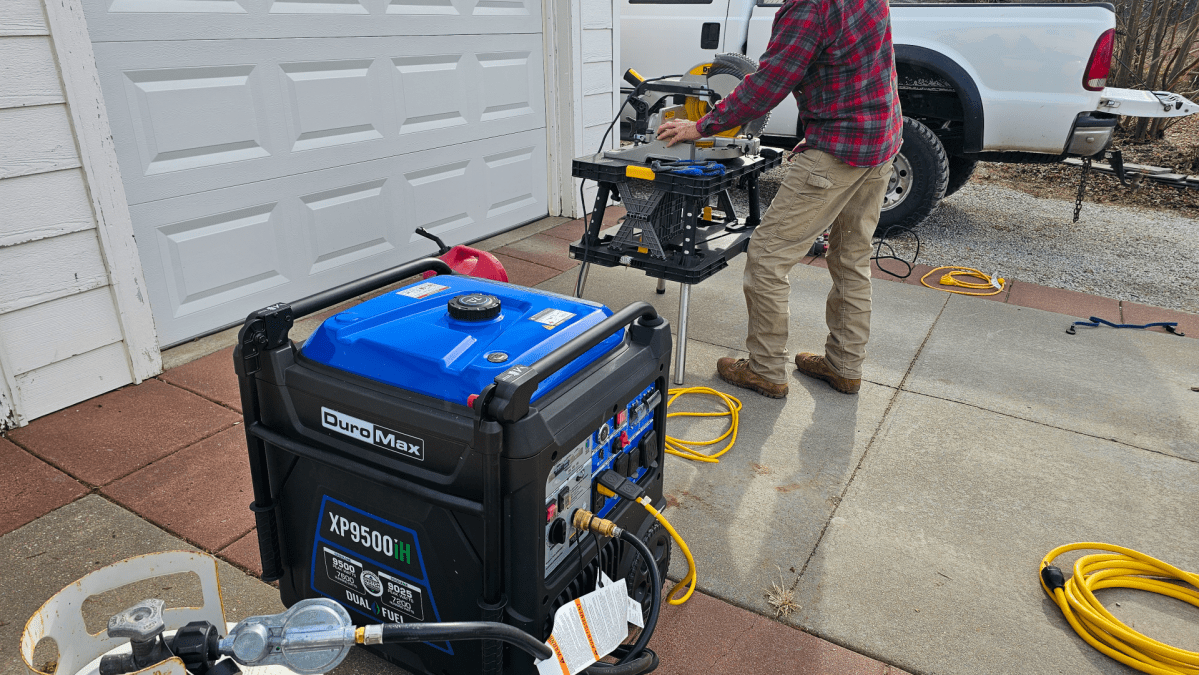
The DuroMax XP11000iH is built for homeowners who want inverter-quiet power without sacrificing capacity. Capable of reaching up to 9,000 running watts on gasoline, we found it able to support large appliances and multiple power tools, all while it also provided safe, stable power to our electronics.
In operation, the generator is quieter than conventional models of similar size, and when we were powering a light load, it was easy to carry on a conversation without raising our voices. Dual-fuel capability adds flexibility, too; this feature allowed us to switch to propane with a mere flip of a switch. Features like electric start and integrated CO alert make day-to-day operation more manageable and add a measure of safety.
At 226 pounds, this is not a portable inverter in the traditional sense, but if you’re looking for whole-home backup power with lower noise and cleaner output, the DuroMax is a serious alternative to traditional standby-style generators.
Get the DuroMax inverter generator at The Home Depot, Lowe’s, or DuroMax.
Best Bang for the Buck
Photo: Amazon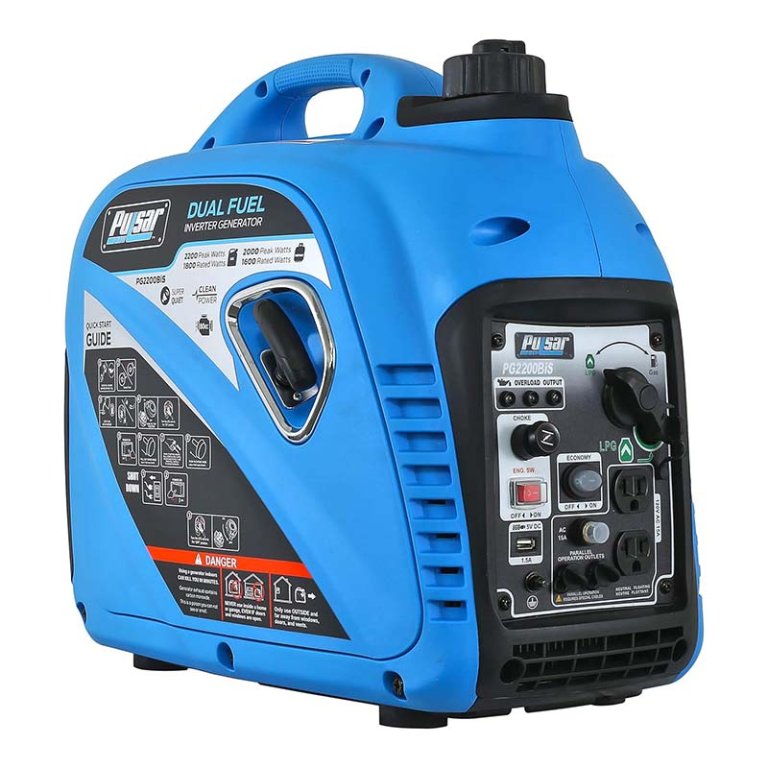
What We Like
- Light enough to move around without strain
- Easy to set up and get the engine running
- Ability to run on either propane or gasoline increases versatility
What We Don’t Like
- Access panel is difficult to remove
- Changing oil required tipping the generator
Product Specs
- Wattage: Gasoline: 2,200 peak watts and 1,800 running watts; propane: 2,000 peak watts and 1,600 running watts
- Fuel: Gasoline or propane
- Outlets/ports: Two 120V-15A AC outlets; 1 USB-A port
- Weight: 46.5 pounds
Our Ratings: Ease of Use 4/5; Noise 4/5; Portability 5/5; Power 4.5/5; Value 4.5/5
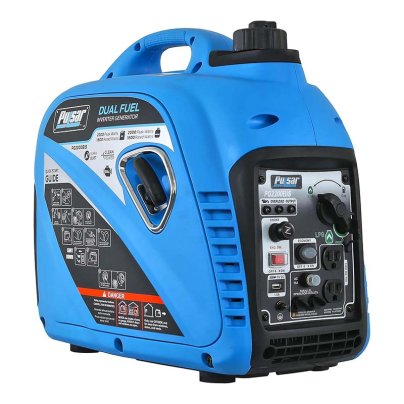
The Pulsar 2,200-watt inverter generator is a great option for powering small tools and devices at home or on the jobsite. The generator uses gasoline or propane and supplies up to 1,800 running watts with gas and 1,600 with propane.
During our tests, we found the initial setup of the generator to be easy, except for filling the oil for the first time. The fill port sits under a side panel we had to remove to gain access. Unscrewing the panel was easy enough, but it took some fussing to get it to pop off completely. After that, filling it up with the supplied Pulsar-brand oil was straightforward.
The engine’s recoil start requires just a couple of pulls before the engine, using gas, kicks on with 2,200 watts of startup power. To test the generator’s capabilities, we ran a couple of heat guns and hair dryers simultaneously, using different combinations of high and low settings to test it at different loads. We found the generator easily handled the necessary output, but it seemed to produce more than the advertised 59 decibels, which is about the level of conversation. The Pulsar sounded a bit louder, more like a vacuum, though that’s about the sound level we’d expect from a generator of its size anyway.
Despite the higher-than-advertised decibel level, we like this generator for light-duty needs, such as small DIY projects and powering a couple of household appliances during an outage.
Get the Pulsar inverter generator at Amazon or Walmart.
Best Light-Duty
Photo: Amazon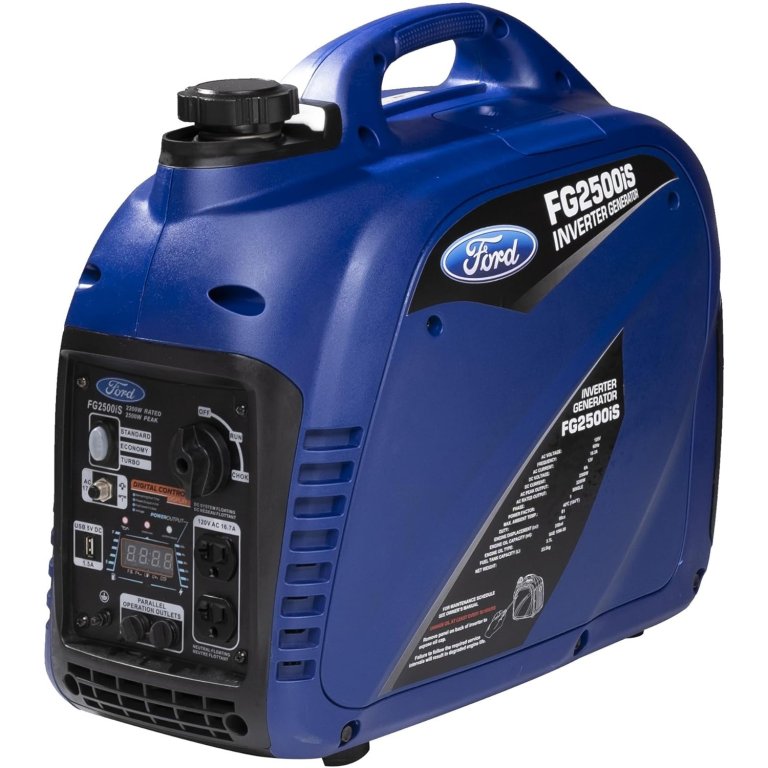
What We Like
- Very quiet operation
- Easy one-person portability
- Small inverter generator
- Good for powering electronics
What We Don’t Like
- Limited power output
- Recoil start only
Product Specs
- Wattage: 2,500W peak / 2,200W running
- Fuel: Gasoline
- Outlets/ports: 2×120V 20A, 1 12V DC, 1 5V USB-A port
- Weight: 48.5 pounds
Our Ratings: Ease of Use 4.3/5; Noise 4/5; Portability 4.5/5; Power 4/5; Value 4/5
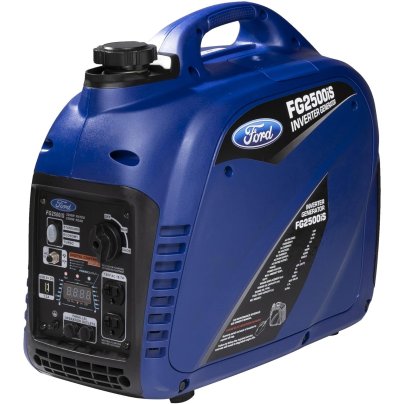
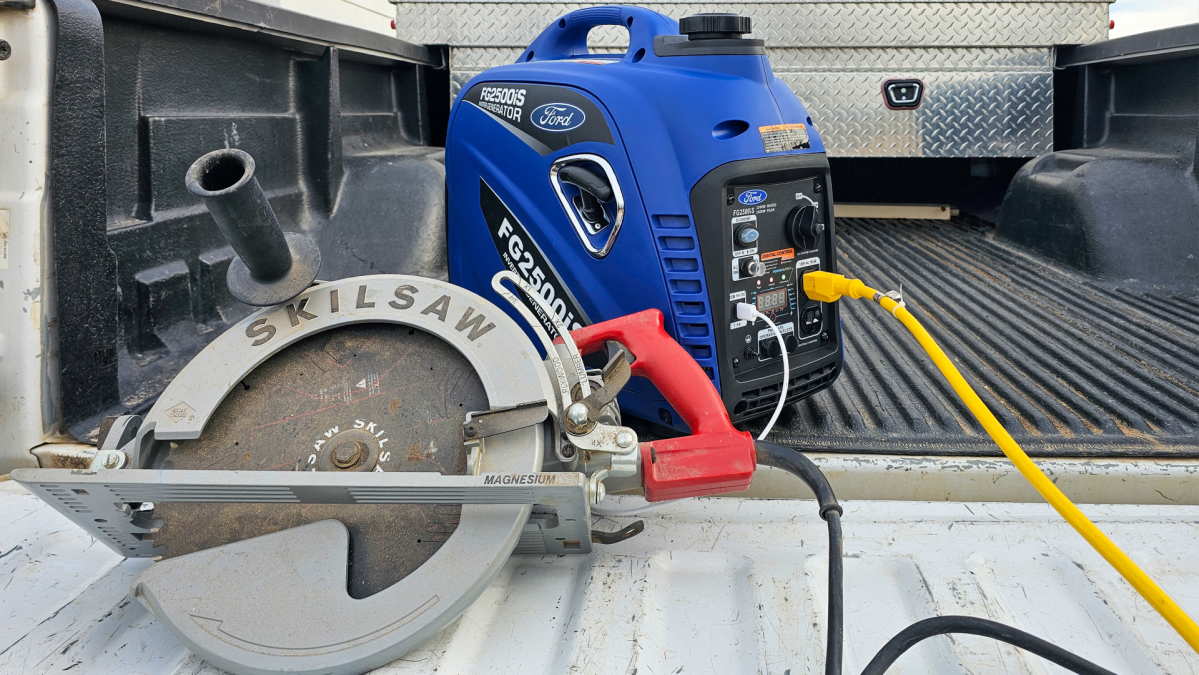
This inverter generator from Ford is a lightweight, low-noise option designed for small but essential power needs. With 2,200 running watts, it’s best suited for charging electronics, running lights, or powering a few small appliances during short outages or off-grid use. At just 48.5 pounds, we found it simple for one person to lift and transport without help.
In operation, the generator ran noticeably quieter than traditional open-frame models, and thanks to its portability, we think it would be a good fit for camping, tailgating, or close-to-home use where noise is a concern. The inverter technology delivers stable power that’s safe for sensitive electronics, and the unit is parallel-capable for users who want the option to scale up later.
This Ford inverter generator isn’t built for heavy loads, but for portable, everyday backup power, it delivers solid performance in a compact package. We had no problem with its recoil start—it started up every time in three pulls or less.
Get the Ford inverter generator at Amazon, Walmart, or Autozone.
Best Gasoline Only
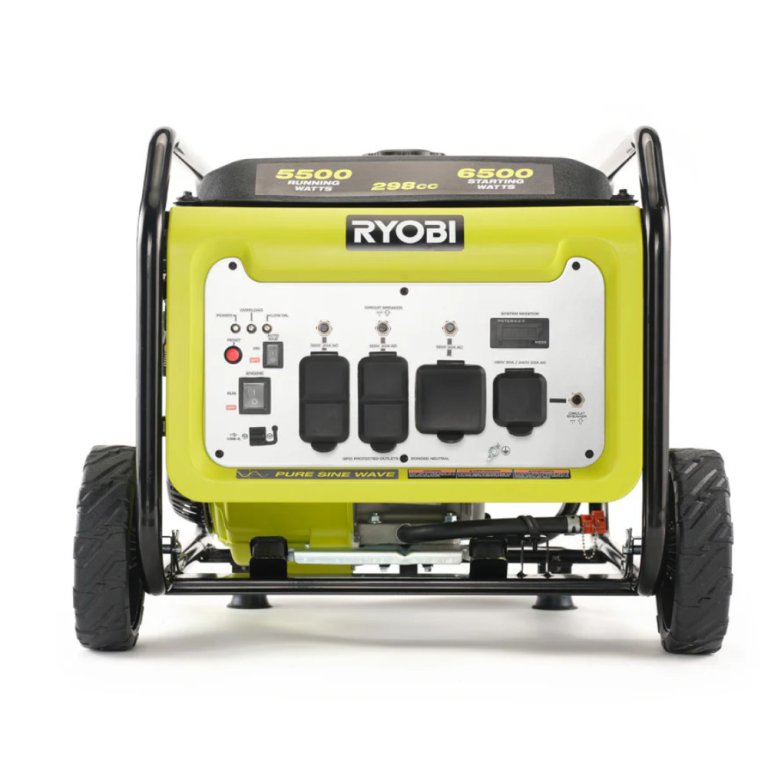
Ryobi 6,500W Open-Frame Gasoline Inverter Generator
Buy at The Home DepotWhat We Like
- Strong power output
- Quieter than conventional generators
- CO shutdown adds safety
What We Don’t Like
- Heavy for solo transport
- Runs on gasoline only
Product Specs
- Wattage: 6,500W peak / 5,500W running
- Fuel: Gasoline
- Outlets/ports: 4×120 V, 1×120/240 V 30A, 1×120V 30A (RV-ready), 1 USB-A port
- Weight: 118 pounds
Our Ratings: Ease of Use 4/5; Noise 4/5; Portability 4/5; Power 4/5; Value 4.5/5
The Ryobi 6,500-watt inverter generator bridges the gap between portable inverters and full-size home backup units. With its 5,500 running watts, it had enough capacity to power multiple devices, plus larger power tools, while still delivering the stable output we expected from inverter technology.
In use, the generator ran noticeably quieter than traditional open-frame models, especially at partial loads. We found it very stable—where other units might suffer a noticeable power drop upon initially powering up a plugged-in tool, that did not happen with the Ryobi. The idle-down feature helps reduce fuel consumption when demand drops, and the CO shutdown system adds an important layer of safety for home use.
At just under 120 pounds, this isn’t a grab-and-go generator, but the built-in wheel kit made it more manageable to reposition around the garage and driveway. For homeowners who want substantial power without the noise and voltage fluctuations of a conventional generator, this Ryobi inverter offers a well-balanced solution.
Get the Ryobi inverter generator at The Home Depot.
Best Tri-Fuel
Photo: Amazon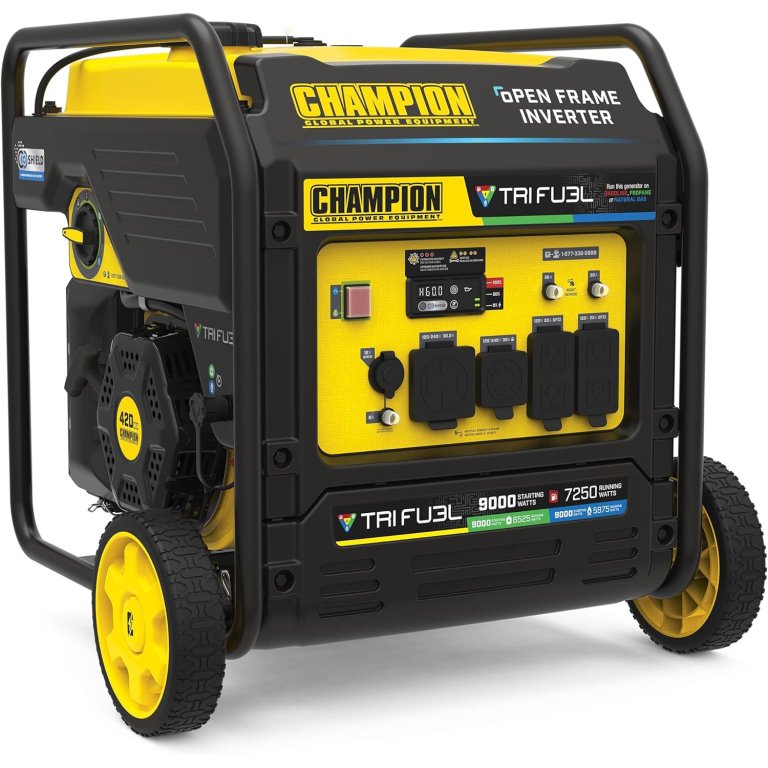
What We Like
- Tri-fuel flexibility
- High output for an inverter model
- Electric start included
What We Don’t Like
- Louder than enclosed inverters
- Heavy to reposition
Product Specs
- Wattage: 9,000W peak / 7,250 W running (gasoline); 9,000W peak / 6,525W running (propane); 9,000W peak / 5,875W running (natural gas)
- Fuel: Gasoline, propane, or natural gas
- Outlets/ports: 2×120 V 20A GFCI, 12V DC, 1×120/240 V 30A, 1×120/240 V 50A
- Weight: 165.8 pounds
Our Ratings: Ease of Use 4/5; Noise 4/5; Portability 4.5/5; Power 4.5/5; Value 4.8/5
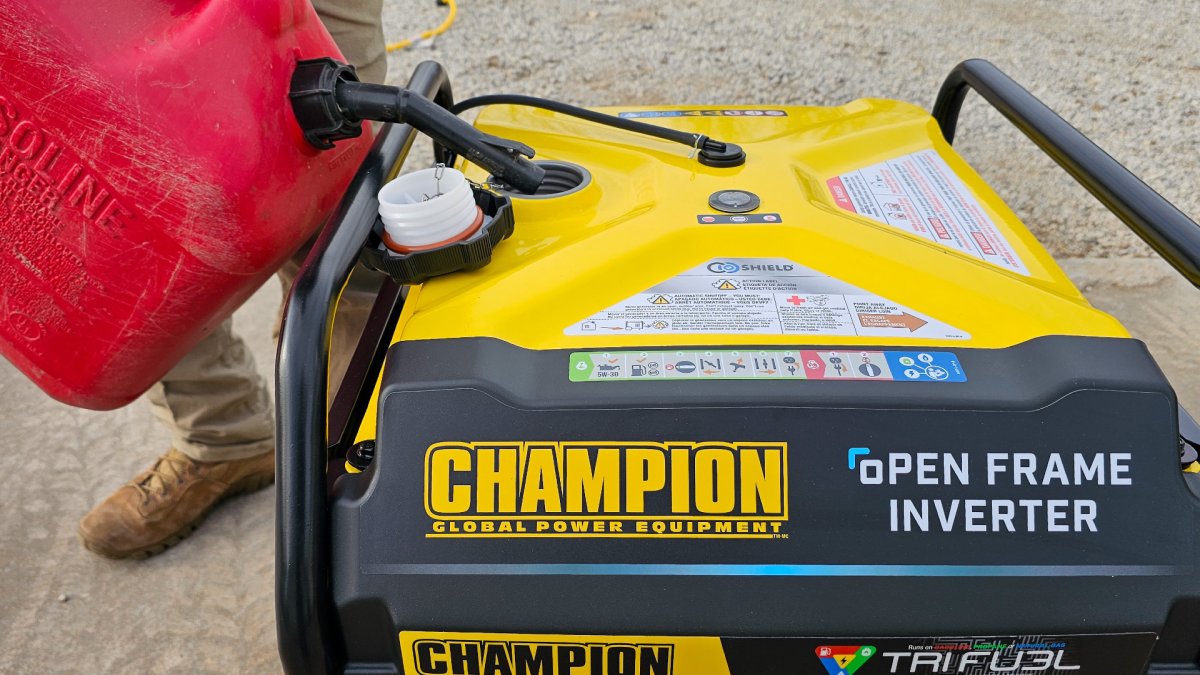
The Champion 9,000-watt tri-fuel inverter generator offers uncommon versatility from a high-output inverter platform. With the ability to run on gasoline, propane, or natural gas, it gave us multiple fueling options—the type of flexibility that would be especially useful during long outages or when fuel availability is limited.
Despite its open-frame design, the generator delivers quieter power than conventional models. We found the noise quite tolerable, though it’s not as hushed as the fully enclosed inverter units we tested. Features like electric start and CO Shield add convenience and safety for residential use.
At 165.8 pounds, this generator is best suited for semi-permanent placement rather than frequent transport. For users who value fuel flexibility and inverter-quality power in a high-capacity backup generator, Champion’s multi-fuel generator is a compelling option. If you plan to use it as a natural gas inverter generator, a plumber should connect the gas line.
Get the Champion inverter generator at Lowe’s, The Home Depot, or Amazon.
Best Small
Photo: Amazon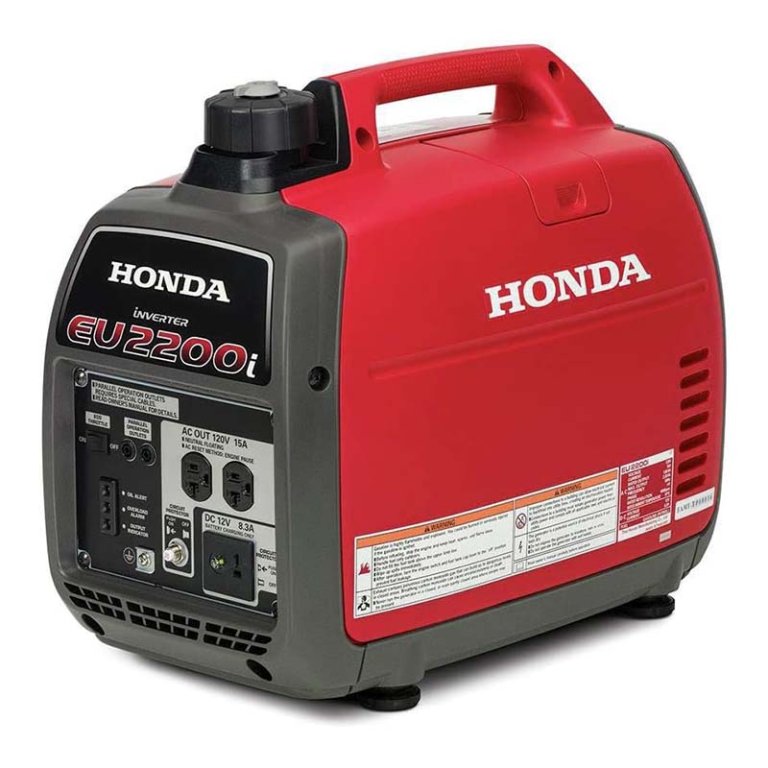
What We Like
- Lightweight and compact
- Whisper-quiet operation
- Compatible with the Honda My Generator app
- CO-Minder advanced carbon monoxide detection
What We Don’t Like
- Premium price point for less output
- Not equipped with USB ports
Product Specs
- Wattage: 2,200 peak watts and 1,800 running watts
- Fuel: Gasoline
- Outlets/ports: Two 125V-20A outlets
- Weight: 47.4 pounds
Our Ratings: Ease of Use 5/5; Noise 4/5; Portability 4/5; Power 5/5; Value 4/5
The Honda EU2200i inverter generator features a Honda GXR120 commercial series 121 cubic centimeter engine with a recoil starter. It generates 120 volts; up to 1,800 running watts (15A); and 2,200 peak watts. Its 0.95-gallon gas tank provides up to 3.2 hours on maximum draw or up to 8.1 hours with a 25 percent output load. This compact, quiet generator is convenient for tailgating, camping, and other remote power needs.
The Honda’s lightweight, compact build made it comfortably portable. The top handle and suitcase-like shape were good for one-handed transport. At about 48 pounds, we wouldn’t want to carry it all day, but moving it from the shed to the truck was no problem. Roller wheels would have been a nice addition. Frequent users could purchase a collapsible hand truck for easier mobility.
The simple output configuration of just one 15A 120V duplex outlet allowed us to use it like any household wall socket without worrying about overloading it. We powered a portable table saw and miter saw on one project, then a refrigerator (alone) for a few hours to see how it would respond. Everything worked perfectly. Since it doesn’t have USB ports, you’ll need a wall hub or power strip to charge devices or power up small electronics.
Get the Honda inverter generator at Amazon, Lowe’s, The Home Depot, or Northern Tool + Equipment.
Best Bluetooth
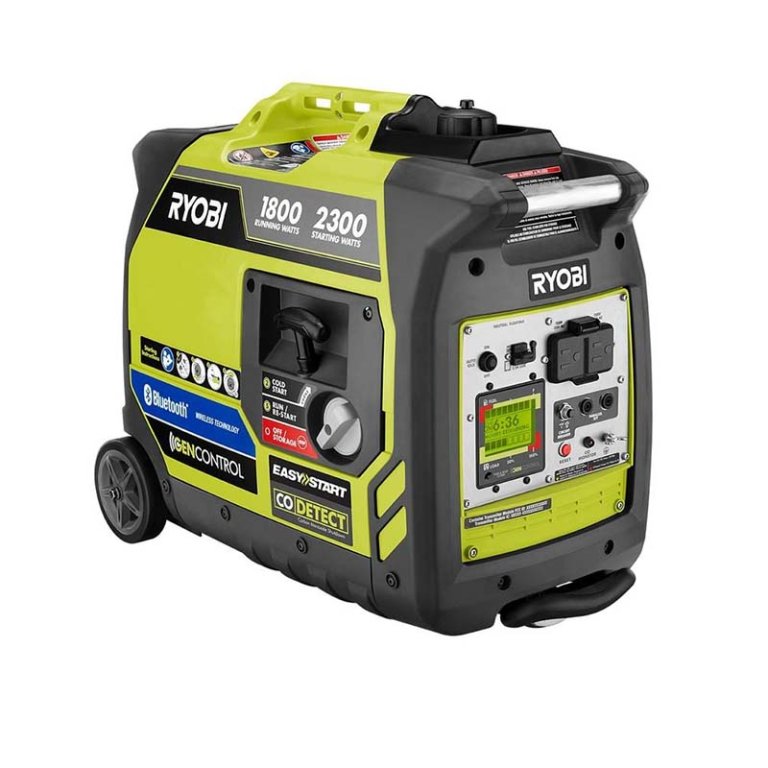
Ryobi 2300-Watt Bluetooth Inverter Generator
Buy at The Home DepotWhat We Like
- Fast and easy to assemble
- Monitoring via Bluetooth technology
- Powers tools, appliances, and digital devices
What We Don’t Like
- Not suitable for powering wattage-hungry appliances
Product Specs
- Wattage: 2,300 peak watts and 1,800 running watts
- Fuel: Gasoline
- Outlets/ports: Two 120V-20A outlets; 2 USB-A ports
- Weight: 52 pounds
Our Ratings: Ease of Use 5/5; Noise 4/5; Portability 4/5; Power 4/5; Value 5/5
The Ryobi 2,300-watt gas generator was a pleasure to test. Unboxing to startup took under 10 minutes, and the app walks users through the process while showing the same readings as the machine’s LED panel.
For our tests, we plugged in several work lights and used various power tools, including a circular saw, a reciprocating saw, a jigsaw, a hammer drill, and a sander. The Ryobi lagged a bit when we tried to run a table saw, and it didn’t provide enough juice for a heated t-shirt press, but otherwise, it met our needs.
We liked the convenience of being able to monitor the status of the Ryobi while sitting comfortably indoors. We were able to shut down the generator from the app but not start it, which is probably a smart idea in terms of safety.
The Ryobi is relatively quiet, registering 57 decibels from 10 feet away, and we could converse easily without raising our voices. This little generator would be an excellent pick for craft festivals and tailgating excursions. It won’t power a jobsite or all appliances in a home, but it’s perfect for smaller-power uses.
Get the Ryobi inverter generator at The Home Depot.
Jump to Our Top Picks
How We Tested the Best Inverter Generators
| Products tested | 11 |
| Time spent testing | 61 hours |
| Tests performed | 5 |
| Price range | $300 to $2,500 |
We researched over 25 different makes and models of quiet inverter generators before selecting 11 top options for testing. When compiling this list, we considered top generator brands like Champion and Honda since they’re well respected in the generator industry. However, we didn’t automatically cut machines from smaller companies if they had good features and high customer satisfaction ratings.
For our real-life tests, we assembled the generators and followed the manufacturer’s instructions for fueling and operation. We tried to max out each generator, estimating how many items we could plug in using an online wattage calculator. We powered tools, appliances, heaters, mini AC units, and more, noting how to use the generators and how much noise they emitted when running.
After testing, we awarded points to each inverter generator using a rubric. We assigned them ratings for ease of use, noise, power, portability, and value.
| Product | Ease of Use | Noise | Portability | Power | Value |
|---|---|---|---|---|---|
| DuroMax 11,000 Dual-Fuel | 5 | 4 | 4 | 4.5 | 4.5 |
| Pulsar 2,200W Dual-Fuel | 4 | 4 | 5 | 4.5 | 4.5 |
| Ford FG2500iS Gas | 4.3 | 4 | 4.5 | 4 | 4 |
| Ryobi 6,500W Gasoline | 4 | 4 | 4 | 4 | 4.5 |
| Champion 9,000W Tri-Fuel | 4 | 4 | 4.5 | 4.5 | 4.8 |
| Honda EU2200i | 5 | 4 | 4 | 5 | 4 |
| Ryobi 2300-Watt Bluetooth | 5 | 4 | 4 | 4 | 5 |
What to Consider When Choosing an Inverter Generator
Inverter generators are a different breed than the open-framed conventional generators most people are familiar with. While both use fuel (gasoline, diesel, or propane), open-frame generators use an alternator to produce usable power for homes, campers, and jobsites. The info below will help narrow down the options to find the best generator deals on units with the power, portability, and convenience you need.
Wattage
Wattage is a critical factor in any generator specification. Inverter generators, like their open-framed counterparts, come in different wattage ratings. The higher the wattage rating, the higher the power output. Higher wattages usually mean larger, more expensive units, so here’s a guide to choosing the right size for a range of needs:
- Light-duty (tent camping, tailgating, etc.): 2,000 to 3,000 watts
- Medium-duty (RV camping, emergency home use, jobsite, etc.): 3,000 to 4,500 watts
- Heavy-duty (powering an entire home, powering a welder, etc.): 4,500+ watts
A compact, portable generator for house use may be feasible for powering a radio or a small refrigerator. However, low-wattage models may offer less flexibility for plugging in other devices. Keep in mind that an inverter generator only supplies as much power as necessary. It doesn’t generate energy if it’s not being pulled, making this generator more of a clean power source.
Fuel Type and Capacity
Inverter generators typically use gasoline as a fuel source, but dual-fuel generators can run on propane as well. This is a big advantage, as it allows owners to choose the fuel used based on their needs, such as power-output requirements, fuel availability in the area, and the fuel type currently on hand.
Inverter generators have an isolated gasoline tank with a fuel capacity that ranges from as small as 2 gallons to more than 10 gallons. The larger the fuel tank is on the generator, the longer it can provide gasoline-based power. However, the size of the generator also increases.
Fuel capacity does not affect how much propane can be used with the generator. Propane gas is stored under pressure in canisters, which attach to the generator with a hose and pressure regulator for direct fuel consumption.
Recoil vs. Electric Start
Inverter generators feature an electric start switch, recoil cord, or both ignition methods:
- Electric start: Generators with an electric start store extra electricity in an internal battery, which starts up the device automatically. Users simply flip a switch or press a button to start the generator.
This ignition method is much easier than using a recoil cord, but it requires stored electricity in the generator. If you make generator mistakes, like not charging the internal battery, the electric start cannot be used.
- Recoil cord: Recoil cords are an old but reliable technology used in many fuel-powered tools. This startup method requires a quick and steady pull on the recoil cord to kickstart the engine. While it will take some effort and possibly more than a few pulls, there’s no reliance on electricity.
Using a recoil cord, a power generator with inverter capability can be started anytime, even after long-term storage in the garage or shed.
Load Sharing
Purchasing a set of like-branded generators will often allow them to be wired in parallel, also known as load sharing. This means that one generator can be plugged into another using a brand-specific kit. This safely combines their wattages to produce even more power.
Additionally, owning two generators provides a fail-safe if one stops working. There is still the ability to produce power, just at a lesser output. Load sharing can be a less expensive way to produce enough wattage to run a whole house or power everything in an RV at once.
Noise Level
The most noticeable difference between inverters and open-framed generators is the amount of noise they produce.
- Open-framed generators are unrefined and loud, producing decibel levels exceeding the 100-decibel mark.
- Inverter generators are roughly half as noisy as open-framed models, often in the 50- to 60-decibel range.
To better understand generator noise output, consider these common sounds and their equivalent operating decibel level:
- Refrigerator: 40 decibels
- Hair dryer: 90 decibels
- Motorcycle: 100 decibels
Inverter generators also use sensors to detect how much power they need to expend, throttling down for smaller loads and producing lower noise levels. Neighbors at home or in a campground will appreciate a quiet generator rather than a noisy, open-framed model.
Size and Weight
Physical size and weight will be a factor for some shoppers. As the name suggests, suitcase inverter generators are top-handled units that can be picked up with one hand and carried easily, as they’re typically lightweight at about 40 to 50 pounds. The drawback is that these units usually have a power output of 2,200 watts or less.
Wheeled units provide much more power (3,000+ watts) but are large and heavy. These portable generators are more challenging to throw in the bed of a truck or a camper’s storage compartment. As such, using one of these units as a home generator may be easier.
Wheel Kit
Some users may struggle with the weight of larger, more powerful units. Thus, some portable inverter generators have wheels and handles for easier transport to desired locations.
Wheel kits may also be sold separately as an addition to a generator or a replacement for an older wheel kit. Either way, having a wheel kit will make transporting heavy portable generators much easier.
FAQs
Looking for more information on inverter generators? Consider these answers to some of the most frequently asked questions about this particular type of generator.
Inverters take DC power created by a gas or propane generator and convert it to AC power for household appliances.
While conventional generators rely on large alternators to produce raw AC power, inverter generators use a specialized alternator and a digital inverter board to refine that power into a stable current safe for electronics. The large alternators used in conventional generators require the engine to work harder and produce more heat, too, which generates a lot of noise, while inverter generator engines are quieter. In addition, manufacturers can enclose them in a plastic housing for even better noise control, without the risk of overheating.
Yes, in general, inverter generators are easier to use, more efficient, and produce safer electricity for electronics. For those reasons alone, many users might find them worth it. To help protect your investment, it’s also worth purchasing a generator cover.
Yes, most inverter generators will have no problem running a modern refrigerator, which only needs 1,000 watts maximum at startup.
Most inverter generators last 2,000 to 3,000 hours with proper maintenance, clean fuel, and regular oil changes.
Many inverter generators can run 8 to 18 hours on a full tank, depending on load, fuel capacity, and efficiency mode.
Inverter generators should be placed at least 20 feet from a house, with exhaust directed away from doors and windows.
No, inverter generators generally require similar maintenance, including oil changes and air filter checks, but benefit from cleaner operation and reduced engine strain.
Meet the Testers
Glenda Taylor is a contractor, product tester, and writer focusing primarily on construction and power tools. She tests a wide range of power tools as well as other home improvement, household, and lawn-and-garden products.
Mark Wolfe is a writer and product tester, focused on mechanical durability and user convenience. As a green industry veteran and an avid DIYer, he has gained valuable insight on choosing dependable power equipment and avoiding poor-quality machinery.
Additional testing performed by Corey Foster, Austin Fracchia, Becky Helzer, Michelle Larson, and Zach Lazzari. The Bob Vila test team is made up of contractors, remodelers, home design enthusiasts, and freelancers. Each member is dedicated to delivering high-quality product information to our readers so they can shop with confidence, knowing the products they purchase have been fully tested and vetted.
Additional research provided by Tom Scalisi.