

We may earn revenue from the products available on this page and participate in affiliate programs. Learn More ›
A gas garage heater is one of the most effective ways to make cold-weather garage time more bearable, whether you’re tackling weekend projects, maintaining vehicles, or powering through repairs that can’t wait for spring. We tested several garage heaters in real-world conditions to see which models actually deliver reliable warmth when temperatures drop, even in spaces that are tough to heat.
Finding a quality gas garage heater matters because garages are notoriously drafty and poorly insulated. A weak or poorly designed heater can struggle to warm the space, burn through fuel inefficiently, or create uncomfortable blasts of hot air. The best options provide consistent, targeted heat, easy controls, and enough power to warm a one- or two-car garage without overcomplicating setup or installation.
For this guide, we tested multiple gas garage heaters firsthand and also researched several highly rated models we didn’t test but believe are worth considering based on performance specs, safety features, and long-term owner feedback. After hands-on testing, the Mr. Heater Buddy Flex stood out as our favorite thanks to its instant radiant warmth, portability, and ease of use in a typical garage workspace.
Ahead, we’ll break down what to look for when shopping, including fuel type, heating capacity, and safety features to help you choose the best gas garage heater for your space.
- BEST OVERALL: Mr. Heater Buddy Flex Radiant Propane Space Heater
↓ Jump to Review - BEST BANG FOR THE BUCK: Gasland Double Burner Tank Top Heater
↓ Jump to Review - BEST COMPACT: Mr. Heater MH4B Little Buddy Heater
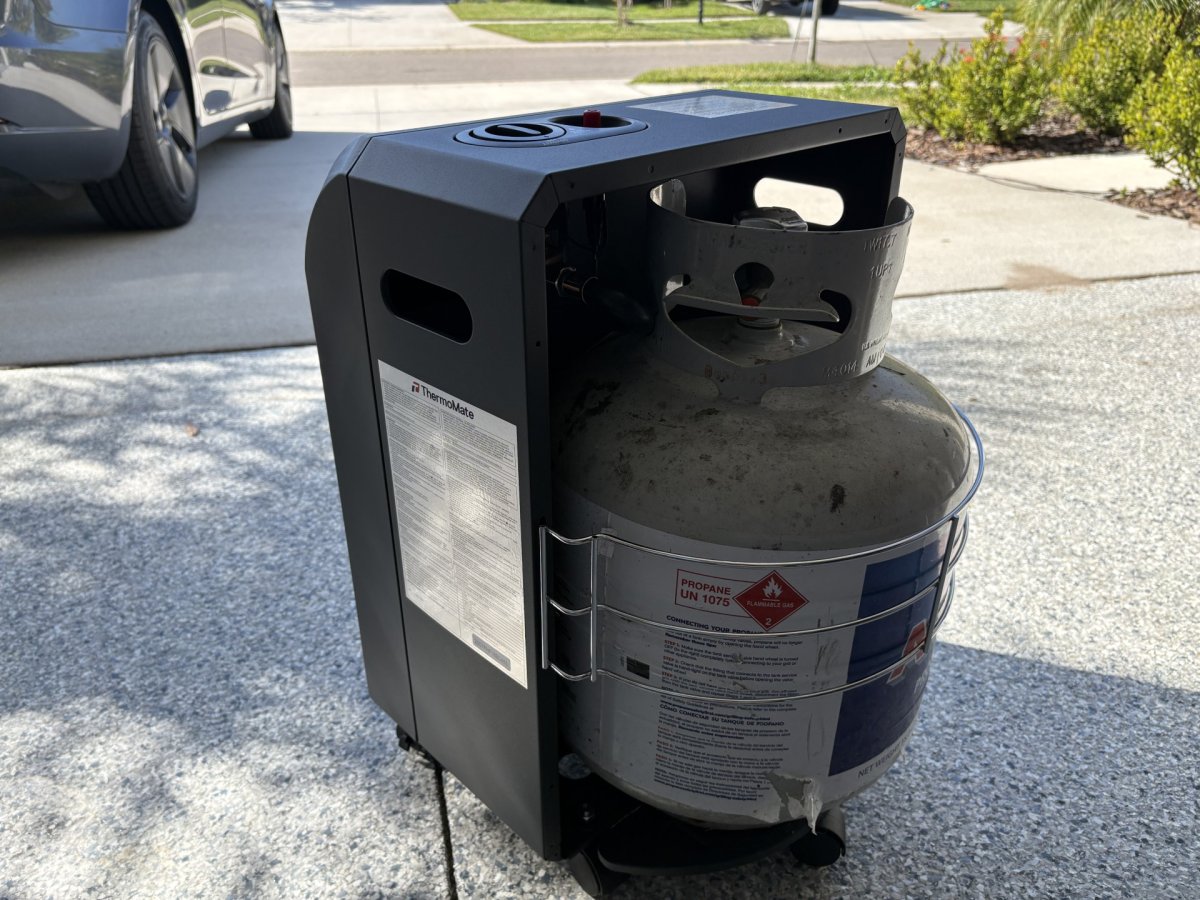
↓ Jump to Review - BEST MID SIZE: Thermomate Propane Heater
↓ Jump to Review - BEST PORTABLE: Mr. Heater MH9BX Portable Buddy Heater
↓ Jump to Review - BEST DIESEL: BougeRV 5KW Diesel Heater
↓ Jump to Review
Gas Garage Heaters Comparison
| Product | Type | Fuel Source | BTU/heating capacity |
|---|---|---|---|
| Mr. Heater Indoor Safe Portable Radiant Buddy Flex Heater | Portable radiant heater | Propane | 6,000 to 11,000 BTU |
| Gasland Propane Tank Top Heater | Tank-top radiant heater | Propane | 9,000 to 30,000 BTU |
| Mr. Heater MH4B Little Buddy Propane Heater | Portable radiant heater | Propane | 3,800 BTU |
| Thermomate Propane Heater | Radiant propane heater | Propane | 6,000 to 18,000 BTU |
| Mr. Heater MH9BX Portable Buddy Heater | Radiant (infrared/ventless) | Propane | 4,000 to 9,000 BTU |
| BougeRV 5KW Diesel Heater | Indirect-vent portable heater | Diesel | ~27,000 BTU (5kW) |
Our Top Picks
Shopping for a gas heater for indoors just got a little easier. The following is a list of some of the best shop space heaters on the market. Be sure to keep the top shopping considerations in mind while comparing these products. From choosing the best fuel source to the proper size, there’s an option for any garage space below.
Best Overall
Photo: The Home Depot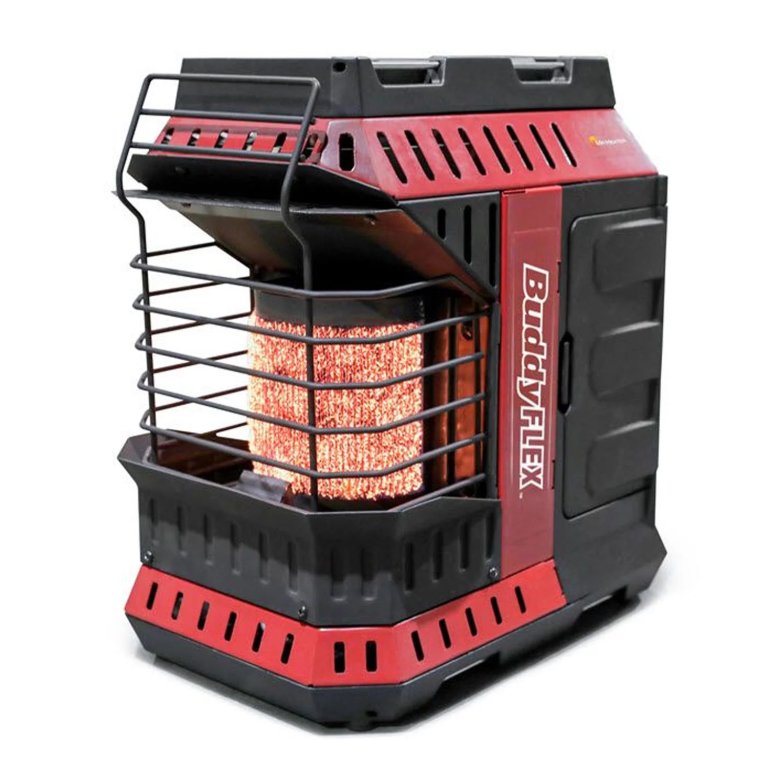
What We Like
- Instant radiant heat
- Lightweight and portable
- Simple, intuitive controls
- Quiet operation
What We Don’t Like
- Limited runtime per tank
- Best for smaller spaces
Product Specs
- Type: Portable radiant heater
- Fuel source: Propane
- BTUs/heating capacity: 6,000 to 11,000 BTU
Our Ratings
| Assembly/Installation | 5/5 | Ease of Use | 5/5 | Performance | 4.8/5 | Value | 5/5 |
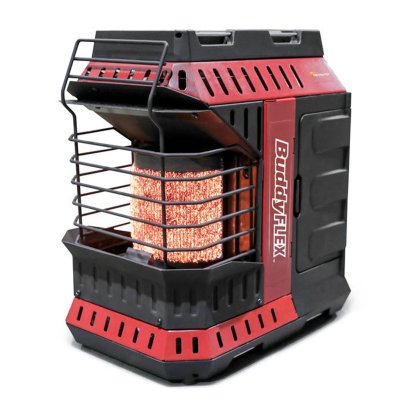
We tested the Mr. Heater Buddy Flex during a Florida winter, with outdoor temperatures dropping to around 31 degrees Fareinheit and a garage that felt especially frigid. Even in those conditions, this heater delivered impressive results. Thanks to its radiant heating design, warmth is felt almost instantly without the discomfort of hot air blowing around the space. Within minutes, our garage work area became noticeably more comfortable.
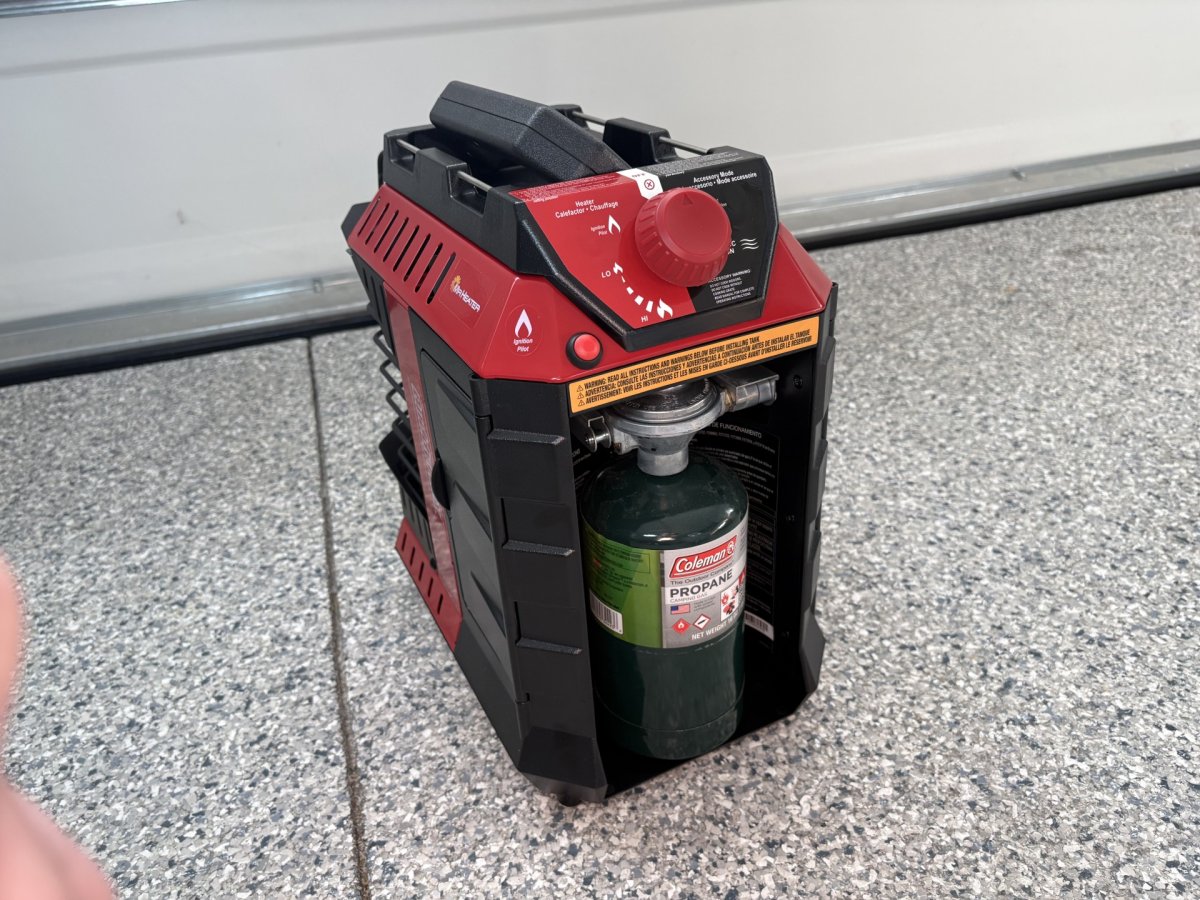
Setup was straightforward. We attached a small propane cylinder to the side, where it fit securely, then powered the unit on using the intuitive controls. The heating element glows bright orange when it’s on, so you get immediate visual confirmation that it’s working. We also appreciated how portable this heater is—it’s lightweight, easy to move, and has a large carry handle that makes repositioning simple.
With adjustable output ranging from 6,000 to 11,000 BTU, the Buddy Flex proved capable of heating a focused garage workspace, rated for areas up to 275 square feet. Runtime averaged about 3 to 4 hours on a full propane tank at higher settings. In real-world use, however, we rarely needed to run it for more than 20 to 30 minutes at a time, allowing a single tank to last across multiple garage sessions.
Overall, this heater is a strong choice for anyone who wants fast, targeted heat in a garage or workshop without installing a permanent heating system.
What our tester says: “The radiant heat is instant, you feel it right away without hot air blowing all over the garage. It warmed up my work area fast, was easy to move around, and felt ideal for short garage sessions rather than running nonstop.”—Paul Rankin, Product Reviews tester and writer.
Get the Mr. Heater Buddy Flex gas garage heater at The Home Depot or Walmart.
Best Bang for the Buck
Gasland Double Burner Tank Top Heater
Buy at GaslandWhat We Like
- Very powerful heat output
- Simple, fast setup
- No electricity required
- Excellent value for BTUs
What We Don’t Like
- Manual ignition required
- Loud at high settings
Product Specs
- Type: Tank-top radiant heater
- Fuel source: Propane
- BTUs/heating capacity: 9,000 to 30,000 BTU
Our Ratings
| Assembly/Installation | 4.5/5 | Ease of Use | 4/5 | Performance | 5/5 | Value | 5/5 |
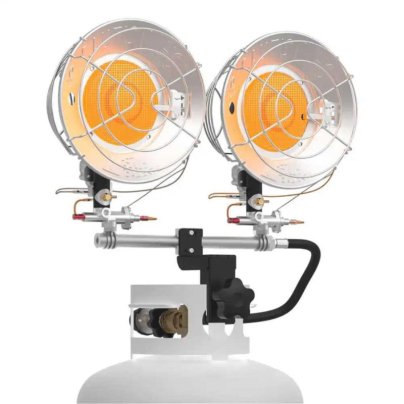
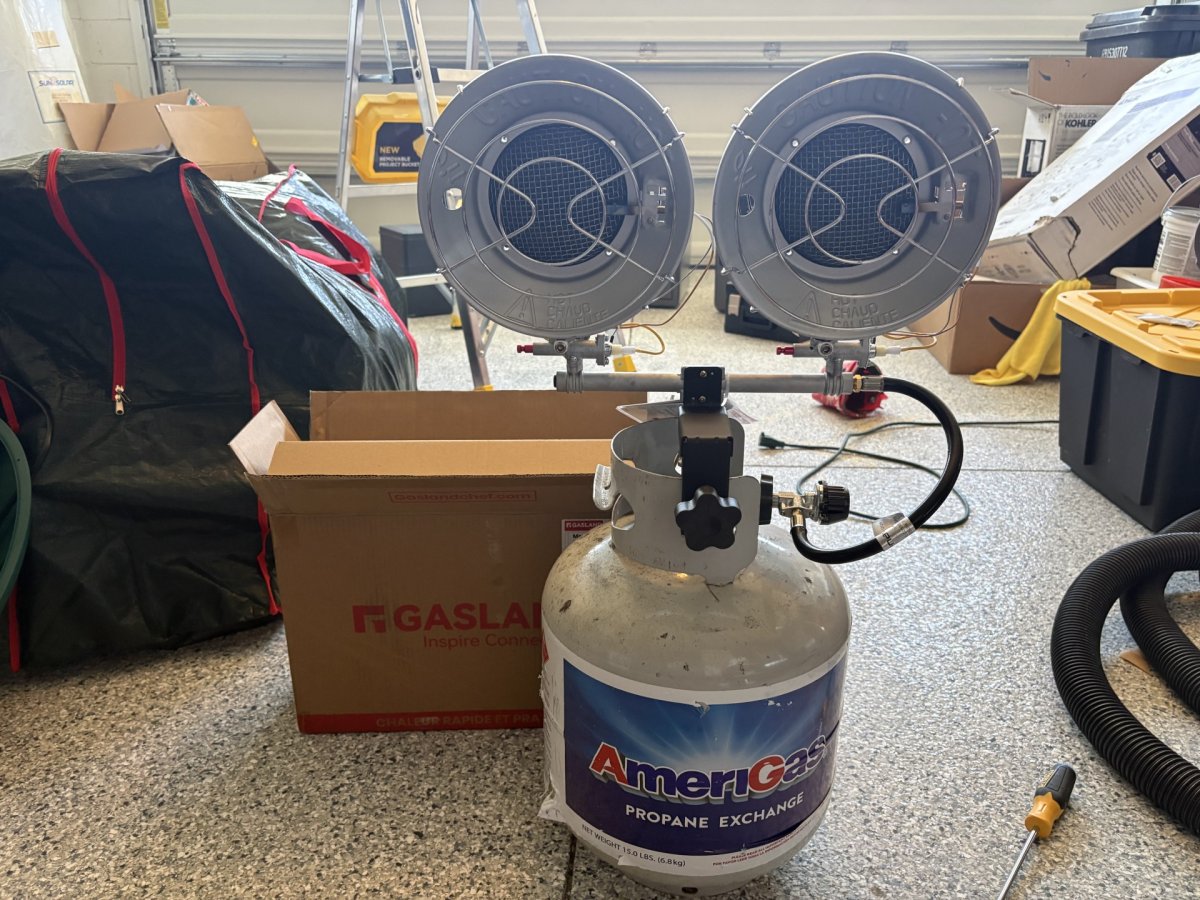
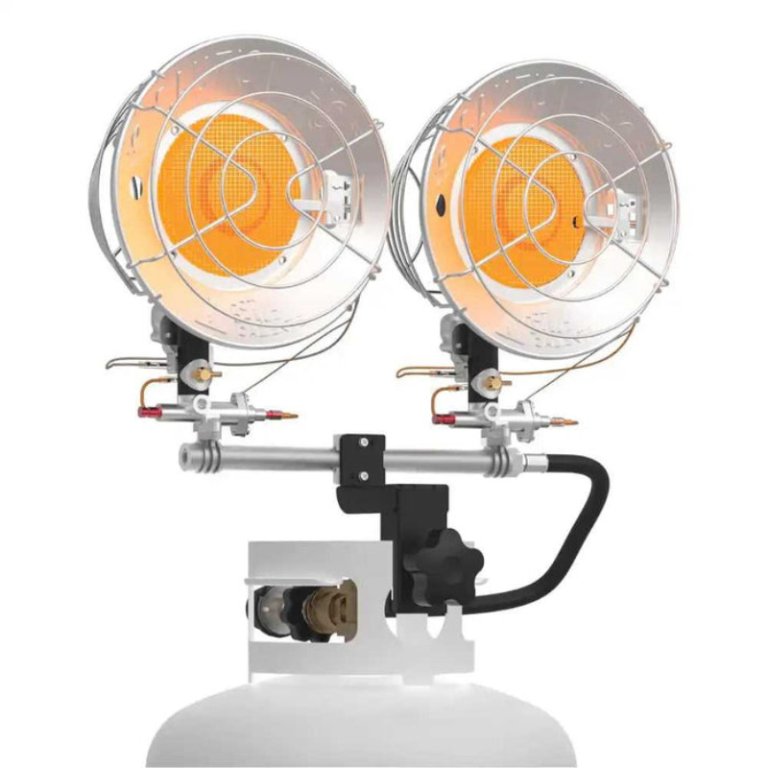
We found the Gasland heater to be the most no-nonsense, rough-and-ready heater we tested. This is a bare-bones, screw-it-on-and-go solution that mounts directly to a standard 20-pound propane tank and gives you a serious amount of radiant heat for the price. If you want maximum output with minimal setup, this heater delivers.
During testing, setup took only a few minutes. Once attached to the tank, ignition is manual, requiring a lighter or torch inserted through the ignition holes on the heater. That process felt a little unconventional at first, but it worked reliably every time. Once lit, the heater puts out strong radiant warmth almost immediately, making it well-suited for garages, job sites, or outdoor work areas where quick heat matters more than refinement.
With adjustable output up to 30,000 BTU, this heater can warm a surprisingly large area. We did notice that at higher settings, the burners produce a noticeable roar, though this is typical of high-output tank-top heaters. For most use cases, running it below max power provided plenty of heat without the extra noise. Since it runs entirely on propane and requires no electricity, it’s also a solid option for off-grid use or emergency situations.
Overall, this is an excellent value pick for shoppers who prioritize power, simplicity, and affordability over polish or advanced features.
Get the Gasland garage heater at Gasland.
Best Compact
Photo: Amazon
What We Like
- Extremely compact design
- Instant radiant warmth
- Lightweight and portable
What We Don’t Like
- Very limited heating range
- No fan-assisted airflow
Product Specs
- Type: Portable radiant heater
- Fuel source: Propane
- BTUs/heating capacity: 3,800 BTU
Our Ratings
| Assembly/Installation | 5/5 | Ease of Use | 5/5 | Performance | 3.5/5 | Value | 5/5 |
The Mr. Heater Little Buddy is designed for one thing: delivering quick, safe heat in very small spaces. With a compact footprint and lightweight build, it’s an easy heater to grab for short indoor use, emergency situations, or outdoor activities where portability matters more than raw power.
During testing, the Little Buddy performed best in tight, enclosed spaces. Because it’s a radiant heater, warmth is felt directly in front of the unit rather than being pushed through the room, making it especially useful for warming hands or keeping a seated area comfortable. In a garage setting, this would shine in a small work corner (it’s not heating up the entire space).
The Little Buddy includes important safety features for indoor use, including a low-oxygen shutoff and tip-over protection. When the heater was laid on its side during testing, it shut off immediately, which adds confidence for use in enclosed areas. Like other Buddy heaters, it runs on small propane cylinders and doesn’t require electricity.
This heater isn’t meant to warm a garage or large workspace, but that’s not the goal. Instead, it shines as a compact, affordable solution for supplemental heat in very small rooms or as a backup heater during power outages.
Get the Mr. Heater Little Buddy gas garage heater at Amazon (3-pack), Walmart, or Mr. Heater.
Best Mid-Size
Photo: Amazon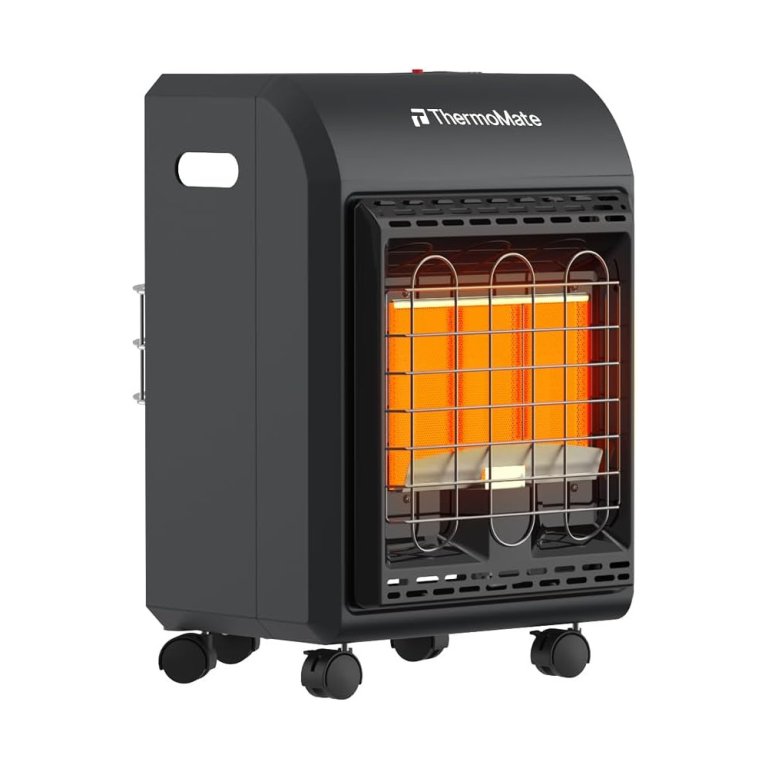
What We Like
- Strong radiant heat output
- Easy to roll and reposition
- Very quiet operation
- Excellent safety features
What We Don’t Like
- Finicky ignition process
- Dated control design
Product Specs
- Type: Radiant propane heater
- Fuel source: Propane
- BTUs/heating capacity: 6,000 to 18,000 BTU
Our Ratings
| Assembly/Installation | 5/5 | Ease of Use | 3.8/5 | Performance | 4.8/5 | Value | 4/5 |
The ThermoMate radiant propane heater feels like a throwback in the best and worst ways. It has the look and function of a classic indoor radiant heater, but with modern safety features and mobility that make it far more practical for garage or workshop use. During testing, what stood out immediately was how easy it was to move around, thanks to its caster wheels, allowing us to roll it exactly where heat was needed instead of heating the entire space at once.
Ignition was the one area that felt dated. It took repeated presses of the red igniter button before the heater finally fired up, which required a bit of patience. That said, once it was running, the payoff was immediate. The radiant panels give you a strong, steady blast of heat that warms people and objects directly, not just the air around them.
With three heat settings up to 18,000 BTU, the ThermoMate is well-suited for medium-sized garages or workshops, rated to heat up to 450 square feet. It operates quietly and includes multiple safety features, including tip-over protection and an oxygen depletion sensor, which adds peace of mind when using it in semi-enclosed spaces. Runtime is also impressive, especially on the lowest setting, making it a practical choice for extended projects.
Overall, this heater is ideal if you want strong radiant heat with easy mobility and aren’t bothered by old-school ignition quirks.
Get the Thermomate gas garage heater at The Homeappliances, Amazon, or Thermomate.
Best Portable
Photo: The Home Depot
What We Like
- Compact and highly portable
- Strong safety features included
- Quick radiant heat
- No electricity required
What We Don’t Like
- Limited heating range
- Short runtime on small tanks
Product Specs
- Type: Radiant (infrared/ventless)
- Fuel source: Propane
- BTUs/heating capacity: 4,000 to 9,000 BTU
Our Ratings
| Assembly/Installation | 5/5 | Ease of Use | 5/5 | Performance | 4/5 | Value | 5/5 |
The Mr. Heater Portable Buddy is a compact, affordable option for heating small garage spaces, workshops, and emergency setups. Producing between 4,000 and 9,000 BTUs, this radiant propane heater for the garage is designed to warm areas up to about 225 square feet, making it best suited for one-car garages or focused work zones rather than large, open spaces.
This heater runs on 1-pound propane cylinders right out of the box, though it can be connected to a larger propane tank with a separate hose. Its radiant design heats people and objects directly, which helps it feel effective quickly without needing to warm all the surrounding air first. The ventless construction allows for indoor use, and built-in safety features like tip-over protection and an oxygen depletion sensor add reassurance when operating it in enclosed spaces.
In testing, the Portable Buddy raised room temperatures noticeably within a short period of time, though performance will vary based on insulation, ceiling height, and drafts. Runtime on a small propane bottle ranges from roughly 3 hours on high to 6 hours on low, making it practical for short work sessions or emergency use during power outages.
Overall, this heater stands out for its portability, simplicity, and strong safety profile. It’s a reliable choice for shoppers who want dependable heat in a small space without investing in a permanent garage heater.
What our tester says: “Once I mastered the lighting technique, I was able to light the propane heater on the first try every time without fail.”—Glenda Taylor, Staff Writer and Product Reviews Tester
Get the Mr. Heater Portable Buddy gas garage heater at Amazon, The Home Depot, Walmart, or Mr. Heater.
Best Diesel
Photo: Amazon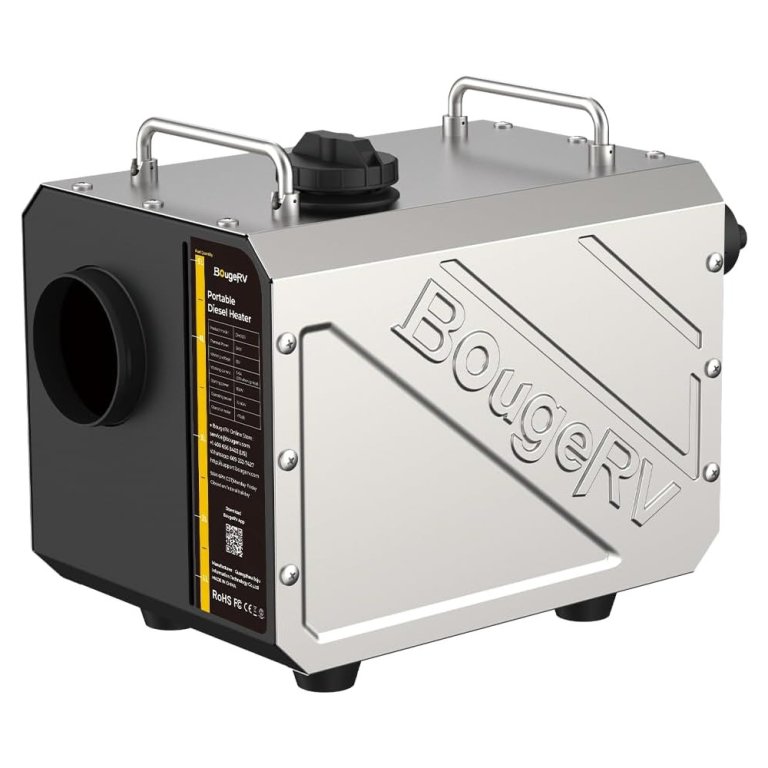
What We Like
- Clean heat with no indoor fumes
- Very fast heating performance
- Multiple power options
- Excellent value for output
What We Don’t Like
- Requires outdoor placement
- Some setup planning needed
Product Specs
- Type: Indirect-vent portable heater
- Fuel source: Diesel
- BTUs/heating capacity: ~27,000 BTU (5kW)
Our Ratings
| Assembly/Installation | 4/5 | Ease of Use | 4/5 | Performance | 5/5 | Value | 5/5 |
After testing a wide range of garage heaters over the years, the BougeRV Portable Diesel Heater immediately stood out for its fundamentally different approach. Instead of generating heat inside the workspace, this unit stays outdoors and delivers clean, hot air indoors through a flexible hose. That design alone solves one of the biggest drawbacks of propane and kerosene heaters: fumes where you’re actually working.
In real-world testing, performance was impressive. The BougeRV brought the temperature in our shop up roughly twice as fast as a comparable propane heater and maintained steady heat without constant cycling. Noise levels were also noticeably lower than those of a propane salamander, making it far more comfortable for long work sessions. The heat output felt similar to what you’d expect from a diesel vehicle heater—strong, consistent, and reliable.
Fuel flexibility is another major advantage. Diesel is easy to store, widely available, and often already on hand for homeowners and contractors. The heater can run on household power, a 12-volt connection, or directly from a battery, which makes it adaptable for garages, job sites, camping setups, and emergency situations. While glow plugs require a brief warm-up and outdoor placement takes some planning, those trade-offs are minor compared to the clean heat delivered indoors.
For anyone sensitive to fumes or looking for serious heating power without vent-free compromises, this diesel heater is a standout value.
Get the BougeRV gas garage heater at Amazonor BougeRV.
Jump to Our Top Picks
How We Chose and Tested the Best Gas Garage Heaters
| Products tested | 6 |
| Time spent testing | 1 week |
| Tests performed | 4 to 5 |
| Price range | $75 to $160 |
To find the best gas space heaters for the garage, we looked at a mix of propane, natural gas, and diesel-powered models from well-known brands and value-focused manufacturers. In total, we considered more than a dozen heaters, narrowing our final picks based on hands-on testing, performance data, safety features, and real-world usability. We looked closely at heating capacity, fuel efficiency, price, design, ease of setup, portability, and built-in safety measures such as tip-over protection and oxygen depletion sensors.
Our testing focused on how quickly and evenly each heater warmed a space, how controllable the heat output was, and how comfortable the heat felt during extended use. We tested heaters in garages, workshops, and small enclosed spaces, measuring temperature increases over time and noting noise levels, ignition reliability, and overall stability.
These recommendations reflect the importance of steady, reliable heat from a trusted fuel source, especially in cold conditions. Because some heating methods aren’t suitable for small or poorly ventilated spaces, we included both natural gas and propane options for different needs. We also evaluated forced-air, convection, and radiant heaters, recognizing that each produces a different style of warmth. Finally, we prioritized heaters that could safely and effectively warm everything from small sheds to large two-car garages.
| Product | Assembly/ Installation | Ease of Use | Performance | Value |
|---|---|---|---|---|
| Mr. Heater Indoor Safe Portable Radiant Buddy Flex Heater | 5/5 | 5/5 | 4.8/5 | 5/5 |
| Gasland Propane Tank Top Heater | 4.5/5 | 4/5 | 5/5 | 5/5 |
| Mr. Heater MH4B Little Buddy Propane Heater | 5/5 | 5/5 | 3.5/5 | 5/5 |
| Thermomate Propane Heater | 5/5 | 3.8/5 | 4.8/5 | 4/5 |
| Mr. Heater MH9BX Portable Buddy Heater | 5/5 | 5/5 | 4/5 | 5/5 |
| BougeRV 5KW Diesel Heater | 4/5 | 4/5 | 5/5 | 5/5 |
What to Consider When Choosing a Gas Garage Heater
“Several factors are crucial when selecting the best garage heater,” says Jeff Palla, president of Mr. Handyman, a national home maintenance and repair company. “Consider the size of the space, insulation, and ventilation,” he says. “Look for heaters designed for indoor use to ensure safety. Also, factor in the ease of installation and maintenance, as well as the heater’s efficiency and heating capacity.”
Type
The three main types of gas garage heaters are forced air, convection, and radiant. Here are some more details about the different heating methods used in garage heaters:
- Forced-air gas heaters draw in cold air from the space, heat it, and pump it back in.
- Convection heaters (also known as blue flame) warm the air around them, starting a cycle of warm air rising and cooler air working its way to the heater.
- Radiant heaters project heat onto objects within the space, making them a great option for heating a workbench. Additionally, these heaters come in two variations: direct vent and ventless.
- Direct-vent heaters exhaust their gases outside, while the exhaust from a ventless heater enters the heated space. Direct-vent heaters are more expensive and more challenging to install, but ventless heaters can irritate those particularly sensitive to odors and fumes.
There are other non-electric garage heaters as well, such as kerosene-burning options. While all types of heaters will help warm a garage, Palla suggests going with radiant heating. “For an unfinished garage, radiant heaters might be more effective as they heat objects directly and work well in drafty or less insulated spaces,” he says. “They provide warmth without relying on air circulation.”
Fuel Source
When it comes to choosing a product based on fuel source, note that there are natural gas, electric, and propane gas garage heaters. All are efficient, but there are scenarios where one might be better than another.
“Propane offers portability and can be stored easily, while natural gas tends to be cheaper and is piped directly,” Palla says. “Consider availability, cost, and convenience when choosing between the two.”
For garages that aren’t on natural gas grids, propane heaters might be a better choice. Propane also burns cleanly, but it’s more readily available by the bottle than natural gas. Many gas stations, grocery stores, and home improvement stores operate bottle-swap stations where an empty tank can be exchanged for a full one.
It’s important to understand that propane and natural gas heaters are not interchangeable. The nozzles or jets that supply gas to the flame on each type of heater are differently sized, and users wouldn’t want to use a propane tank, for example, on a natural gas heater without a conversion kit.
Keep in mind that if you’d prefer not to use fossil fuels, there are electric garage heaters as well. These options can heat small or large garages and are either portable or wall-mounted. Portable electric heaters are lightweight and usually include carrying handles to supply heat wherever needed, while wall-mounted options are semi-permanent and easy to install for continuous heat.
Freestanding vs. Mounted
Choosing among the best gas garage heaters might depend on preference between freestanding and mounted units. Users can position freestanding heaters anywhere they’d like, allowing them to focus heat generation in a particular area. This can be a big benefit, particularly when using a smaller heater in a big space.
Mounted units aren’t going anywhere, which has benefits and drawbacks. These units typically install off the ground, keeping them safe and out of the way. As long as they’re large enough to heat an entire space, they’re a very convenient option. If they’re too small, however, there will be cold spots in the garage.
Heating Capacity
Shopping for the best garage heater requires some attention to a unit’s capacity or output. Described in BTUs, a heater’s capacity can help determine the space for which it’s most suitable.
Larger garages and barns will require a large high-output heater with a BTU rating between 80,000 and 100,000. These heaters can often handle garages north of 2,000 square feet in size.
Smaller garages won’t need as much firepower. For an attached 1- or 2-car garage, a 30,000 BTU unit is often more than suitable. Very localized heat, such as above a workbench, might only require 5,000 BTUs.
“Calculate the BTUs needed by multiplying the garage’s square footage by the heating factor,” says Palla. “Generally, for moderately warmer climates, allocate around 30 to 35 BTUs per square foot. In colder regions, aim for 45 to 50 BTUs per square foot to effectively heat the space.”
Safety
The best gas garage heaters are clean-burning, efficient, and easy to use, but they aren’t without safety concerns. The potential for accidents and injuries certainly increases with a gas heater installed in a garage.
To help reduce the risk of accidents, many of the best gas garage heaters have safety features, such as child-safety locks, that make it difficult for a child to light a heater inadvertently. Also, low-oxygen shutoffs will detect when effective, safe combustion isn’t possible, shutting the heater off entirely.
It’s also extremely important to ensure that carbon monoxide detectors within the home and garage are working properly. Gas heaters that are well-maintained and running properly create an “ideal burn,” which poses no threat of carbon monoxide poisoning.
But poorly running heaters don’t burn as efficiently and can cause unsafe carbon monoxide buildup. A carbon monoxide detector will alert when dangerous levels of carbon monoxide are building up within the home or garage, which can be the result of many different factors. Since carbon monoxide is colorless and odorless, these detectors are sometimes the only way to tell that there is an issue.
Finally, keeping flammable items clear of a heater is essential. Garage spaces are full of flammable items, combustible liquids, and other dangerous materials that can cause a fire if they’re in close proximity to a gas heater.
Installation
How simple or challenging a particular gas garage heater might be to install could be a factor while shopping. Folks looking to unbox a heater and warm up the space right away might prefer a portable heater that simply screws onto a propane tank. Those looking for a more permanent solution might prefer a mounted unit, which will require a more involved installation process.
Installing mounted units often requires specialized brackets that attach to the ceiling or wall. Also, if these units vent outside, they require a hole in the wall for the exhaust pipe to run through. If connecting to gas pipes is necessary, it might be best to hire out the process to a plumber.
Additional Features
Depending on the style, the best gas garage heaters have convenient features to make them more useful or simply easier to use.
Mounted units compatible with external thermostats make controlling garage temperatures much easier. Setting the thermostat to a preferred temperature will ensure the heater kicks on and off, maintaining that temperature within the space. Also, remote controls make adjusting temperatures an easier process.
For portable units, temperature-control knobs allow users to throttle the flame output to balance warmth and fuel efficiency, stretching a bottle of propane as far as possible.
FAQs
Even though you’re familiar with the best gas garage heaters on the market, you might still have some questions about these heaters. Below is a collection of some of the most commonly asked questions about gas garage heaters, along with the answers to clear them up.
Yes, as long as you follow the manufacturer’s instructions for use and installation, gas garage heaters are safe. Just be sure to vent units that require it and ensure that the carbon monoxide detectors are working.
Yes, there are many propane-fueled heaters available that will heat a garage safely and efficiently.
Maybe. Depending on the particular product, some propane heaters do need ventilation while others do not. It’s helpful to check the manufacturer’s use and installation instructions.
The answer to this question depends on the region in which you live. If you experience very mild winters, you might require only 30 BTUs per square foot, while very cold climates will require double that.
A 500-square-foot garage in a warmer climate may only require 15,000 BTUs, while that same garage in colder climates could require 30,000 BTUs. Those numbers can jump considerably if the space is poorly insulated.
Gas appliances, particularly furnaces and heaters, have an average life expectancy between 15 and 20 years. Keep in mind that factors such as regular servicing or humidity levels will have an effect on how long a heater lasts.
Maybe. Slightly oversizing can help with faster warm-up, but extreme oversizing wastes fuel and can make temperature control uncomfortable.
Yes, if you use your garage regularly. Heaters improve comfort, productivity, and year-round usability, especially in cold or drafty spaces.
Meet the Tester
Paul Rankin is a hands-on product reviewer who tests garage heaters in real workshops and home garages, focusing on safety, heat performance, and practical, no-nonsense recommendations.
Additional research provided by Tom Scalisi and Glenda Taylor.