We may earn revenue from the products available on this page and participate in affiliate programs. Learn More ›
Key Points
- We tested 10 LED grow lights over 30 days to find the best options for seed starting, supplemental houseplant lighting, and intensive indoor growing.
- The Mars Hydro TS1000 topped our list for its even full-spectrum coverage, quiet operation, and strong performance across multiple plant types.
- The right LED grow light depends on your space, plant type, and power needs.
For those who are attempting to cultivate houseplants, start plants from seed, or grow vegetables indoors, natural light isn’t always enough. Though some plants can survive in low-lighting conditions, many others benefit from the addition of plant grow lights.
Light-emitting diode (LED) grow lights are ideal for many home gardeners. They are energy efficient and can produce the full spectrum of light wavelengths, from infrared to ultraviolet, that plants need to thrive. LED grow lighting differs from the standard LED bulbs used in home light fixtures, and selecting the right one for a particular project can be complicated. This guide can help.
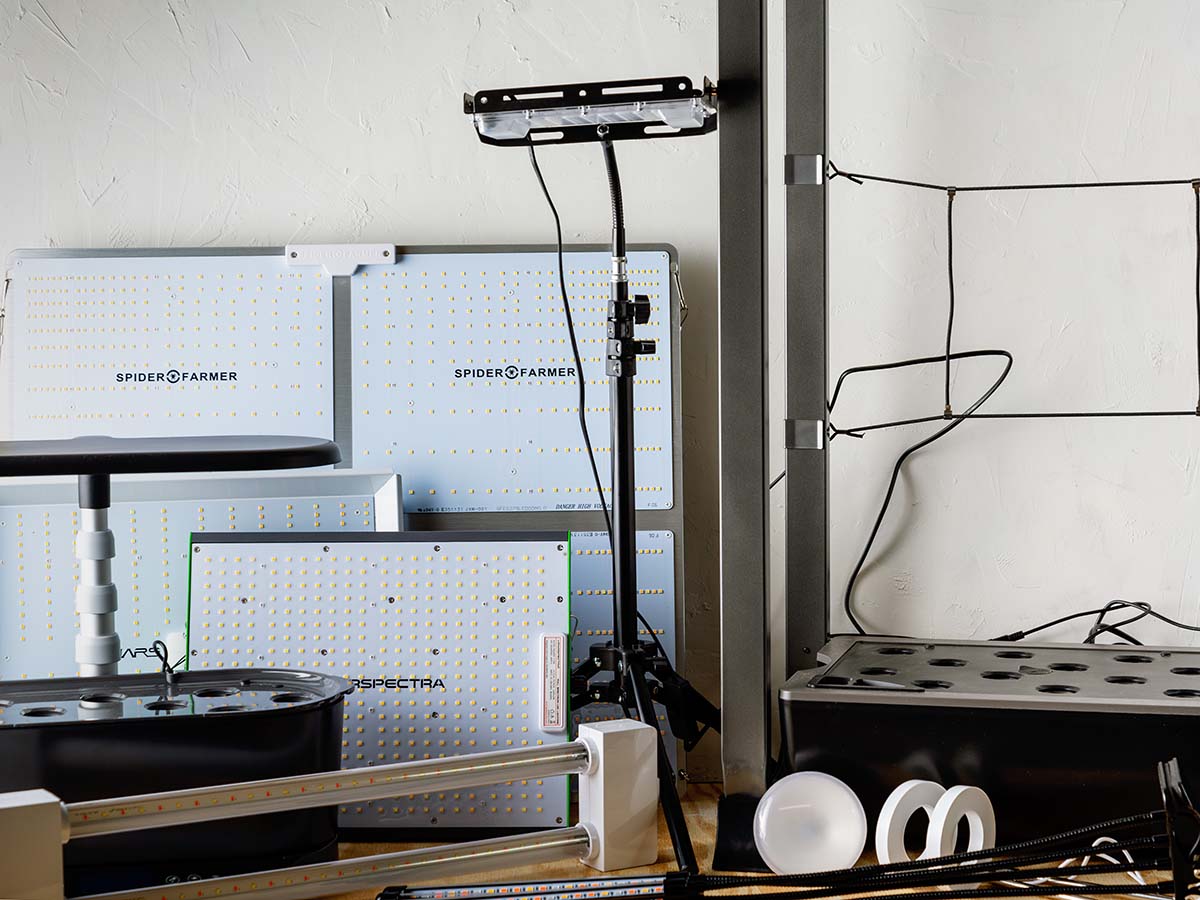
We researched 42 LED growing lights in our search for the best LED grow lights. After narrowing our options, we tested our top picks on our plant collection over 4 weeks. The list of products we tested is shown below, and more details are provided in the individual reviews. Our favorite was the Mars Hydro TS1000 Dimmable 150W LED Grow Light, which helps provide even, low-power light to your indoor plants. Later, we’ll dive deeper into the shopping criteria that can help plant lovers choose the best LED grow light for indoor plants.
- BEST OVERALL: Mars Hydro TS1000 Dimmable 150W LED Grow Light
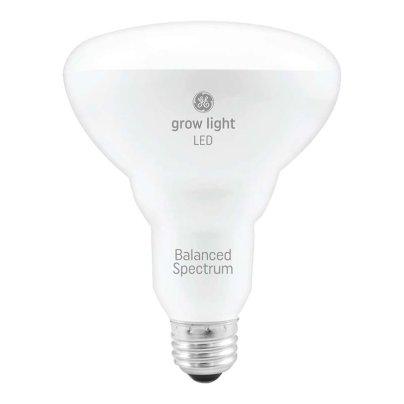
- BEST BANG FOR THE BUCK: GE 9W Balanced Light LED Grow Light Bulb
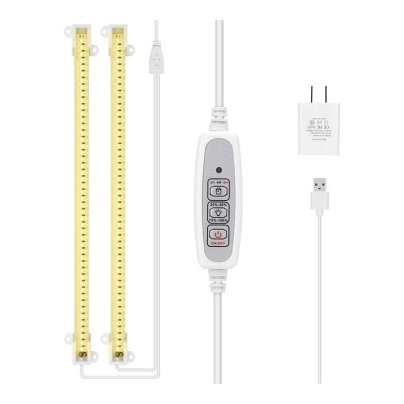
- BEST STRIP: Mosthink Sunlike White LED Grow Light Strips
- BEST SPREAD-STYLE: Spider Farmer SF4000 450W LED Grow Light With Dimmer
- BEST FOR HERBS: AeroGarden Bounty LED Grow Light
- BEST FOR A SINGLE PLANT: Lordem LED Plant Grow Light for Indoor Plants
- BEST WITH STAND: LBW LED Grow Light With Stand
- BEST FOR SEED STARTING: Gardener’s Supply Company LED Stack-n-Grow Lights
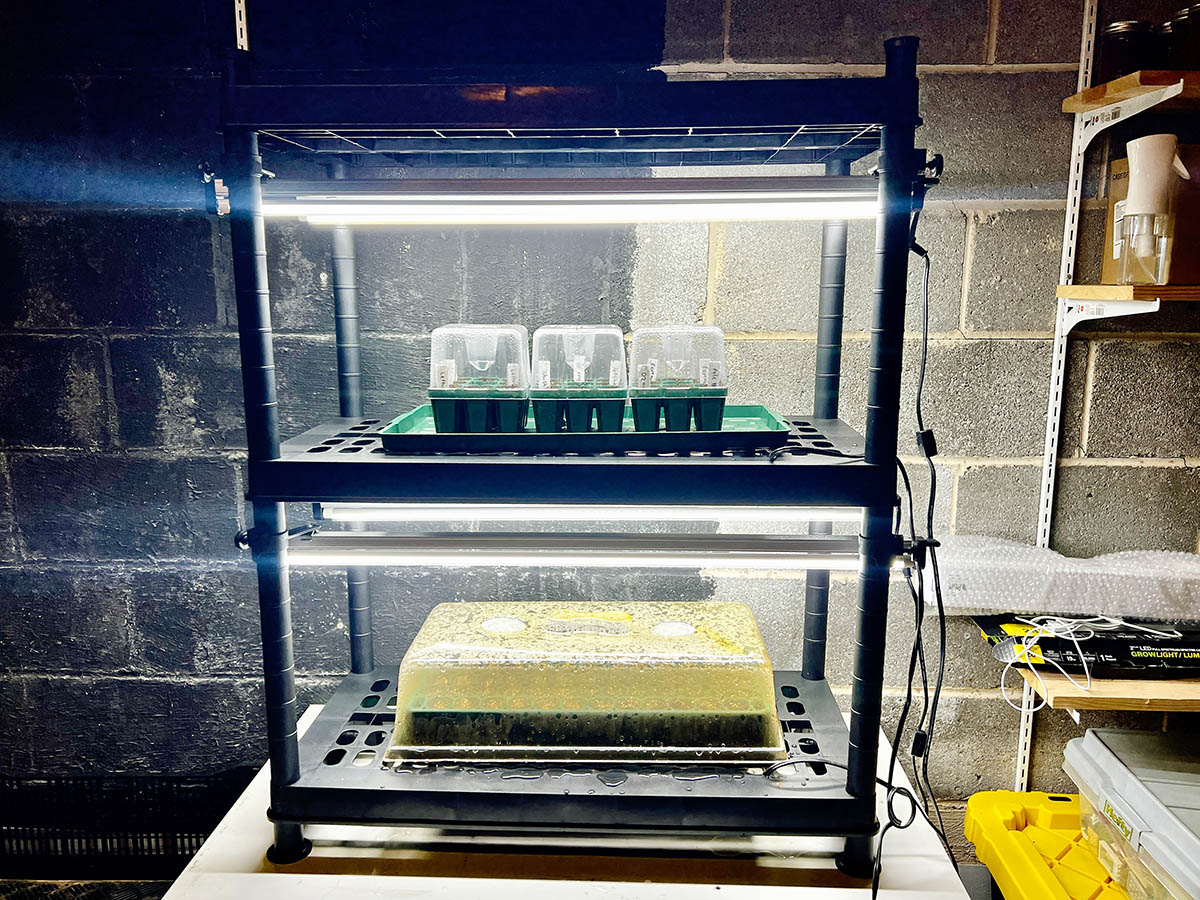
LED Grow Lights Comparison Chart
| Product | Type | Coverage | Wattage |
| Mars Hydro TS1000 Dimmable 150W LED Grow Light | Spread-style | 3 feet by 3 feet | 150 |
| GE 9W Balanced Light LED Grow Light Bulb | Light bulb | 1 foot by 1 foot | 9 |
| Mosthink Sunlike White LED Grow Light Strips | Strip lights | 1 foot by 1.5 feet | 15 |
| Spider Farmer SF4000 450W LED Grow Light With Dimmer | Spread-style | 6 feet by 6 feet | 450 |
| AeroGarden Bounty LED Grow Light | Integrated LED panel | 1.5 foot by 1 foot | 30 |
| Lordem LED Plant Grow Light for Indoor Plants | Ring light | 8.5 inches by 8.5 inches (.5 square foot) | 10 |
| LBW LED Grow Light With Stand | Spread-style | 1.5 feet by 1.5 feet | 30 |
| Gardener’s Supply Company LED Stack-n-Grow Lights | Traditional | 3 feet by 4 feet | Not listed |
Our Top Picks
The following reviews outline our choices for best full spectrum LED grow lights in various categories, with lights available at a range of price points. Read on to find out how they performed in our growing tests and which ones we recommend for different growing situations.
Best Overall
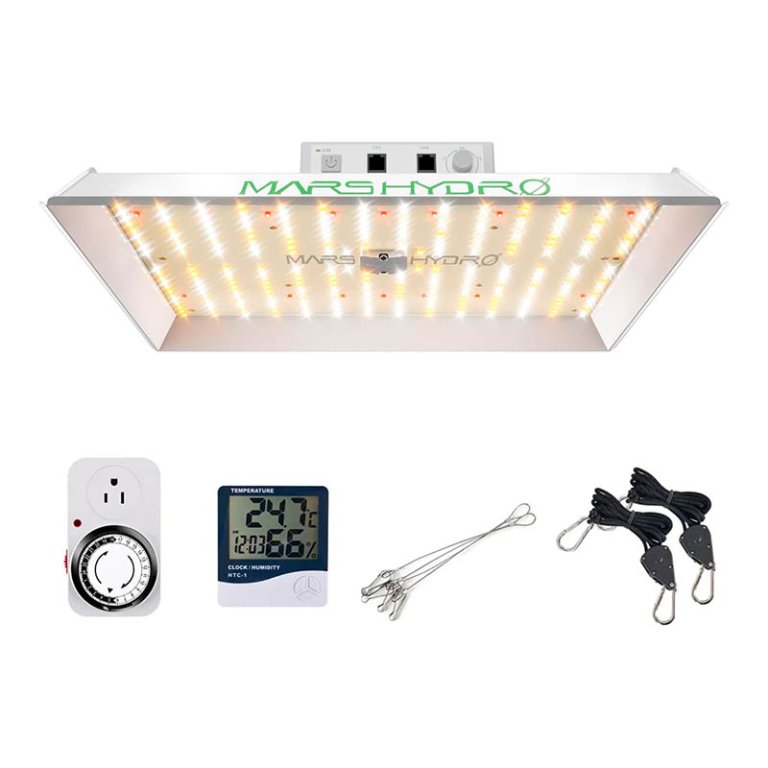
Mars Hydro TS1000 Dimmable 150W LED Grow Light
See ItWhat We Like
- Full-spectrum lighting promotes germination, vegetative growth, flowering, and fruiting
- 354 LEDs on an adjustable-height spread-style fixture delivers intense, even coverage
- Dimmable grow light with low power draw reduces costs
- Daisy-chain connectivity allows users to easily expand the system as needed
- Low heat production and internal heat-sink system means no noisy cooling fan
What We Don’t Like
- Industrial appearance is not aesthetically compatible with most living spaces
- Requires 2 overhead anchor points for installation
Product Specs
- Type: Spread-style
- Coverage: 3 feet by 3 feet
- Wattage: 150
Our Ratings: Setup: 4/5; Adjustability: 5/5; Durability: 5/5; Coverage: 5/5; Value: 5/5
The spread-style Mars Hydro TS1000 LED grow light is a panel fixture with 354 tiny LED bulbs. This energy-efficient light uses only 150 watts of actual power, with a PPFD of 743 micromole/m2/s at a distance of 18 inches. (For an in-depth description of this measurement, see the section on Power below.) It produces full-spectrum white light and can encourage plant growth at every stage of the growing process. The lights are dimmable and have daisy-chain functionality to connect a maximum of 15 units using only one electrical outlet.
Use a single lamp to cover 6.5 square feet for the flowering stage and 9 square feet for the vegetative stage. This grow light regulates temperature internally, so it requires no fan, ensuring quiet operation.
From a horticultural and budget standpoint, the Mars Hydro TS1000 was our favorite LED grow light. It produced a large enough light footprint to maintain nine houseplants in our tests and produced excellent light intensity. We envisioned using it to raise garden seedlings in the spring, or to grow veggies indoors in the winter.
We tested this fixture in the dark basement growing area, where the plants beneath its light thrived. The foliage remained dense and deep green in color, there was no leaf drop, and by the end of the month new buds and leaves had begun to grow.
Locking pulleys made it easy to raise the height of the fixture as necessary, but releasing the lock to lower the height required climbing a ladder. The dimmer knob was easy to access and turned smoothly. Overall, the quality and performance were excellent and the price was reasonable. However, the fixture’s industrial appearance may be less desirable for in-home growing in the living space.
Read our full review: Mars Hydro TS1000 Dimmable 150W LED Grow Light
Get the Mars Hydro LED grow light at Amazon or Mars Hydro.
Best Bang for the Buck
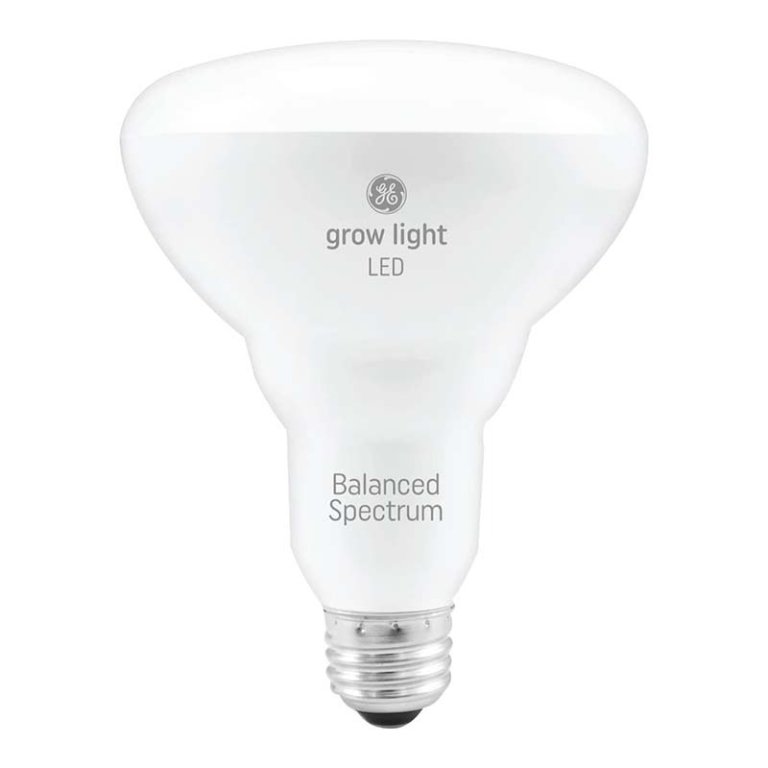
GE 9W Balanced Light LED Grow Light Bulb
See ItWhat We Like
- Conveniently compatible with any conventional lamp or light-bulb fixture
- Produces full-spectrum light with a natural red-blue wavelength balance
- Budget-friendly price point and a working life of 25,000 hours
- Great choice for supplemental houseplant lighting or small seed-starting projects
What We Don’t Like
- Relatively small light footprint means more than 1 bulb may be needed
- Lacks adjustability: not dimmable, no built-in timer, and no light-spectrum adjustment
Product Specs
- Type: Light bulb
- Coverage: 1 foot by 1 foot
- Wattage: 9
Our Ratings: Setup 5/5; Adjustability: 5/5; Durability: 5/5; Coverage: 4/5; Value: 5/5
The GE BR30 9-watt grow light is actually an LED light bulb that turns any conventional lamp or light fixture into a grow light. It delivers a PPF (photosynthetic photon flux; see the section on Power below) of 16 micromoles per second and produces full-spectrum lighting that appears white to the eye, with balanced red and blue wavelengths. What this basic non-dimmable bulb lacks in features it makes up in versatility. Install one into a clamp light fixture, or use several in a string light fixture, then plug into an inexpensive mechanical timer for a wide range of uses. It is a great choice for growing garden seedlings, overwintering tropical plants indoors, or growing a pot of basil on the countertop.
One bulb covers a .5-square-foot area for flowering plants, or up to 2.25 square feet for vegetative growth. The quiet, efficient bulb produces almost no heat, so there is no concern about burning foliage or overheating the room.
We tested the GE grow light bulb in our poorly lit living room growing space. After installing the bulb into a clamp light fixture, we positioned it 9 inches above two potted plants and set a mechanical timer (not included) to “on” 18 hours a day per GE’s instructions for vegetative growth.
The plants flourished. They remained a vibrant green color, produced new leaves and buds, and retained the healthy older leaves beneath. We noted that the general direction of the growth was upward toward the light, even though one of the plants was a trailing type. But the leaves and stems took on the typical shape for the plant types, rather than becoming elongated as often happens in lower-than-ideal light.
Get the GE LED grow light bulb at Amazon or Walmart.
Best Strip
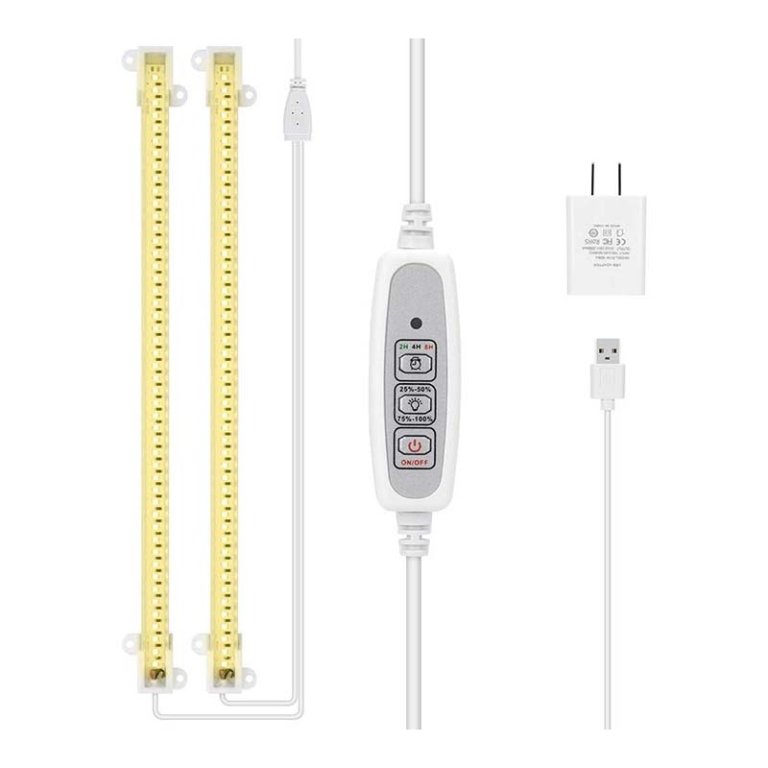
Mosthink Sunlike White LED Grow Light Strips
See ItWhat We Like
- Lightweight strip lighting with flexible mounting options and a 6.5-foot power cord
- 2 dimmable 7.5-watt LED light strips with a built-in 2-/4-/8-hour timer
- Low-profile design easily disappears into the background when not in use
What We Don’t Like
- Difficult to adjust the light height once the strips have been installed
- Limited practical applications; best for under-shelf supplemental lighting setup
- Relatively low/diffused output compared to other plant grow lights; PPF/PPFD ratings are not given
Product Specs
- Type: Strip lights
- Coverage: 1 foot by 1.5 feet
- Wattage: 15
Our Ratings: Setup 4/5; Adjustability: 4/5; Durability: 4/5; Coverage: 4/5; Value: 5/5
Anyone in need of a compact, lightweight under-shelf grow light will want to consider this versatile set of Mosthink LED grow-light strips. The two 12-inch low-profile strip lights (24 LEDs each) may be configured either side by side or end to end, and they can be mounted with either the included wood screws, double-sided tape, or cable ties. These full-spectrum LEDs produce light in the 380 nm to 800 nm wavelengths, like natural sunlight. The built-in 2-/4-/8-hour timer and 25/50/75/100 percent dimmer offer customizable lighting to promote plant health and vigor.
Each strip illuminates an area approximately 6 inches wide and 18 inches long for a combined total of 1.5 square feet. The moderate light output is best for growing and maintaining healthy foliage. Because these light strips accumulate very low heat, there is no risk of burning leaves or damaging nearby surfaces.
We used the included double-sided tape to affix the Mosthink LED grow-light strips to the underside of a shelf on the wall, side by side and spaced 3.5 inches apart. We placed two 6-inch potted plants side by side under the light, where they grew well. The foliage looked really good, and the plants produced a fair amount of buds and leaves. Overall, this is a fine setup for supplemental lighting.
We really liked the low-profile design of these light strips. At only about a half-inch thick, they barely rise above the surface they are mounted on. They didn’t get in the way when we were moving things around, and they seemed to fade into the background when not in use.
We did not love the three-way timer, however, because it had a maximum setting of 8 hours instead of the 12 hours we would have preferred. Our solution was to delay the start time until about 4 hours after sunrise, since our room faced east (sunrise) and the plants would benefit most from additional afternoon light.
Get the Mosthink LED grow-light strips at Amazon.
Best Spread-Style
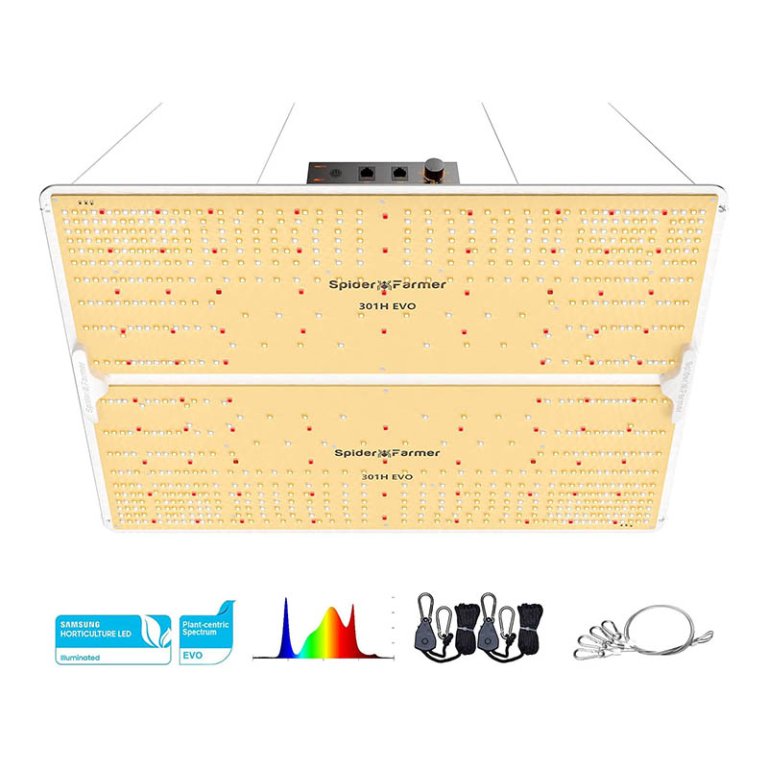
Spider Farmer SF4000 450W LED Grow Light With Dimmer
See ItWhat We Like
- Largest coverage area of all the grow lights we tested
- High-intensity, dimmable lights cover the full spectrum of light wavelengths
- Well suited for gardening in dark spaces such as basements and garages
- Includes daisy-chain functionality to accommodate larger indoor garden projects
What We Don’t Like
- By far the most expensive grow light we tested
- High energy consumption makes it impractical for smaller spaces
Product Specs
- Type: Spread-style
- Coverage: 6 feet by 6 feet
- Wattage: 450
Our Ratings: Setup 4/5; Adjustability: 5/5; Durability: 4/5; Coverage: 5/5; Value: 4/5
Dedicated home gardeners looking to upgrade their setup may need the power supplied by the Spider Farmer SF4000 LED grow light. It’s larger than many grow lights, so one unit can cover a large surface area. For an even larger setup, the light has daisy-chain functionality, allowing growers to connect up to 12 lights.
This Spider Farmer light is powerful, with a maximum PPFD of 2479 micromole/m2/s at a height of 12 inches. Because of this extra power, however, it consumes a lot of energy for an LED fixture, requiring 450 watts of electricity.
We installed the Spider Farmer SF4000 in our dark basement grow area. It was, by far, the largest, heaviest, and most expensive grow light we tested, and it generated the broadest footprint with the most intense light. Compared to our Best Overall pick, this one offered four times as much growing space for vegetative growth, and more than 3.5 times as much space for flowering and fruiting plants. This would be a great choice for anyone interested in growing larger quantities of flowers or veggies indoors.
Due to the extraordinary light intensity and our shortage of smaller plants, we included three 12-inch potted plants under this light. They took up one third of the available space for direct light but offered space beneath their canopies to place low-light plants, which we did. This was the only light we tested that offered adequate intensity and footprint size to grow a multilevel (direct and filtered light) garden. All of the plants looked great from start to finish.
Get the Spider Farmer LED grow light at Amazon or Spider Farmer.
Best for Herbs
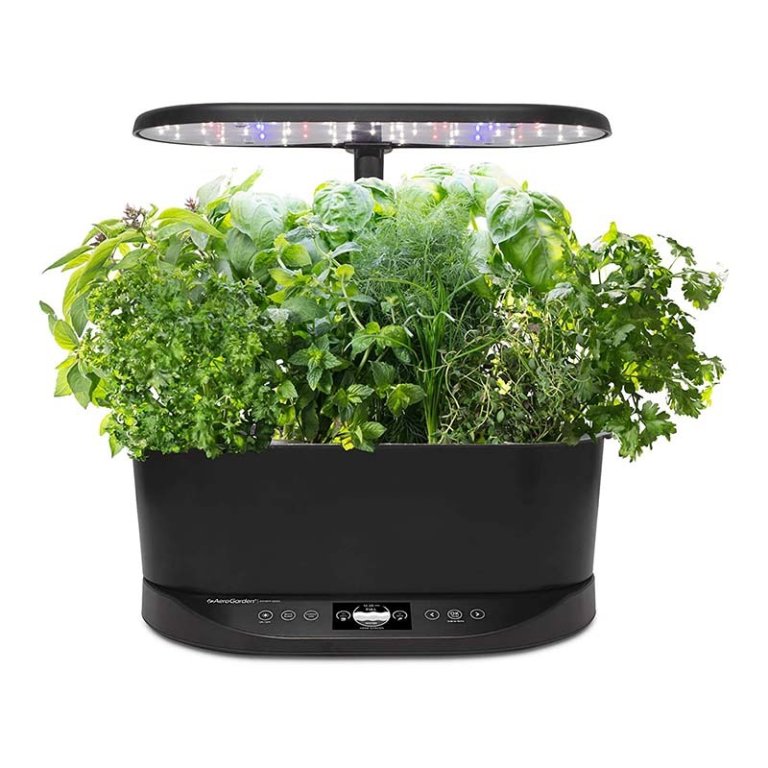
AeroGarden Bounty LED Grow Light
See ItWhat We Like
- Complete countertop hydroponic system with integrated full-spectrum LED lighting
- Touch-screen control panel with fully customizable light timer
- Telescoping mount arm adjusts light panel height from 8 to 24 inches high
- Easy to operate, easy to adjust, highly productive growing system
What We Don’t Like
- Relatively small integrated growing space
- High cost considering only the grow light, but a value price for the quality of the full system
Product Specs
- Type: Integrated LED panel
- Coverage: 1.5 foot by 1 foot
- Wattage: 30
Our Ratings: Setup 4/5; Adjustability: 5/5; Durability: 4/5; Coverage: 5/5; Value: 4/5
The AeroGarden Bounty is a complete countertop hydroponic gardening system. Its base features an automatic circulating nutrient reservoir that holds a plug tray where the plants grow, the high-resolution display, and a control panel. The telescoping 30-watt full-spectrum LED grow light attaches at the rear of the base, so no fixture mounts or other external hardware is necessary. The system only takes about 15 minutes to set up and start growing.
The kit included pre-seeded grow plugs with Genovese basil, curly parsley, dill, thyme, Thai basil, mint, chives, and Italian parsley. All that’s necessary is to fill the reservoir with water, add the liquid nutrient, insert the grow deck, and turn on the power. Follow the startup prompts on the display screen to set the light and pump schedules. For best results, it is recommended to start with the grow light at the lowest height setting and gradually increase the height as the seedlings grow.
We set up the AeroGarden Bounty in our dim living room grow space. Setup was uncomplicated and quick, and the instructions were easy to follow. After setup, we only needed to monitor the unit, topping off the water and adding plant food when prompted. All of our herb seeds sprouted in less than a week, and by the end of the month we were harvesting basil and parsley. The plants grew much faster than we anticipated, and the foliage looked (and tasted) great.
In our experience, this may be the best way to grow culinary herbs indoors. Traditional problems growing herbs indoors include lack of available sunlight, clunky grow lights that require some sort of external structure for mounting, and dealing with the messes associated with potting soil and water. AeroGarden simplifies the whole process with a sleek and tidy system that actually works. It’s a pricey option for anyone who just wants a grow light, but when taken as a complete solution it makes a lot of sense.
Get the AeroGarden Bounty LED grow light at Amazon or Walmart.
Best for a Single Plant
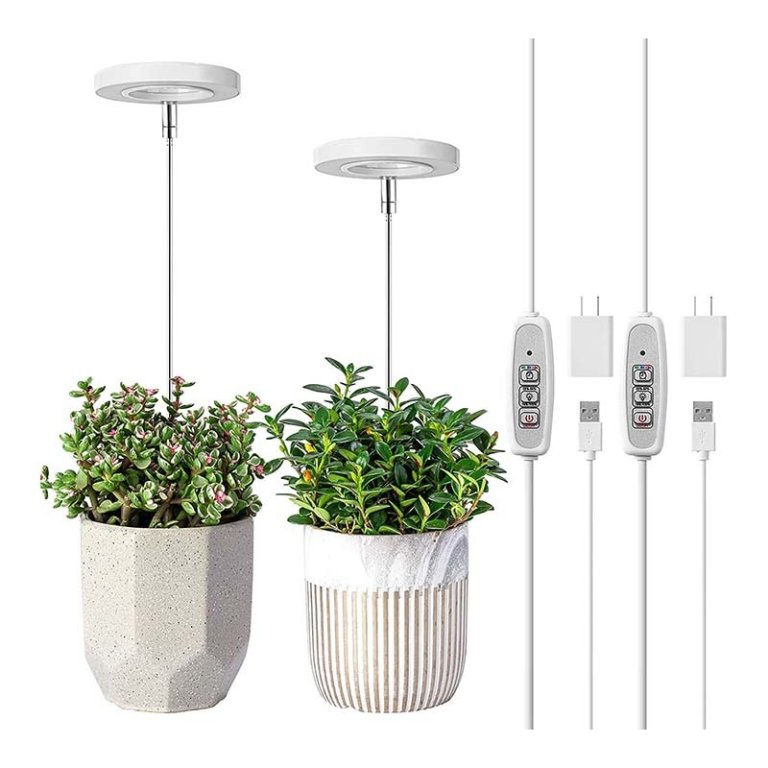
Lordem LED Plant Grow Light for Indoor Plants
See ItWhat We Like
- Full-spectrum white 10-watt grow light rated for 50,000 hours of working life
- Adjustable light settings, automatic 4-/8-/12-hour timer, and 25/50/75/100 percent brightness
- Adjustable height; telescoping steel stake is easily inserted into any plant pot
What We Don’t Like
- Stake does not stand securely in smaller pots; 6-inch standard pot size or larger is best
- The light appears dim, but our results were quite positive
Product Specs
- Type: Ring light
- Coverage: 8.5 inches by 8.5 inches (.5 square foot)
- Wattage: 10
Our Ratings: Setup: 5/5; Adjustability: 5/5; Durability: 4/5; Coverage: 5/5; Value: 4/5
Houseplant lovers sometimes find themselves with the perfect spot to display their beauties, but not enough natural light. The Lordem LED plant grow light solves that problem on a plant-by-plant basis. Just extend the telescoping steel stake, insert it into the potting soil, and plug it in. The ring light emits 10 watts of supplemental light from 48 full-spectrum white LEDs to support healthy foliage growth and flowering. In addition to the adjustable height, the light is dimmable and includes a built-in automatic timer with 4-/8-/12-hour options.
These LED plant lights are available individually or in packs of two or three. Each light covers a half square foot (approximately 8.5 by 8.5 inches, or a 10-inch-diameter pot) of plant space.
We inserted the Lordem LED grow light in a 6-inch potted plant on a shelf in our living room growing area, and then cared for the plant as usual. The plant grew well and seemed to thrive with the 12-hour timer and full-brightness settings. The foliage looked great, with good coloration and leaf density and no yellowing or dropped leaves.
The only drawback we encountered was that we had to remove and replace the light for watering—our habit was to take each of the plants to the kitchen sink for deep watering every week or two in order to wash down the foliage and deep soak the potting medium. Also, we noted that a 6-inch pot was probably the minimum size we would use with this light in to avoid accidents from a top-heavy configuration. All in all, this option came at an excellent price point and provided highly effective results.
Get the Lordem LED grow light at Amazon.
Best with Stand
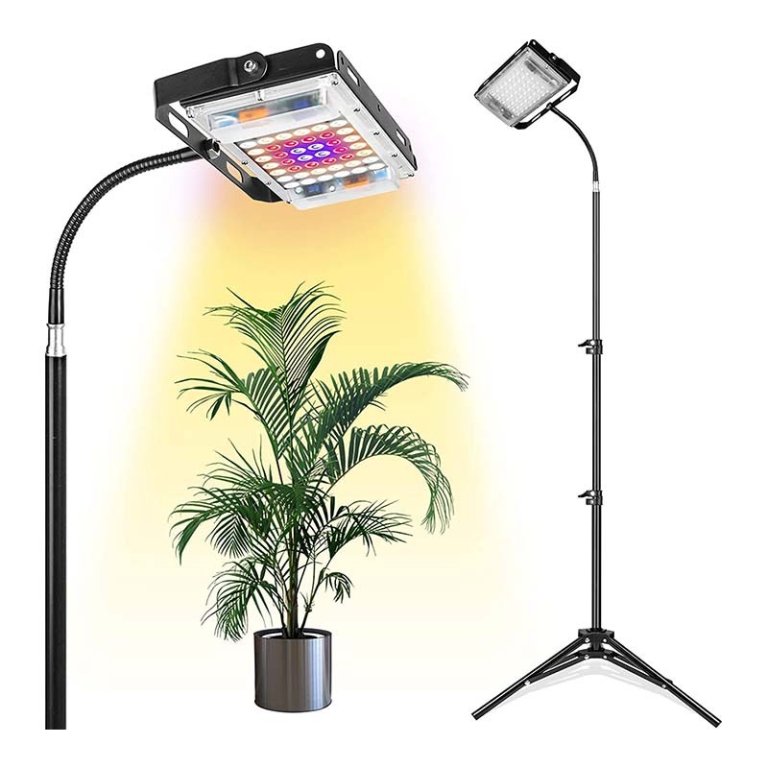
LBW LED Grow Light With Stand
See ItWhat We Like
- Full-spectrum 30-watt LED grow light covers 2.5 square feet of growing area
- Tripod-mounted light fixture with height adjustment from 15 to 48 inches
- Flexible gooseneck mount allows the light to be positioned in any direction
- Offers 6 adjustable brightness levels and built-in 4-/8-/12-hour timer
What We Don’t Like
- Power cord connects directly to the lamp and hangs loosely to the ground, where it can become a trip hazard
- Industrial appearance may not be ideal for some decor and living spaces
Product Specs
- Type: Spread-style
- Coverage: 1.5 feet by 1.5 feet
- Wattage: 30
Our Ratings: Setup: 5/5; Adjustability: 4/5; Durability: 4/5; Coverage: 4/5; Value: 4/5
Where permanently mounted light fixtures or stake lights won’t work, a freestanding grow light may be the best choice. This LBW grow light offers the versatility to set it up anywhere and move it around as needed. The 30-watt full-spectrum spread-light fixture attaches atop a flexible gooseneck, so it can be pointed in any direction. The lamp itself comes equipped with 48 LEDs and boasts a PPFD rating of 457 micromole/m2/second at 12 inches. It easily illuminates up to 2.25 square feet for germination, vegetative growth, and flowering.
The tripod’s height-adjustment feature allows users to set the light at any height between 15 and 48 inches. From a position on the floor, it is suitable to light up taller tabletop plants. At less than 3 pounds, it’s easy to set up, take down, and relocate.
We set up the LBW grow light on the floor in our low-light living room growing area and positioned the lamp over a 24-inch plant stand with three 6-inch plants. It felt well balanced on the stand—no danger of accidentally tipping over. The flexible gooseneck held securely in any position we chose, and the telescoping tripod also held firm without sliding down. The light appeared very bright and cast a good light footprint on our plant collection. The plants thrived and grew well through the test period.
The only parts of this light that we didn’t love were the loose-hanging power cord and the semi-industrial look of the lamp itself. The power cord hangs free below the lamp and could become a trip hazard. We used a cable tie to fasten the loose cord to the upright part of the tripod to eliminate the cord tension at the top of the assembly.
Get the LBW LED grow light at Amazon.
Best for Seed Starting
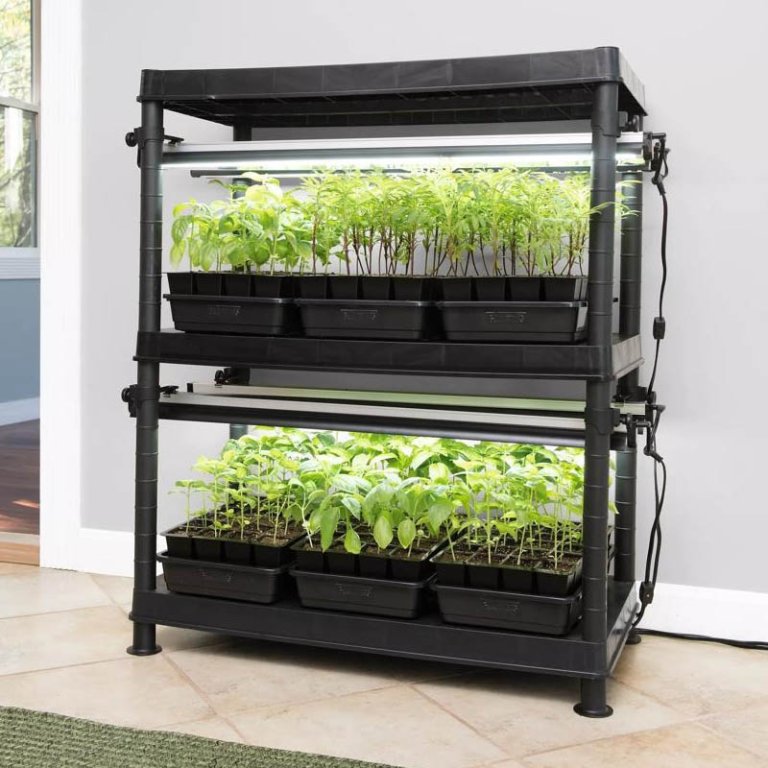
Gardener’s Supply Company LED Stack-n-Grow Lights
See ItWhat We Like
- Facilitates easy expansion with up to 2 stackable add-on units, increasing growing space as needed
- Provides the ideal light range for plant growth, ensuring even coverage and efficiency
- Features lightweight yet durable shelves, each supporting up to 110 pounds
What We Don’t Like
- Offers long-term energy savings but may require a significant initial investment
Product Specs
- Type: Traditional
- Coverage: 3 feet by 4 feet
- Wattage: Not listed
Our Ratings: Setup 4/5; Adjustability 4/5; Durability: 4/5; Coverage: 5/5; Value 4/5
The LED Stack-n-Grow Lights system from Gardener’s Supply Company is an excellent choice for gardeners who want to kick-start their seed-starting process. Its modular and user-friendly design makes it a fantastic option for novice and experienced growers.
The system’s full-spectrum LED bulbs provide the essential light spectrum needed for seeds to germinate and young plants to thrive. One of the Stack-n-Grow system’s standout features is its scalability. The base unit can be effortlessly expanded with add-on tiers, allowing gardeners to increase their growing space as needed. This adaptability makes it an excellent investment for those who plan to scale up their gardening projects over time.
Assembling the unit was straightforward once we found the directions (we had to download them from the website). The unit must be placed on a level surface and anchored to the wall to ensure maximum stability. We started all of our spring vegetables under the lights and loved the ability to adjust the height of the lights as our seedlings grew.
Although we like the lights, the cost is higher than that of simpler, non-modular grow lights. Despite this, the benefits of tailored growth conditions, expandability, and energy efficiency present a compelling case. The Stack-n-Grow Light system is a reliable and effective tool for anyone serious about seed starting, providing a controlled environment for seeds to flourish into healthy plants.
Get the Gardener’s Supply Company LED Stack-n-Grow Lights at Gardener’s Supply.
Jump to Our Top Picks
How We Tested the Best LED Grow Lights
Testing Stats
- Products tested: 10
- Time spent testing: 30 days
- Tests performed: 3
After researching 42 LED growing lights, we chose the 10 in this guide for hands-on testing. Our selection criteria included light spectrum, balance, actual power draw, and each light’s type and intended purpose. These picks include options that will satisfy a diverse range of indoor growing needs, including seed starting, supplemental lighting for foliage or flowering houseplants, adjustable full-spectrum lighting for intensive hydroponic production, and more.
We set up two separate trial areas to test each model according to its type and capability. For those designed to provide supplemental light for indoor plants, we used a room with an east-facing window but inadequate natural light for average houseplants, setting up a growing area on the wall opposite the window. We made a growing area in our basement with no windows to test the models designed to provide all the lighting requirements for plants to thrive.
To evaluate each light’s effectiveness, we placed one 6-inch houseplant per square foot of “light footprint” beneath each light. We watered and fertilized the plants as we would typically. Every 3 days, we noted any observations, such as leaf color changes, bud or leaf growth, and changes to leaf or stem shapes. Each LED grow light in our test group proved to be very effective for its intended purpose.
| Product | Setup | Adjustability | Durability | Coverage | Value |
| Mars Hydro TS1000 Dimmable 150W LED Grow Light | 4/5 | 5/5 | 5/5 | 5/5 | 5/5 |
| GE 9W Balanced Light LED Grow Light Bulb | 5/5 | 5/5 | 5/5 | 4/5 | 5/5 |
| Mosthink Sunlike White LED Grow Light Strips | 4/5 | 4/5 | 4/5 | 4/5 | 5/5 |
| Spider Farmer SF4000 450W LED Grow Light With Dimmer | 4/5 | 5/5 | 4/5 | 5/5 | 4/5 |
| AeroGarden Bounty LED Grow Light | 4/5 | 5/5 | 4/5 | 5/5 | 4/5 |
| Lordem LED Plant Grow Light for Indoor Plants | 5/5 | 5/5 | 4/5 | 5/5 | 4/5 |
| LBW LED Grow Light With Stand | 5/5 | 4/5 | 4/5 | 4/5 | 4/5 |
| Gardener’s Supply Company LED Stack-n-Grow Lights | 4/5 | 4/5 | 4/5 | 5/5 | 4/5 |
Types of LED Grow Lights
LED grow lights come in a variety of forms. Learning about the most popular ones can help shoppers choose a suitable type for an indoor garden.
Spread-Style
Spread-style LED lights have many small individual lights spread out over their entire surface area, which makes them effective in providing light to a large number of plants. The two main subcategories of spread lights are quantum board and spider-style.
- Quantum board lights use a large number of small LED grow lights spread out over a relatively large, flat surface area. They use full-spectrum white LED diodes and typically feature passive cooling, allowing the plants to be placed immediately under them without the danger of too much heat emission.
- Spider-style lights feature multiple LEDs on narrow “arms” in an open bar design rather than on a solid board. These tend to be more expensive than quantum board lights.
Chip on Board (COB)
Chip on board (COB) lights feature a number of tiny LEDs placed close together on a single chip, resulting in a single powerful point of light. While the center point of the area they cover receives optimal lighting, they don’t offer the same level of widespread, equal coverage as spread-style LEDs.
Since they’re so powerful, COB lights often emit more heat than other types of LEDs and may require the use of fans to cool down the area. They use full-spectrum white LED diodes and provide deeper canopy penetration than spread-style LEDs.
Traditional
Traditional LED grow lamps are usually compact, making them a good choice for small spaces. They use LEDs that provide medium power and typically feature multicolored LEDs that cover the full spectrum of color frequencies, unlike white LEDs. This gives their light a colorful appearance that indoor growers might or might not like.
What to Consider When Choosing an LED Grow Light
The following sections detail some of the most important qualities to keep in mind when shopping for the best LED grow lights for your needs.
Light Spectrum
Natural sunlight features all the colors on the electromagnetic spectrum. Some LED lights can reproduce only certain color frequencies, while full-spectrum white LED lights produce all the hues necessary for every stage of the growing process.
- Blue light helps plants grow in the earliest stages of their lives. It’s the first color plants can absorb in their vegetative state.
- Purple light is also used in the vegetative state; however, it’s not as effective for photosynthesis as blue light.
- Red light helps in the latter stages of growing and is essential for buds to flower.
- White light encompasses all the colors of the spectrum. Used alone, it can be effective for every developmental stage.
Power
It’s a bit difficult to compare LED grow lights because manufacturers use a variety of metrics to measure the power of their lights and the amount of light they emit. The brightness of LED lights is measured in lumens. Seedlings require approximately 2,000 lumens per square foot to thrive, while flowering plants may need as much as 10,000 lumens.
While lumens measure visible light, biologists often use photosynthetic photon flux (PPF) or photosynthetic photon flux density (PPFD) to measure light intensity in terms of the light that indoor plants will actually absorb. PPF is measured in μmol/second (or micromoles per second), which is the number of photons of light emitted every second. PPFD is also measured in micromole/m2/s and measures the density of light distributed per square meter per second. The higher the PPF and PPFD, the more effective the light should be.
Heat Output
One of the risks of using a grow light is that the heat emitted by the bulbs can damage plants. However, LED lights give off very little heat relative to the amount of light they produce. But they do produce some heat, so many models are equipped with built-in cooling systems to ensure proper temperature regulation.
Some LED lights have aluminum heat sinks, and others come equipped with fans. A unit with a fan might be loud, so shoppers will want to factor noise level into their choice when selecting a grow light.
Coverage and Wattage
To choose the right plant grow light, first establish how much coverage is needed. To do this, group the plants together and measure the square footage they take up. Most grow lights will clearly list the coverage they provide.
To establish how much electricity a light uses, look for its “actual power draw” or “actual power consumption.” This is measured in watts and gives a good indication of the light’s power. Bulb wattage is not a good indicator because LEDs are designed to be energy efficient.
Connectivity
Many LED grow lights are designed to link to other units to cover larger areas, which is typically referred to as “daisy-chain connectivity.” Products with this capability simply plug into each other and then plug into one outlet, which minimizes the number of cords required for setup.
FAQs
The following questions and answers about LED plant lights can provide shoppers with additional information.
Cheap LED grow lights for vegetables won’t perform at the same level as those used by professional growers. Professionals generally use high-intensity discharge lamps (HID) or fluorescents, though the industry is shifting to favor LEDs. Because of their energy efficiency, LEDs are a better choice for home use.
When comparing the power of various grow lights, look at the “actual power draw” or “actual power consumption” in watts. Generally speaking, grow lights should use 32 watts per square foot of grow space at the absolute minimum, though 50 to 80 watts per square foot is ideal.
The actual brightness of LED lights is measured in lumens rather than watts, which is another way of measuring light intensity. Vegetables typically require 2,200 lumens per square foot, while other plants generally need approximately 1,375 lumens per square foot.
LED lights should generally be at least 12 inches above your plants to prevent leaf burn.
LED grow lights are more energy efficient than high-pressure sodium (HPS) lights. They also emit less heat, which means users needn’t worry as much about temperature regulation.
Meet the Testers
Mark Wolfe is a writer and product tester with a background in the nursery and landscaping industry. For more than 20 years, he has mowed, edged, planted, pruned, cultivated, irrigated, and renovated beautiful landscapes. Now he tests and writes reviews about the latest outdoor power equipment, hand tools, lawn-care products, and other outdoor-living goods.
Debbie Wolfe is a photographer, author, and freelance writer in various niches. She has contributed hundreds of home, garden, and crafting articles and DIY tutorials for leading media outlets and retailers, including HGTV, Real Simple, Forbes Advisor, The Spruce, The Home Depot, Walmart, and Mother Earth News. She is the author of two DIY books: Do-It-Yourself Garden Projects and Crafts and Crafting with Herbs from Skyhorse Publishing. Her testing approach is straightforward and budget-minded.
Additional research provided by Savannah Sher.